



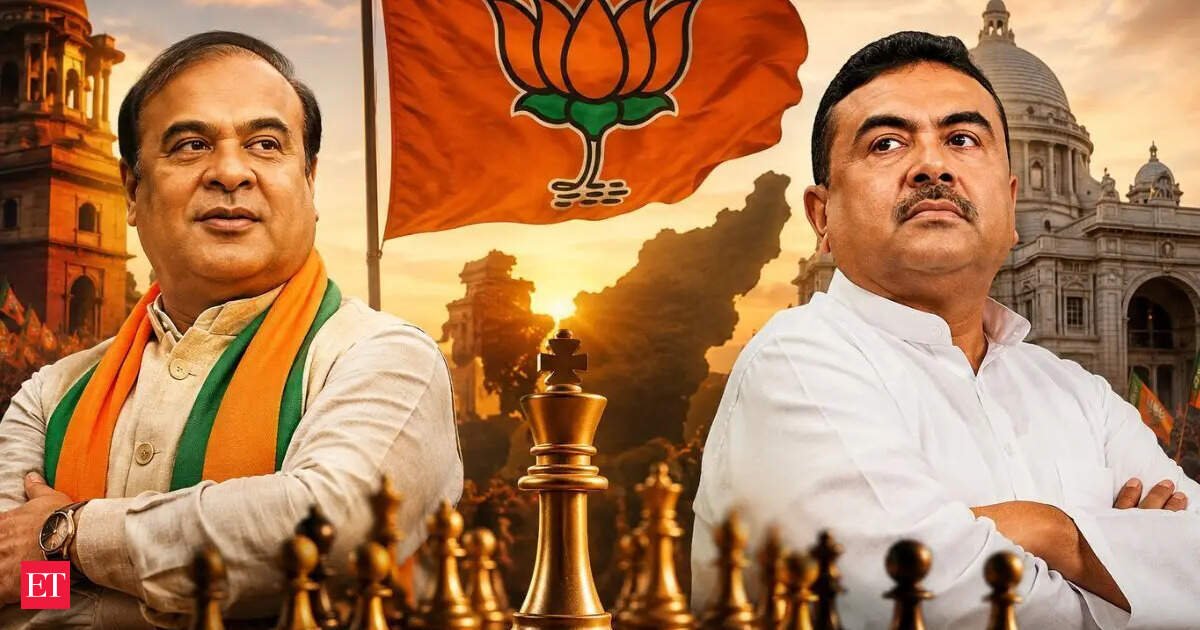
Both leaders were once trusted lieutenants inside rival regional parties. Both left after internal power struggles. And both later became the BJP’s strongest weapons against their former political homes.
From Mamata loyalist to BJP’s Bengal face
For years, Suvendu Adhikari was considered one of the closest aides of Mamata Banerjee in the All India Trinamool Congress. He played a key role in strengthening the TMC across rural Bengal, especially in East Midnapore.
But differences with the party leadership widened over time, eventually pushing Adhikari out of the TMC and into the BJP ahead of a crucial Bengal election.
What initially looked like a risky political move soon turned into a major breakthrough for the BJP. Adhikari emerged as the saffron party’s most aggressive face in Bengal and helped expand its reach deep into TMC strongholds.
His elevation as Chief Minister now marks the BJP’s biggest success in Bengal politics so far.
The Assam model
The Bengal story closely mirrors what happened earlier in Assam with Himanta Biswa Sarma. Once a senior Congress leader and close aide of former Assam Chief Minister Tarun Gogoi, Sarma left the Congress after leadership differences and joined the BJP in 2015.
His entry transformed the BJP’s fortunes in the Northeast. Sarma brought organisational strength, political networks and regional influence that the BJP previously lacked in Assam.
The BJP soon ended the Congress’ long rule in the state, with Sarma eventually becoming Chief Minister and one of the BJP’s most influential eastern leaders.
BJP’s Ang, Bang, Kalinga plan
What once looked like an ambitious political dream for the BJP has now become one of its biggest milestones in eastern India. With the party securing power in West Bengal in 2026, the BJP has effectively completed its long-pursued “Anga-Banga-Kalinga” political map, spanning Bihar, Bengal and Odisha.
The Bengal victory is far more than just another electoral success. It represents the culmination of a broader expansion strategy that began after Prime Minister Narendra Modi came to power in 2014. Over the last decade, the BJP steadily pushed into regions where the party once had little organisational presence or ideological influence.
The latest win also signals a major political comeback for the saffron party. After facing setbacks in the Lok Sabha elections and seeing its parliamentary numbers dip, the BJP has managed to regain momentum through decisive state-level victories in the East.
The first major breakthrough came in Odisha in 2024, when the BJP ended the long rule of Naveen Patnaik. That victory was followed by another strong performance in Bihar, where the NDA retained power and BJP leader Samrat Choudhary emerged as a key face in state politics after years dominated by Nitish Kumar.
The Bengal win has now completed the party’s eastern push, delivering perhaps the most politically symbolic victory of them all by defeating Mamata Banerjee and the All India Trinamool Congress in one of the BJP’s toughest battlegrounds.
From fringe force to national machine
Over the past decade, the BJP’s political expansion has dramatically altered India’s electoral landscape. In 2014, the party’s influence was largely concentrated in the Hindi heartland and western India. By 2026, however, the BJP and its allies had expanded across large parts of the country, governing states that together account for a major share of India’s population and geography.
Political observers say the transformation is not just about the number of states under BJP rule, but also about the party’s ability to establish itself in culturally and politically diverse regions that were once considered difficult territory.
Bengal becomes the final frontier
For the BJP leadership, West Bengal carried both strategic and symbolic importance. Despite rapid gains in previous elections, the state had remained firmly under Mamata Banerjee’s control for over a decade.
The BJP’s breakthrough is being seen as the climax of a sustained campaign led by senior party strategist Amit Shah, who had repeatedly declared that the BJP would one day rule “Anga, Banga and Kalinga”.
That slogan now appears to have turned into political reality.
During one of his campaign rallies in Bengal, Shah had confidently predicted the fall of the Trinamool Congress government, saying that once counting began, it would be “ta ta, good-bye to Didi.” At the time, critics dismissed the remarks as campaign rhetoric. But following the BJP’s victory, those statements are now being revisited as a sign of the party’s confidence in its long-term eastern strategy.
The Bengal victory also builds on earlier eastern gains. The BJP’s rise in Odisha and consolidation in Bihar created the momentum that eventually helped the party breach Bengal — a state long seen as one of the final major barriers to the BJP’s dominance in eastern India.


