



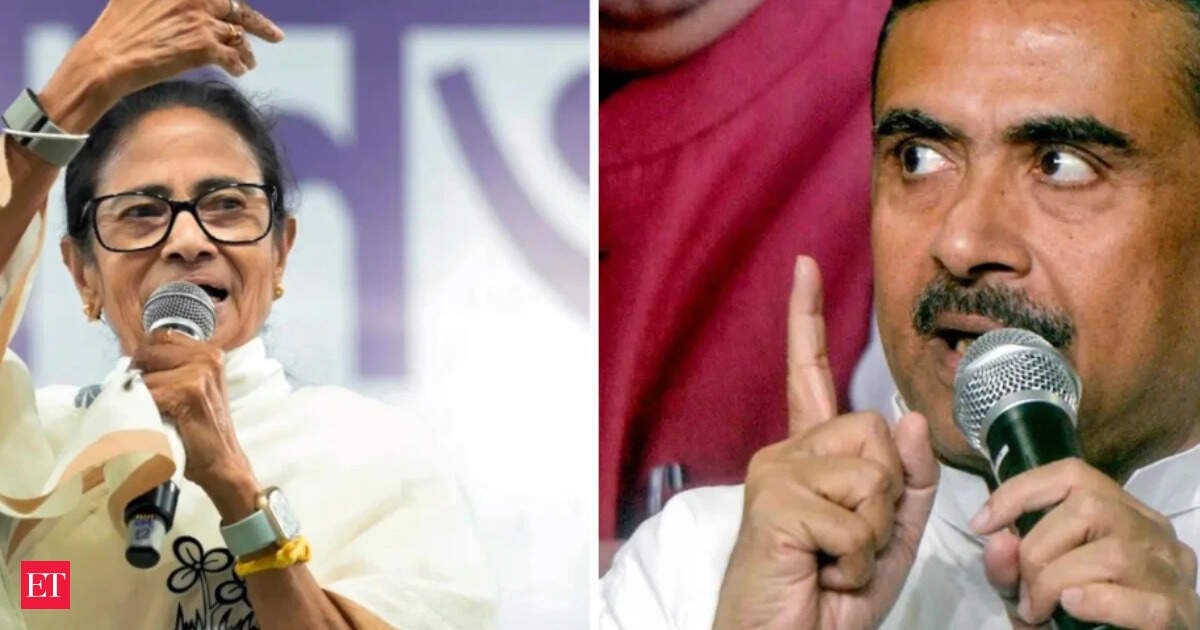
The story of Suvendu Adhikari is not a story of political betrayal or even sheer personal ambition. In its more instructive sense it is the story of Bengal’s changing political grammar. It reveals how personality-driven regional parties often struggle with succession, how cadre networks migrate when power equations shift and how organisational skill can sometimes matter more than ideology. Adhikari sensed before many others that the BJP’s rise in Bengal required something more than rhetoric from Delhi — a local political machinery and a man who could operate that. He became that engine. And in doing so, the protégé ultimately unseated his mentor.
Also Read | West Bengal Polls: BJP picks Bhabanipur ‘giant killer’ Suvendu Adhikari as chief minister
A political upbringing steeped in organisation
Suvendu Adhikari did not arrive in politics as an outsider. He emerged from one of Bengal’s most influential political families in the coastal belt of Purba Medinipur. His father, Sisir Adhikari, was a Congress leader before joining Mamata Banerjee in the formative years of the Trinamool Congress. The Adhikaris possessed a durable local network rooted in cooperatives, municipalities, transport unions and rural patronage structures, something that often matters more in Bengal politics than ideological sophistication or commitment.
Unlike many second-generation politicians who rely primarily on inheritance, Suvendu built his own reputation through relentless ground mobilisation. Those who worked with him in the early years often described him less as a speechmaker and more as an organiser obsessed with logistics, booth arithmetic and local influence networks. He cultivated district-level workers personally, remembered names and intervened in local disputes with unusual speed. In Bengal’s intensely localised political culture, this mattered enormously.
His rise coincided with Mamata Banerjee’s transformation from a fiery opposition leader into the powerful nucleus of an anti-Left movement. The Trinamool Congress of the late 1990s and early 2000s was not yet a polished electoral machine. It was an improvised coalition of disgruntled Congress workers, anti-Left activists and regional satraps. Mamata supplied the emotional energy. Leaders like Suvendu supplied the structure. And Trinamool acquired political and electoral hegemony.Also Read | Suvendu Adhikari, the man who helped TMC topple Left, now becomes BJP’s first Bengal CM
Nandigram and the making of a mass leader
If there was one moment that permanently altered Suvendu Adhikari’s political stature, it was Nandigram. The 2007 land acquisition movement against the Left Front government transformed the politics of Bengal and catapulted Adhikari into statewide prominence. Nandigram was an agitation over farm land being given for industrial development. But it evolved into a moral and political symbol around which Mamata Banerjee built her final assault on the Left’s three-decade rule. But while Mamata became the movement’s face, Suvendu emerged as one of its principal strategists on the ground.
He understood the emotional and social composition of rural Bengal better than many urban Trinamool leaders. He recognised how fears over land, identity and state violence could be converted into a durable anti-Left coalition. In Nandigram, Adhikari demonstrated his capacity to combine agitation politics with organisational discipline. He built local committees, coordinated mobilisation and maintained communication lines in areas where the state’s authority had weakened.
This was the phase when Mamata began to see him not merely as a district strongman but as a future pillar of the party. His stature expanded rapidly after the Trinamool came to power in 2011. He held important ministerial portfolios, deepened the party’s reach in southern Bengal and became indispensable during elections.
Within the party structure, Suvendu belonged to a shrinking category of leaders who possessed an independent mass base. He could mobilise crowds without depending entirely on Mamata’s appeal. In highly centralised parties, that is both an asset — and a source of future tension too.
The succession question
The seeds of Suvendu’s eventual rupture with Mamata lay not in ideology but in succession. As Mamata Banerjee consolidated power after 2011, another centre of authority gradually emerged inside the Trinamool Congress around her nephew Abhishek Banerjee. Younger, media-savvy and increasingly influential in party affairs, especially among the youth, Abhishek represented the next generation of the party’s leadership. Over time, many organisational decisions, candidate selections and strategic discussions began flowing through his camp. For ambitious regional leaders, this altered the internal balance of power.
Suvendu had spent years building the party in difficult terrains. He believed his political capital came from organisational labour rather than proximity to Mamata. To leaders of his generation, the rise of Abhishek appeared to indicate the transition of the Trinamool from a movement-driven party into a tightly controlled family-centric structure.
The friction was not always public but it became increasingly visible. Adhikari reduced his appearances at party events. His supporters complained quietly about marginalisation. Power centres within districts started shifting. What sharpened the conflict further was personality. Suvendu was not temperamentally suited to subordination. He carried himself with the confidence of a leader who believed he had earned his position through struggle. The idea of eventually operating under Abhishek Banerjee’s authority was something he appeared unwilling to accept.
In retrospect, Mamata Banerjee may have underestimated the depth of the alienation. Like many charismatic leaders, she perhaps assumed personal loyalty would override political ambition. But regional parties often face their greatest instability during informal succession transitions. The Trinamool was no exception.
Crossing over to the BJP
When Suvendu Adhikari joined the BJP, the party still remained an incomplete political force in Bengal. It had ideological momentum and central leadership backing but lacked a robust grassroots architecture in large parts of the state. The BJP’s rise after the 2019 Lok Sabha elections had demonstrated electoral potential, yet the party still struggled with local leadership coherence and booth-level durability. Adhikari came and changed that equation.
His importance to the BJP was deeply symbolic but he also brought with him an understanding of Bengal’s electoral sociology that the BJP’s central leadership lacked. He knew which local caste blocs mattered in different districts, how patronage chains functioned and how rural political communication operated beyond television narratives. More importantly, he helped normalise the BJP within sections of Bengal that had previously viewed it as an outsider party dominated by leaders from Delhi. Suvendu’s is most significant political contribution was that he translated the BJP into Bengal’s local political language.
He also became the bridge through which large sections of the Trinamool’s mid-level organisational structure shifted toward the BJP. Elections are rarely won solely by speeches or rallies. They are won through polling agents, local mobilisers, coordinators and neighbourhood influence networks. Adhikari understood this machinery intimately because he had helped build it for the Trinamool itself. The irony was profound. Mamata Banerjee’s own political methods were now being used against her.
The battle against Mamata
The political symbolism of Suvendu Adhikari eventually confronting Mamata Banerjee directly carried Shakespearean undertones. Here was the loyalist-turned-challenger taking on the leader who had shaped his rise. But beyond the drama, Suvendu’s political strategy was coldly methodical.
He recognised that defeating the Trinamool required dismantling its aura of inevitability in rural Bengal. His campaign focused relentlessly on organisational penetration rather than rhetoric alone. While the BJP’s national leadership supplied ideological aggression and central visibility, Suvendu concentrated on local attrition. District by district, he worked to weaken the Trinamool’s confidence and convince workers that power might eventually shift.
He also positioned himself as the BJP’s authentic Bengali face at a time when critics accused the party of overreliance on outsiders. His understanding of local idioms and regional anxieties gave the BJP a degree of cultural grounding it previously lacked.
For Mamata Banerjee, the challenge was uniquely painful because it emerged from within her own political tradition. She had defeated the Left through agitation, emotional mobilisation and organisational endurance. Suvendu now deployed many of those same techniques against her government. In many ways, he understood the Trinamool’s strengths and vulnerabilities better than anyone else in the BJP.
The architect of a political transfer
The BJP’s eventual victory in Bengal cannot be explained by anti-incumbency alone. Nor can it be reduced merely to central leadership campaigns. The transition required a transfer of political infrastructure from one ecosystem to another. Suvendu became the principal architect of that transfer.
He recognised earlier than most that Bengal’s politics was entering a post-ideological phase where electoral management, local alliances and leadership perception would outweigh older ideological loyalties. The Left had already collapsed because its organisational structure weakened. Suvendu’s strategy involved ensuring the Trinamool faced a similar erosion from within. By the time the latest assembly elections arrived, the BJP no longer resembled an external challenger. It had become embedded within Bengal’s local political networks. Much of that embedding bore Suvendu’s imprint.
Tomorrow’s oath-taking ceremony will therefore represent more than an individual triumph. It will symbolise a long political migration from Congress to Trinamool, from anti-Left insurgency to anti-Trinamool consolidation and from protégé to rival.
For Mamata Banerjee, Suvendu’s ascent will remain a deeply personal political defeat. She created the movement that gave him stature. She trusted his organisational instincts during the years when the Trinamool was still battling for survival. Yet in nurturing a generation of ambitious regional leaders without establishing a stable succession balance, she also created the conditions for rebellion. And for Suvendu, the journey has come full circle. The organiser who once helped Mamata Banerjee capture Bengal now stands ready to govern the state after toppling her reign.


