


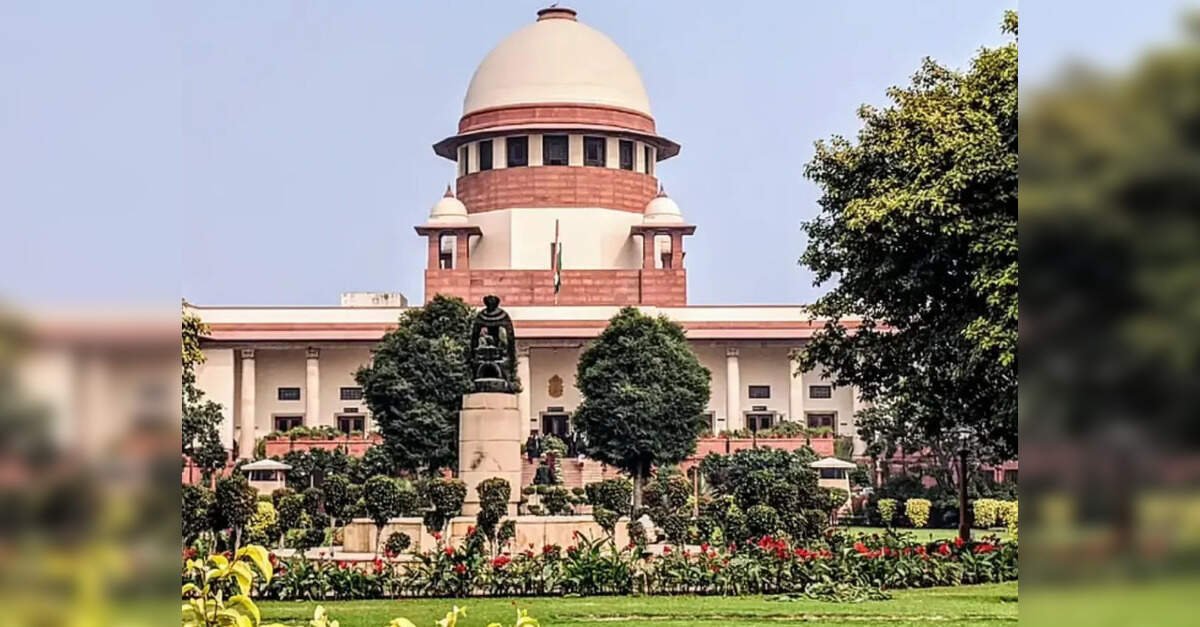
New Delhi: The Supreme Court on Thursday dismissed a batch of petitions filed by Reliance Communications (RCom) and its four lenders challenging the department of telecommunications‘ invocation of about ₹800 crore bank guarantee (BG) furnished by them in a case related to Anil Ambani firm’s insolvency proceedings.
A bench comprising justices PS Narasimha and Alok Aradhe, while refusing to stay the department’s move said that the lenders-State Bank of India, Punjab National Bank, Canara Bank and Yes Bank-should have approached the high court rather than coming directly to the apex court.
The DoT’s invocation notices of August 14 seek to invoke bank guarantee of ₹249.29 crore by State Bank of India (SBI), ₹281.44 crore by Yes Bank, ₹157.07 crore by Canara Bank and ₹114.09 crore by Punjab National Bank (PNB). The lenders argued that the apex court’s February judgment on transfer of spectrum as an asset of the debt-laden company couldn’t be the basis of invocation of their BGs.
Stating that the invocation of BGs by the department was illegal, arbitrary, ultra vires and without jurisdiction and liable to be quashed, the banks told the apex court that its February judgment only dealt with whether spectrum can be transferred as an asset in the insolvency proceedings, but was silent on the BG part.
“The judgement does not adjudicate upon liability of surety. The judgement is thus wholly irrelevant to the power sought to be exercised, and a decision founded upon an irrelevant consideration (by the DoT) is liable to be set aside,” said the counsel for four lenders.
The BGs were furnished specially in relation to the spectrum and the DoT, despite having already lodged its claim in the corporate insolvency resolution process (CIRP) in the capacity of an operational creditor, has not sought to invoke it, said the petitions filed through counsel Angad Baxi.
“DoT simultaneously cannot seek to jump the gun by invoking the BG for recovery of the very underlying pre-CIRP dues, thereby seeking to obtain a payment outside and ahead of the CIRP process,” Baxi added.
Yes Bank said, “Such invocation materially prejudices the interests of financial creditors and disrupts the statutory scheme of the IBC (Insolvency and Bankruptcy Code), under which claims are to be dealt with through CIRP and in accordance with the applicable priority and distribution framework.”
