






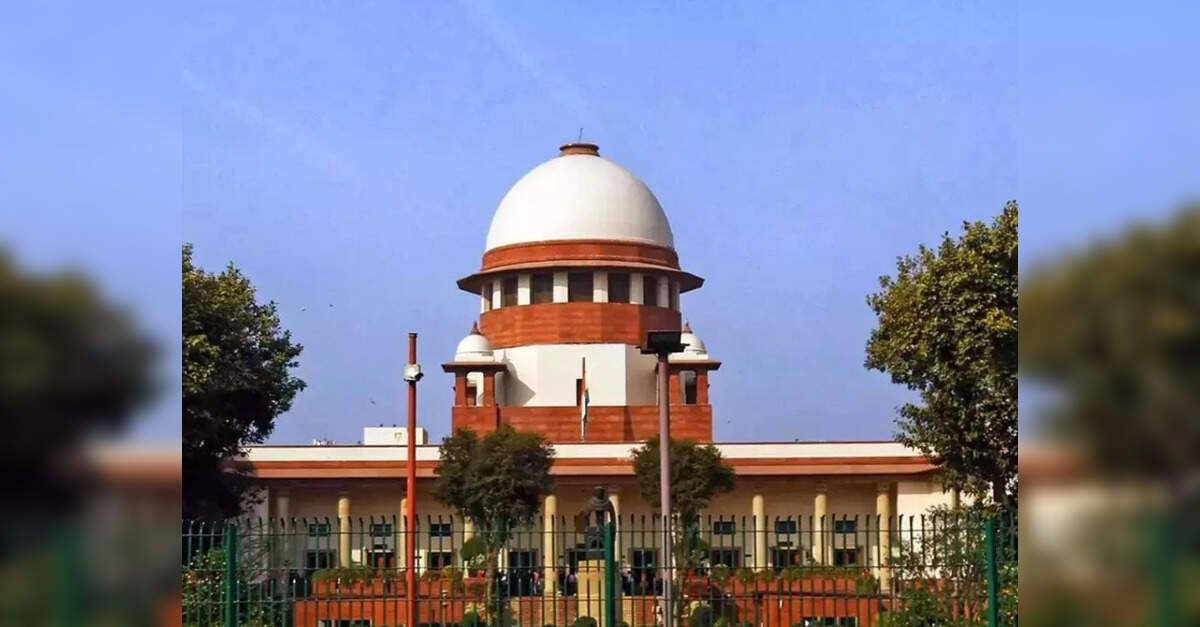
New Delhi, In a major relief to law graduates, the Supreme Court on Friday reduced to a year the earlier mandatory requirement of three-year legal practice for them to take entry level judicial service examination.
However, the selected candidates will have to undergo training at the judicial academy and a further one-year clerkship, a bench of Chief Justice Surya Kant and Justices A G Masih and K Vinod Chandran said in a split decision of 2:1.
On May 20 last year, a bench headed by then Chief Justice of India B R Gavai, since retired, had barred fresh law graduates from appearing in the entry-level judicial services examination, fixing a minimum three-year law practice criterion.
On Friday, a three-judge bench headed by CJI Kant, in a majority verdict of 2:1, modified the May 2025 verdict and relaxed the mandatory three-year legal practice criteria for law graduates aspiring to become judicial officers.
“All law graduates shall be eligible to apply, notwithstanding the three-year practice requirement. Having regard to the fact that more than a year has elapsed since the judgment under review was pronounced, such candidates shall, for the purposes of their applications, be deemed to have completed one year of active practice,” it said.
The top court said they shall not be required to furnish a separate certificate of practice in support of the said deemed period.
It added that candidates selected pursuant to the said recruitment shall, upon appointment, be designated as “Trainee Judicial Officers” and shall undergo a compulsory period of one year of intensive training at the concerned state judicial academy.
“This period shall be treated as equivalent to one year of practice at the Bar for the purposes of the three-year requirement,” it said.
The top court said during the period of such training, the trainee judicial officers shall be paid a fixed emolument equivalent to one-half of the remuneration payable to a judicial magistrate first class in the concerned state.
“They shall, in addition, be entitled to the facilities and other benefits ordinarily made available to trainees at the concerned State Judicial Academy,” the bench said, adding that upon successful completion of the said training, the trainee judicial officers shall undergo a further period of one year of structured law clerkship.
It said the first six months shall be spent as a law clerk under the supervision of the principal district or district and sessions judges or members of the higher judicial services, and the remaining six months under the supervision of a sitting judge of the concerned high court.
“The aforesaid one-year period of law clerkship shall also be treated as equivalent to one year of practice at the Bar for the purposes of satisfying the three-year requirement,” the top court said.
The bench said upon completion of the law clerkship, the sitting judge of the high court, under whose supervision the trainee judicial officer has served, shall submit a reasoned evaluation report concerning the performance and suitability of the trainee.
“Upon such evaluation being found satisfactory, the Trainee Judicial Officer shall be appointed to the regular post in the field and shall thereafter be entitled to the regular pay scale and other service benefits attached to the post,” it ruled.
For the period following the transition period, that is notification(s) issued on or after April 1, 2027, the bench said every candidate seeking to appear for the examination for appointment as Civil Judge (Junior Division) shall possess at least one year of actual practice from the source.
“Such practice shall be subject to verification through issuance of a Certificate of Practice, which shall not be issued unless the candidate’s presence and participation in effective judicial proceedings, whether along with a senior member of the Bar with at least 10 years practice or otherwise, have been duly recorded in accordance with the mechanism to be prescribed by the High Courts,” it said.
The bench further said the application of a candidate for recruitment to the judicial service from the said recruitment cycle will be entertained only upon submission of the requisite certificate evidencing completion of one year of actual practice in the district courts.
“Candidates selected pursuant to such recruitment shall, notwithstanding their one year of prior practice, undergo the same one-year period of intensive training at the state judicial academy followed by six months of law clerkship under the principal district/district and sessions judges or members of the higher judicial services and thereafter another six months of law clerkship under a sitting judge of the concerned high court,” it said.
The bench said its scheme formulated herein should not be made immutable as judicial recruitment is an evolving process, and the effect of the present arrangement can be properly assessed only after it has operated for a reasonable period.
It said a period of three years would provide sufficient institutional experience to evaluate whether the combination of limited prior practice, structured training and supervised clerkship is achieving the desired objective.
It said this court may thereafter revisit the scheme on the basis of material before it and the scheme would remain in force for a period of five years.
Justice Vinod Chandran, who was part of May, last year, verdict dissented with the view of the CJI and Justice Masih and dismissed the review petitions.


