


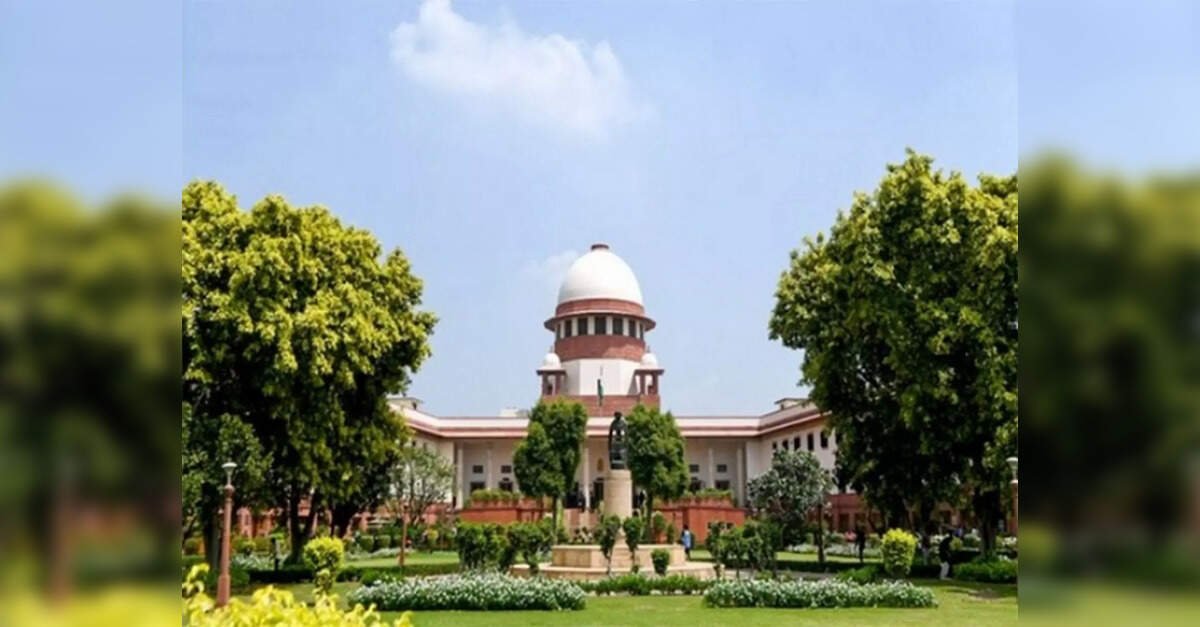
New Delhi, In a move to modernise the legal landscape while safeguarding judicial integrity, the Supreme Court released draft ‘Regulations for Use of Artificial Intelligence (AI) in courts’ which contain a list of permissible and forbidden usage, stating that “no judicial outcome shall be reached through Algorithmic Decision-Making alone.”
Inviting comments and suggestions from stakeholders and the general public by June 20, the Artificial Intelligence Committee of the Supreme Court provides for allowing AI tools in “case management (including identification of defects in new filings), cause list preparation, hearing scheduling and docket prioritisation”.
The draft regulations for use of AI in courts “shall apply to the use, deployment, or integration of AI in any judicial, adjudicatory or administrative function of the Supreme Court of India, High Courts, and all Courts including the Tribunals and statutory Commissions performing adjudicatory functions, within the territory of India”.
The necessity for such a regulatory framework has become increasingly evident as the top court and several High Courts have raised concerns about the misuse of AI tools, which sometimes produce non-existent case laws that have even influenced actual judgments.
At the same time, the justices of the Supreme Court have emphasised the importance of using AI tools to enhance benefits such as translating judgments into local languages and streamlining legal searches.
“These regulations aim to govern the use of AI, grounded in the principles of human primacy, transparency, accountability, data protection, and judicial independence, while establishing an institutional framework for responsible AI adoption across India’s judicial system,” the apex court said in its notice.
The 35-page draft proposes a clear “red line” for technology, indicating that while AI may assist, it will never replace the human mind.
According to one of the regulations, “the use of AI in court processes shall at all times remain strictly subservient to human judgment and judicial authority and every AI System shall function solely in an assistive capacity and shall not supplant or compromise the independent exercise of judicial authority by a duly appointed judicial officer and the ultimate authority to determine matters of law, fact and justice shall vest exclusively in the judicial officers of the competent jurisdiction.”
Regulation 20 states that the use of AI for reaching judicial outcomes, such as judgments, sentencing, or determining the credibility of witnesses, is strictly forbidden.
All adjudicatory functions must involve a “Human-in-the-Loop” (HITL) approach, ensuring that final decision-making authority remains solely with a duly appointed judicial officer.
“No judicial outcome (including any judgment, order, or finding of fact or law) shall be reached through Algorithmic Decision-Making alone or solely on the basis of AI-generated information, data, or analysis and the human judicial authority shall be the determinative authority in all adjudicative decisions,” it said.
The draft outlined a strategic roadmap for adopting AI to tackle the judiciary’s massive caseload.
It said that courts will be encouraged to use AI for case management, automated transcription of proceedings, translation of legal documents into regional languages, legal research assistance, and guided chatbots to help litigants navigate court procedures.
The draft regulations expressly permit AI to be used for a range of judicial and administrative functions, subject to approval and human supervision.
Among other things, AI may be used for Legal research and precedent retrieval, citation verification, summarising pleadings, judgments and documents, and translation of judgments, orders and legal documents.
The draft also delineated areas where the use of AI will be prohibited.
“No personal data of any person shall be used to train, test, or refine any AI System without the prior approval of the Appropriate Authority and, where applicable, in compliance with applicable data protection law,” it said.
To oversee this digital transition, the draft proposed a powerful three-tier institutional framework and said that there will be a permanent, full-time apex regulatory authority at the Supreme Court level, chaired by a Supreme Court judge, to set mandatory standards.
Additionally, dedicated AI committees will be established in every High Court to oversee local implementation, the draft stated.
The draft regulations provide for setting up of a ‘Centre of Research and Excellence on Artificial Intelligence’ to conduct original research and provide technical advice to the judiciary.
All AI tools must undergo periodic “in-house” audits at least once a year, the regulations state.
Saakar Yadav, Founder, Lexlegis AI, welcomed the move and said, “Recent instances of AI-generated inaccuracies in legal filings should not detract from the larger goal of responsible technology adoption. AI is a powerful tool that can enhance efficiency, reduce repetitive work, and support better legal outcomes…”.
