



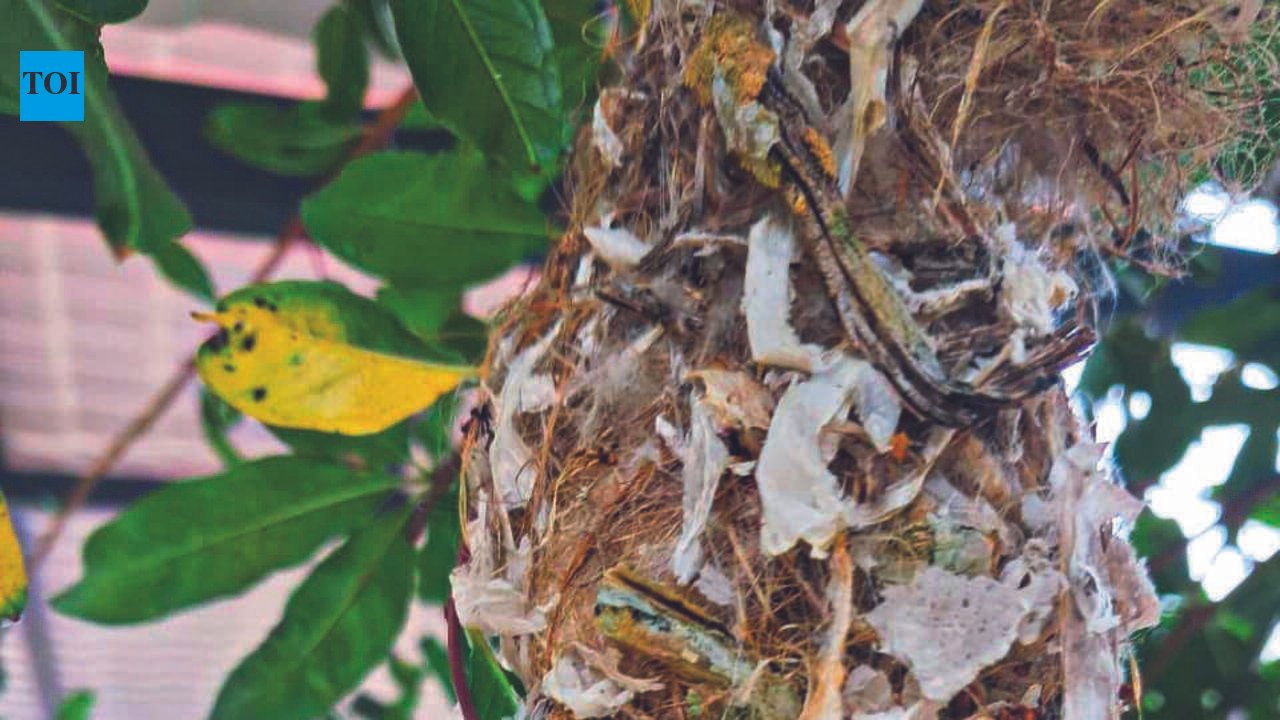
Sadhu Soundararajan says he was “distressed” on Friday morning when he spotted a bird’s nest woven out of plastic strips on a pomegranate tree inside the ashram. “Plastic litter is increasing along the Anaikatti stretch, but I have never seen a bird’s nest made of plastic before,” says the head of Daya Seva Sadan, on Thadagam–Anaikatti Road near Jambukandi Pirivu. Soundararajan photographed the nest and sent it to local birdwatchers and the forest department, urging them to act against plastic use and dumping in and around forest areas.P B Balaji, an eBird reviewer for Coimbatore district, says the structure resembles a sunbird’s hanging, pendulous nest and could possibly belong to the crimson-backed sunbird, a species endemic to the Western ghats. “Sunbirds build nests before the monsoon and abandon them after chicks fledge,” says Balaji. Though they mainly feed on nectar, they also consume spiders, insects and eggshell fragments during breeding for protein and calcium, and line nests with soft material for cushioning, he adds.“Plastic use in nests can harm chicks, as hatchlings are blind for the first few days and may peck at plastic inside the nest, risking ingestion and related health problems,” says Balaji. “Sunbirds are pollinators that aid forest regeneration, and any decline in their population could affect pollination and the wider ecosystem.”A Pavendhan, senior member of Coimbatore Nature Society, says birds may use white plastic to mimic spider webs or cobwebs as camouflage against predators because it is soft and easily available. “Such behaviour reflects a form of urban adaptation and problem-solving, but non-natural materials can have negative impacts on wildlife.”The incident comes amid concern over plastic contamination in the Coimbatore forest division. Large quantities of plastic trash were recently found in elephant dung following reports of elephant deaths, highlighting the need for stricter enforcement to eliminate plastic usage in ecologically sensitive zones.A World Economic Forum report cites a study stating that 176 bird species on all continents except Antarctica have been found to use trash, including cigarette butts, candy wrappers and plastic string in their nests; and that the trash can harm birds and their chicks, as it can entangle them, block their airways, or poison them.


