



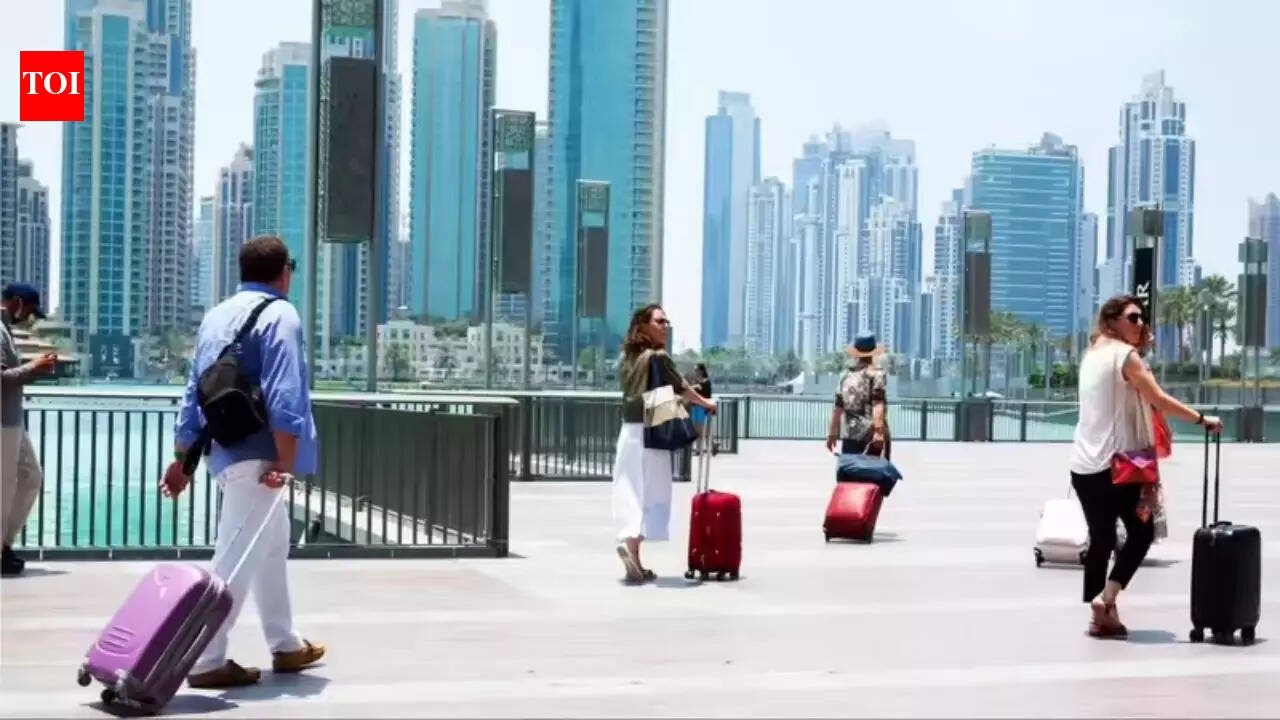
Commercial airlines have suspended most regional services across the Middle East after joint US-Israeli strikes on Iran that killed Tehran’s Supreme Leader Ayatollah Ali Khamenei, triggering a sharp escalation in tensions and widespread airspace closures that have crippled travel through key Gulf hubs.Iran retaliated with waves of missiles, sending projectiles and interceptors over major Gulf hubs including Dubai, Abu Dhabi, and Doha. Several countries temporarily closed their airspace, forcing thousands of stranded travelers to chart their own routes out of the region.
With airports shut and flights grounded, many have resorted to long desert drives, multiple border crossings and expensive last-minute tickets.‘Morning you woke up to missiles intercepted’Among those caught in the disruption was Kalie Moore, who became stranded in Doha after returning from a safari in Kenya. She was preparing to board a connecting flight to Berlin when Qatar closed its airspace as missiles flew overhead.After waiting with thousands of passengers at the airport, Moore checked into a nearby hotel, where staff advised guests to remain indoors.“It was actually pretty crazy because in the morning you woke up to the missiles being intercepted,” Moore told Bloomberg.Realizing flights would not resume soon, she decided to leave Qatar overland for Saudi Arabia, where air operations were still functioning. She teamed up with another traveler and hired a driver to take them on the six-hour journey to Riyadh for $1,000.Despite online narratives of influencers escaping in luxury vehicles and private jets, Moore’s journey was far less glamorous. The pair traveled in an old Toyota, switched cars and drivers at the border, and ate at roadside gas stations.From Riyadh, Moore booked a British Airways flight via London, paying an additional $2,000 to reach home. Her experience mirrors that of many others, including European officials and athletes stranded after events in Dubai.
‘Oman border is closed’A US State Department advisory urging Americans to leave several Middle Eastern countries quickly went viral. Many expatriates in Dubai contacted their employers to check whether evacuation plans would be activated.Some companies have begun relocating staff. Macquarie Group moved certain employees out of Dubai overland via Saudi Arabia and Oman.Two main exit routes have emerged: driving to Saudi Arabia or heading to Muscat International Airport, where operations remain normal. The journey from Dubai to Muscat takes under five hours, though travelers report long traffic queues and uncertain border conditions.“One day it was all open and no queue,” Karim Gharbi, head of Arton Capital’s private jet concierge and global mobility service told Bloomberg.“The second day was too many people going, then the Oman border is closed,” Karim said further adding that his company helped relocate more than 40 people, including families. Some were accompanied by bodyguards to assist with border procedures.‘You hear this explosion — time to go’Thierry Carbou, a French-Canadian tech entrepreneur who has lived in Dubai for 15 years, was having lunch at a beach club when he heard explosions overhead.He returned to his apartment in the Burj Khalifa and was speaking with his family when a blast struck City Walk nearby. “You hear this huge explosion, then this black smoke,” he said. “We looked at each other, and we said, ‘OK, time to go,'” he added.Will Bailey, a 26-year-old fitness coach and influencer from Manchester, had just returned to Dubai to launch a new business when the strikes began. Posting from a beach club as air defenses intercepted missiles overhead, he pointed to smoke rising from a nearby building and said, “That is the Fairmont Hotel in Dubai. Oh my God.”Bailey’s updates drew praise from followers for capturing the unfolding crisis, but also criticism from some in the UK.
‘It is such a scary time’The situation has sparked debate in Britain about whether expatriates should be included in any government evacuation.In Parliament, Liberal Democrat leader Ed Davey questioned whether “washed-up old footballers” and others who moved abroad to avoid higher taxes should receive state-funded evacuation support.Prime Minister Keir Starmer responded that all British citizens were entitled to assistance regardless of tax status.Entrepreneur Duncan Bannatyne defended Dubai residents on social media, writing, “Not one Dubai resident has expressed a desire to leave as far as I know. The British who need to vacate are on holiday or on business in Dubai.”Reality TV personality Arabella Chi said, “It is such a scary time right here at the moment.”Life goes onDespite the tension, daily life in parts of the UAE continues with an air of normalcy. Hotels remain open and beaches are active, even as missile interceptions light up the night sky. Bailey later moved with friends to a residential house away from tourist areas, continuing to post updates.“There are a lot of people in Dubai who are not taking it as seriously as some others,” he said during a radio interview interrupted by another interception, saying “I’m shaking now just hearing that sound.”As regional tensions remain high and airspace closures continue, thousands of travelers and expatriates face uncertain days ahead navigating not just borders and highways, but a rapidly shifting geopolitical landscape.


