


Hyderabad: Telangana has one of the highest college enrolment rates in the country, but far fewer of those students are pursuing research. While over 14 lakh are pursuing undergraduate degrees and another 2.43 lakh are at postgraduate level, only 9,347 are registered PhD scholars, according to the All India Survey on Higher Education (AISHE) 2023-24 released by the Union education ministry.Telangana’s Gross Enrolment Ratio into higher education stands at 46.6, well above the national average of 30. It has 2,160 colleges and 56 colleges per lakh population in the 18-23 age group, among the highest in the country. Hyderabad alone accounts for 465 colleges and Rangareddy has 338. Total enrolment stands at 17,87,460, with women at 9,13,216 outnumbering men at 8,74,244.
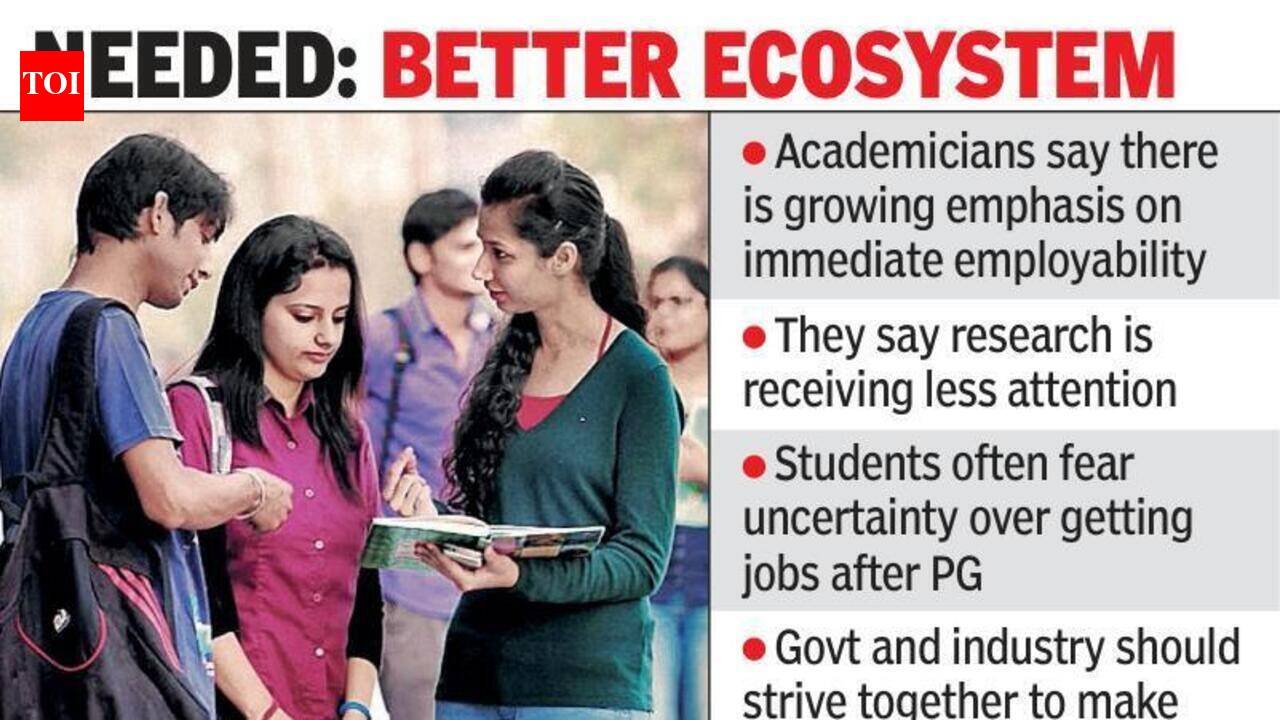
But the number in terms of research remains comparatively lower. Educationists attribute this number to growing employment opportunities, and lack of govt contribution in making research an attractive career to pursue.E Venkatesu, professor of Political Science at the University of Hyderabad, said students make practical calculations. “There is a growing emphasis on skills and immediate employability, while research is receiving less attention. Students often fear uncertainty over getting jobs after PG,” he said. Beyond that, he said, govt funding for research is weak and training in research methods is not strong enough to help students publish in reputed international journals. “Students need better faculty training to produce research that would qualify for publishing in international journals. They need to be taught research through quantitative methods. Govt grants for research are also very poor and need strengthening,” he said.Prof Saurabh Shandilya of IIT Hyderabad said the PhD numbers should be read in context. “A fair comparison would account for a state’s population and the total number of higher education institutions, not just raw headcount,” he said.He also said that with a strong IT sector, startups and AI companies on the doorstep, Telangana also gives graduates more reasons than most states to skip research altogether. “Telangana has much better job prospects after graduation or post-graduation. Youths are mostly attracted towards jobs rather than the long-term, less-paid option of doing a PhD,” he said. But he argued that this has made reforms more urgent, not less.“The govt and industry should strive together to make PhD more attractive, with better fellowships and job prospects. A strong research ecosystem will bring better academia-industry collaboration, support technology transfer, and create a pipeline of highly skilled talent,” he said, adding that for a state building an AI and technology ecosystem, a strong doctoral pipeline is not optional.
