


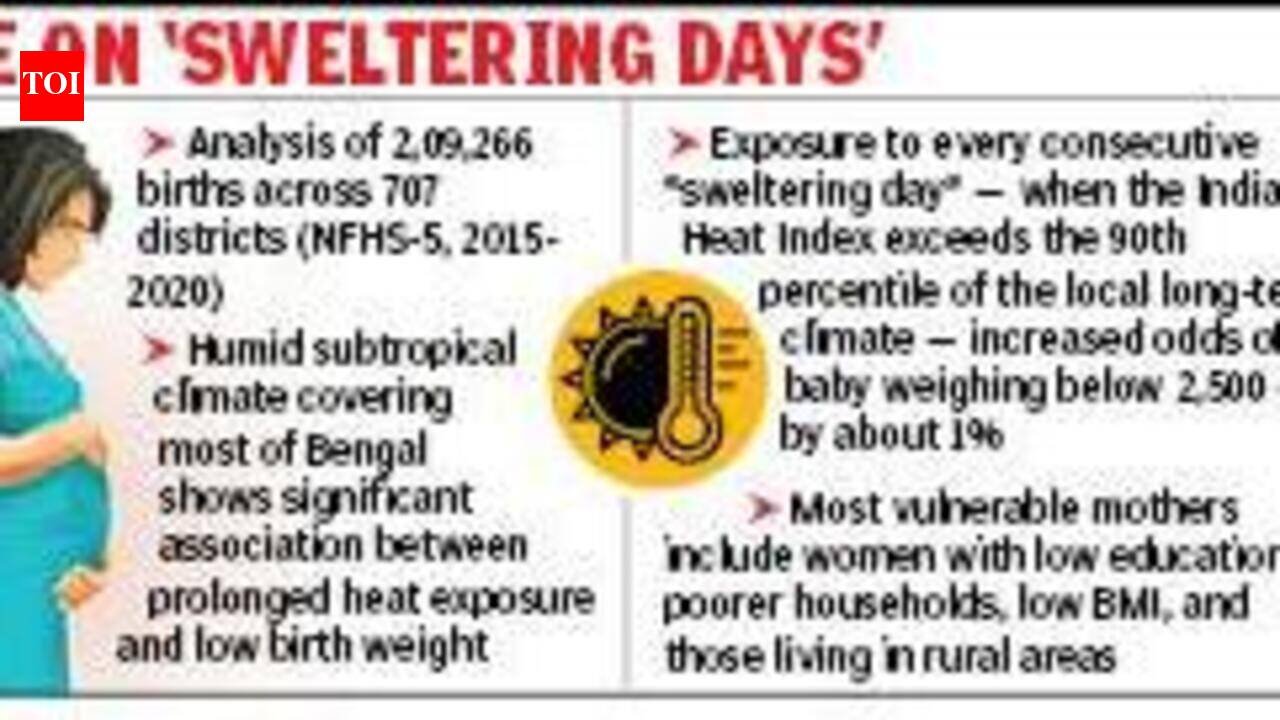
Kolkata: Prolonged exposure to extreme heat during pregnancy significantly increases the risk of low birth weight, pre-term birth and stillbirth, with women in Bengal among the particularly vulnerable because of the state’s humid subtropical climate, researchers conducting the first nationwide study examining the impact of heat stress on pregnancy outcomes in India have revealed.The peer-reviewed study, Effect of Extreme Heat Stress on Adverse Pregnancy Outcomes in India, analysed 2,09,266 births recorded under the National Family Health Survey (NFHS-5) between 2015 and 2020, matching each pregnancy with local heat exposure. Researchers found that every additional consecutive day of extreme heat during pregnancy increased the likelihood of delivering a low-birth-weight baby, with the timing of exposure proving crucial.For Bengal, the study identified humid subtropical regions — which cover most of the state — as among the climatic zones where prolonged heat exposure showed a statistically significant association with low birth weight. Instead of relying on maximum temperatures alone, researchers tracked consecutive “sweltering days” — defined as days when the India Heat Index exceeded the 90th percentile of the long-term local climate. Heat events lasting three or more consecutive days were then linked to individual pregnancies.The study found that each additional consecutive sweltering day increased the odds of low birth weight by about 1%, even after accounting for air pollution, maternal age, nutrition, wealth, education, cooking fuel, and other factors. Researchers said the cumulative effect over increasingly long and frequent heatwaves poses a significant public health concern.Researchers also found that heat exposure during the first trimester was associated with a greater risk of pre-term birth while second-trimester exposure had the strongest association with low birth weight. Heat during the third trimester showed a possible link with stillbirth, although the evidence was less conclusive.Lead author Vineetha Vincent of University of Queensland-IIT Delhi Academy of Research (UQIDAR) said heat should no longer be viewed as merely a background environmental condition during pregnancy. “Our data show that each additional day of extreme heat a mother endures nudges up the risk to her baby, and that risk lands hardest on women who are already vulnerable. As heatwaves lengthen, protecting pregnant women has to be part of how India plans for a warmer climate,” Vincent said.The study also highlights pronounced social inequalities. Mothers with little or no schooling, women from poorer households, and those who were undernourished faced significantly higher risks of adverse birth outcomes as heat exposure increased. Positive associations were observed in both rural and urban areas, although rural women were particularly vulnerable.Co-author Sagnik Dey of IIT Delhi said adaptation measures must prioritise these groups. “The mothers most exposed to extreme heat are often those with the fewest resources to cope with it,” he said.The researchers explain that pregnancy naturally raises a woman’s core body temperature and cardiac workload. Extreme heat and dehydration can further reduce blood flow to the uterus, restrict foetal growth, and trigger premature labour. Humid conditions, such as those prevailing across much of Bengal during summer, can intensify these physiological stresses because the body finds it harder to cool itself through sweating.The authors urged govts to explicitly recognise pregnant women as a priority group in Heat Action Plans, recommending measures such as improved access to cooling, hydration, antenatal counselling and targeted outreach in vulnerable districts. As climate change increases the frequency and duration of heatwaves, they argue that protecting maternal health should become an integral part of India’s climate adaptation strategy.
