



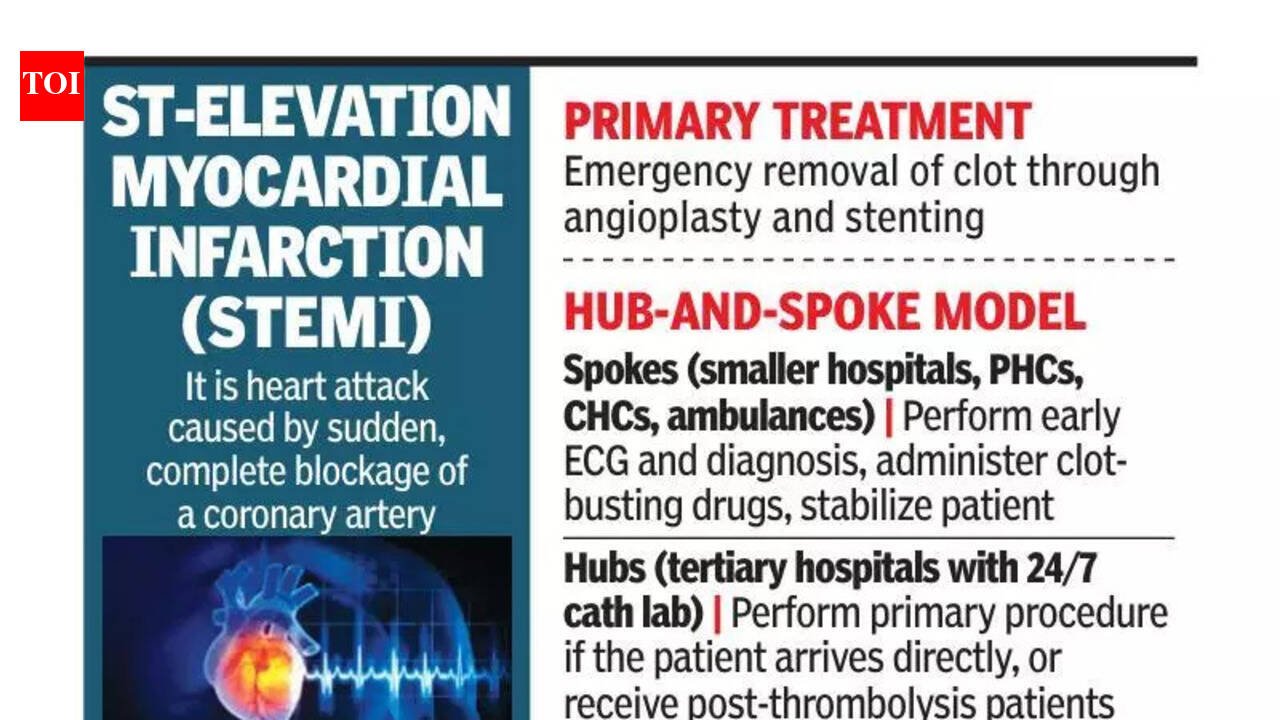
Chennai: In a govt healthcare system, where care is often slowed by scarce ambulances, crowded catheterization labs, and a shortage of specialists, new research from Madras Medical College suggests delaying stenting for up to 48 hours after medical intervention saves lives as effectively as rushing the procedure. These findings could reshape heart attack treatment strategies, authors say.The study, published this week in the American Journal of Cardiology, reports that for patients treated with clot-busting drugs, performing angioplasty—or inserting a stent—up to 48 hours later can be just as effective as the immediate approach within 90 minutes, long considered the gold standard in patients who suffered from ST-elevation myocardial infarction, or STEMI, the most severe form of heart attack.STEMI occurs when one of the heart’s major arteries is suddenly and completely blocked, cutting off oxygen supply to part of the heart muscle. Without swift intervention, the muscle begins to die, making it a medical emergency. Immediate percutaneous coronary intervention (PCI), or angioplasty and stenting, is often out of reach for patients reaching smaller hospitals or rural clinics, where catheter labs are limited. Physicians first administer clot-dissolving medications known as thrombolytics. Patients are transferred to advanced centres for definitive stenting within 24 hours. In Tamil Nadu, doctors used this “hub-and-spoke” model of care for more than a decade, but admit there are still delays due to multiple reasons, including insurance.“We wanted to test whether waiting up to 48 hours after thrombolysis could match the outcomes of immediate PCI,” said Madras Medical College’s Professor of Cardiology Dr Justin Paul Gnanaraj, who is the study’s lead author.The team at Madras Medical College reviewed records of 2,499 patients treated between Sept 2018 and Oct 2019 at the Rajiv Gandhi Govt General Hospital. Just 248 patients (about 10%) received primary percutaneous coronary intervention—angioplasty and stenting—within the recommended 90-minute “door-to-balloon” time frame. Cardiologists thread a balloon-tipped catheter through a blood vessel to the blocked artery, expand the balloon to clear the obstruction, and then place a tiny wire mesh—called a stent—to keep the artery open.At least 210 patients received delayed stenting up to 48 hours after clot-busting drugs. Another 44% received only thrombolytic therapy, while some received treatment later or no treatment at all due to a combination of reasons, including health condition, patient willingness, health insurance, or delay in reaching the hospital.Dividing 210 patients who received delayed stenting into subgroups—those receiving stents within 24 hours and those between 24 and 48 hours—doctors found no significant difference in outcomes. “That was encouraging. No one can now say we are watering a dead plant,” Dr Gnanaraj said.Among those who underwent delayed stenting, the in-hospital death rate was 1.4%, and one-year mortality stood at 7.4%—identical to rates in patients treated immediately. “Our data show that stenting up to 48 hours after clot-dissolving drugs is comparable to urgent stenting. That’s an important message for regions with limited facilities,” said senior cardiologist Dr Anne Princy Steaphen M, one of the co-authors. “It is important for all STEMI patients to undergo angioplasty and stenting within this window as it lowers overall mortality,” she added.Researchers caution, however, that while the current study provides promising evidence, it is based on a hospital registry rather than a randomized trial. Long-term follow-up beyond the first two years and larger studies will be required to confirm delayed stenting as a safe alternative.


