



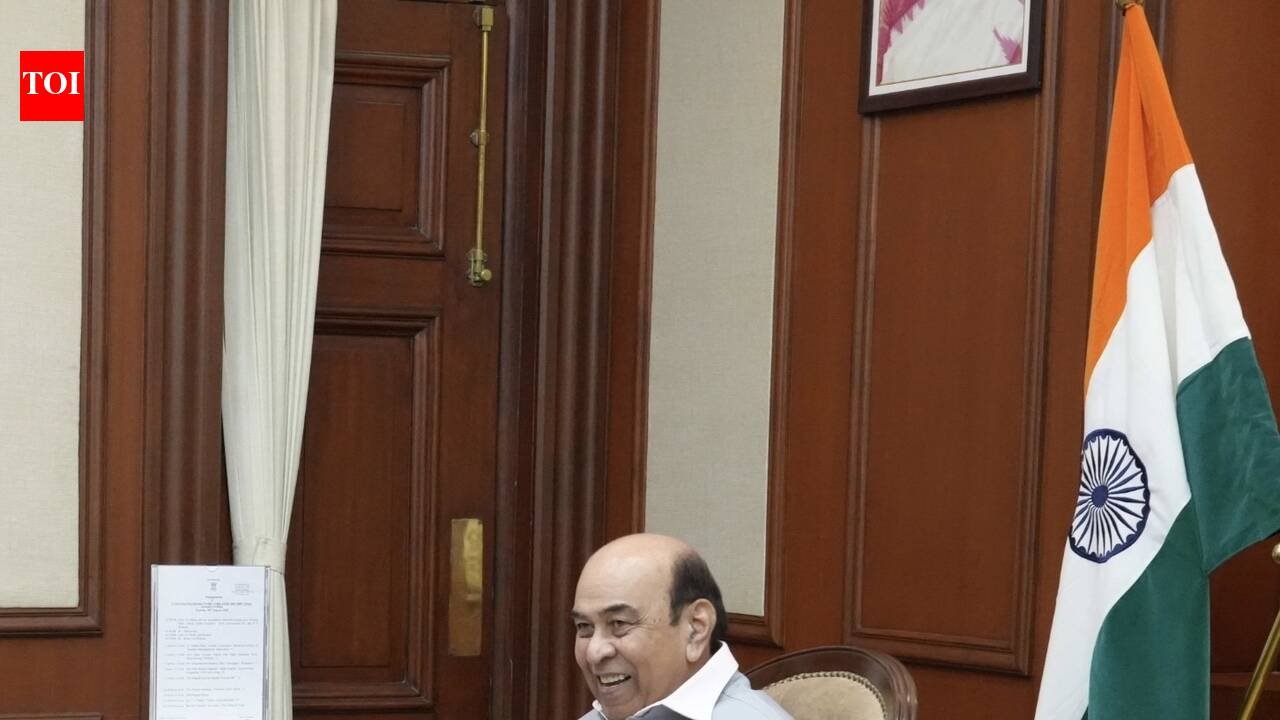
Patna: When Syed Ata Hasnain took charge as Bihar’s 43rd governor, he inherited a higher education system grappling with delayed exams and results, uneven academic standards, inadequate infrastructure and slow processes. Hasnain now is bringing an emphasis on discipline, accountability and execution to the system. In an exclusive interview with TOI’s B K Mishra, he spoke about the road ahead. Excerpts:What are the three most urgent structural changes needed in Bihar’s higher education system?I would identify three—leadership, systems and academic quality. First, universities need strong institutional leadership, beginning with the selection of the best possible VCs through a fair and transparent process. Second, administrative and academic systems must become more efficient, technology-enabled and accountable. Third, we have to strengthen the academic ecosystem—faculty, laboratories, libraries, research and student services. These are interconnected.What has struck you most about Bihar’s higher education system?As a soldier, I have learnt to be prepared for surprises in most situations. What has struck me, however, is the unevenness. Bihar has universities and individuals with considerable capability, but institutional energy and performance are not uniform. That is why I have started detailed university-wise reviews at Lok Bhavan. Each VC and his team makes a presentation. This allows us to understand each university on its own merits.How do you see autonomy and accountability?I don’t see them as opposites. A VC cannot lead effectively if every decision requires external intervention. At the same time, greater authority must come with greater transparency and accountability. My preference is therefore maximum functional freedom within clearly understood rules, accompanied by measurable outcomes and periodic review.What kind of powers should VCs have?A VC should be the confident academic and administrative functionary of a university. But leadership also means responsibility for examinations, academic standards, financial propriety, grievance redressal and the overall quality of the student experience.When will the entire student journey become digital?The Samarth platform provides an important foundation. Universities are at different stages of digital maturity, so I would hesitate to announce an artificial uniform deadline. DigiLocker, for example, is under implementation.What is being done about delayed examinations and results?I have emphasised academic calendars, examination discipline and regular monitoring. Universities have inherited different situations, so a single deadline may not always be realistic. What students can legitimately expect is a steady reduction in delays and much greater predictability in the academic calendar. The situation will also be regularly monitored through virtual meetings with Lok Bhavan.Can Bihar expand higher education without compromising quality?Expansion is meaningful only when institutions actually function. That is why the recent recruitment exercise was so important. Around 2,400 teachers were selected in approximately one month through a transparent process. It demonstrated that speed and transparency need not be opposites. But faculty alone does not make a college. We also need functioning laboratories, libraries and essential academic infrastructure. Non-teaching staff are equally important.Should recruitment be aligned with Bihar’s emerging economic needs?Yes, but with a qualification. Universities cannot recruit only for today’s vacancies; they must anticipate tomorrow’s knowledge requirements. Universities must also retain their strength in fundamental disciplines too.What is your vision for research in Bihar’s universities?Research ecosystem requires good faculty, mentorship, laboratories, libraries, collaboration and incentives. Bihar’s universities should increasingly identify areas where the state itself can become a laboratory for serious scholarship. I would particularly like our universities to ask: What knowledge can Bihar contribute to India and the world that is uniquely informed by the state’s own experience?Why do you believe the present reform effort will be different?The test of any reform is implementation. That is why I have preferred detailed institutional engagement rather than simply issuing general directions. We are reviewing universities individually, interacting more frequently with VCs, obtaining feedback from faculty and students, and having an experienced team at Lok Bhavan that monitors policy implementation. The recent faculty recruitment exercise gives me confidence.Finally, what is your assurance to Bihar’s students?I would not promise that Bihar’s higher education will be transformed by a particular date. My assurance is simpler: Students will increasingly be at the centre of the decisions we take. I cannot promise that every problem will disappear within a particular number of months. As chancellor, I am building a system of leadership, review, transparency, feedback and execution that should progressively make Bihar’s universities capable of improving themselves.


