



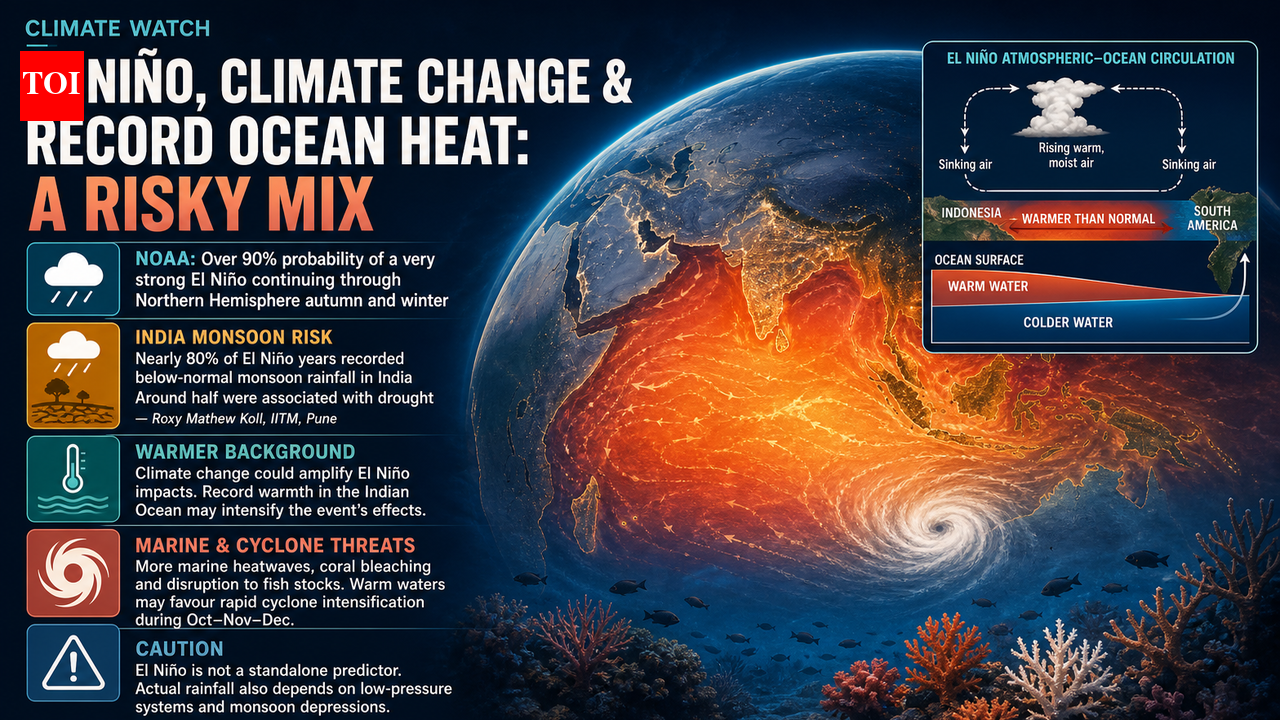
Pune: A powerful El Niño developing over Pacific and expected to intensify further could significantly influence India’s weather in the coming months, affecting the northeast monsoon, winter conditions and the Oct-Dec cyclone season, scientists warned on Wednesday.According to them, the impacts are unlikely to follow the traditional El Niño playbook of drought alone, with a rapidly warming Indian Ocean adding a new layer of complexity, increasing the risk of marine heatwaves, heat stress and extreme rainfall events.Speaking at a media dialogue organised by IIOE-2 ECSN, climate scientist Roxy Mathew Koll of Indian Institute of Tropical Meteorology (IITM), Pune, said the ongoing El Niño was already exceptionally strong and was likely to peak in Nov. “Sea surface temperatures in the central Pacific are currently around 2.6° to 3° above normal, with some regions even warmer. Climate models suggest anomalies could approach 4°,” Koll said.He said while the event was expected to weaken by April-May 2027, its residual heat could continue influencing the global climate for months afterwards.The discussion, moderated by IITM climate researcher Vineet Kumar Singh, focused on the combined effects of El Niño and Indian Ocean warming on extreme weather.The latest assessment from US National Oceanic and Atmospheric Administration (NOAA) also indicates a strengthening El Niño, with more than a 90% probability of a very strong event persisting through the Northern Hemisphere autumn and winter.For India, El Niño has historically been linked with weaker monsoon rainfall. Drawing on over 150 years of monsoon records, Koll said roughly half of all El Niño years experienced drought, while nearly 80% recorded below-normal rainfall.Yet he cautioned against viewing El Niño as a standalone predictor. “Climate change is amplifying some of the impacts traditionally associated with El Niño. In several regions, we are seeing El Niño signals overlaid on a much warmer climate background,” Koll said.The scientists said Indian Ocean’s record warmth could intensify the consequences of El Niño. According to Koll, weaker winds during El Niño reduce evaporation, allowing Indian Ocean to retain more heat.Studies show ocean temperatures often remain unusually high during and even after El Niño events, increasing the likelihood of marine heatwaves. “These events are becoming more common during El Niño and post-El Niño periods,” he said.Marine heatwaves can cause widespread coral bleaching, disrupt marine ecosystems and affect fish stocks. The scientists also warned that abnormally warm ocean waters might provide favourable conditions for the rapid intensification of cyclones during the Oct-Nov-Dec cyclone season. “The impact of such a strong El Niño on this year’s cyclone activity remains to be seen,” Koll said.The effects could extend beyond weather. Smitha BR, a scientist at Centre for Marine Living Resources and Ecology in Kochi, said weaker winds associated with El Niño could suppress coastal upwelling in the Arabian Sea, reducing the flow of nutrient-rich waters that sustain marine productivity.“This can affect fishery production and fish spawning, particularly because rainfall and upwelling create favourable conditions for commercially important species during the monsoon,” she said, adding, “Without upwelling, food availability drops, which can ultimately lead to starvation and mortality across parts of the marine ecosystem.”The scientists also stressed that El Niño’s influence could not be understood in isolation as climate change continues to alter global weather baselines. Himadri Saini, a researcher at University of Melbourne, said warming oceans and atmosphere are steadily changing what is considered “normal” weather. “We need to rethink what we mean by normal,” she said, adding that events once regarded as exceptional a few decades ago are becoming increasingly common in a warmer climate.Saini said while large-scale ocean-atmosphere patterns like El Niño created the broader climate backdrop, actual rainfall depended on smaller weather systems, including low-pressure systems and monsoon depressions. “Ocean warming changes how heat is transferred to the atmosphere and can influence weather thousands of kilometres away,” she said.
