


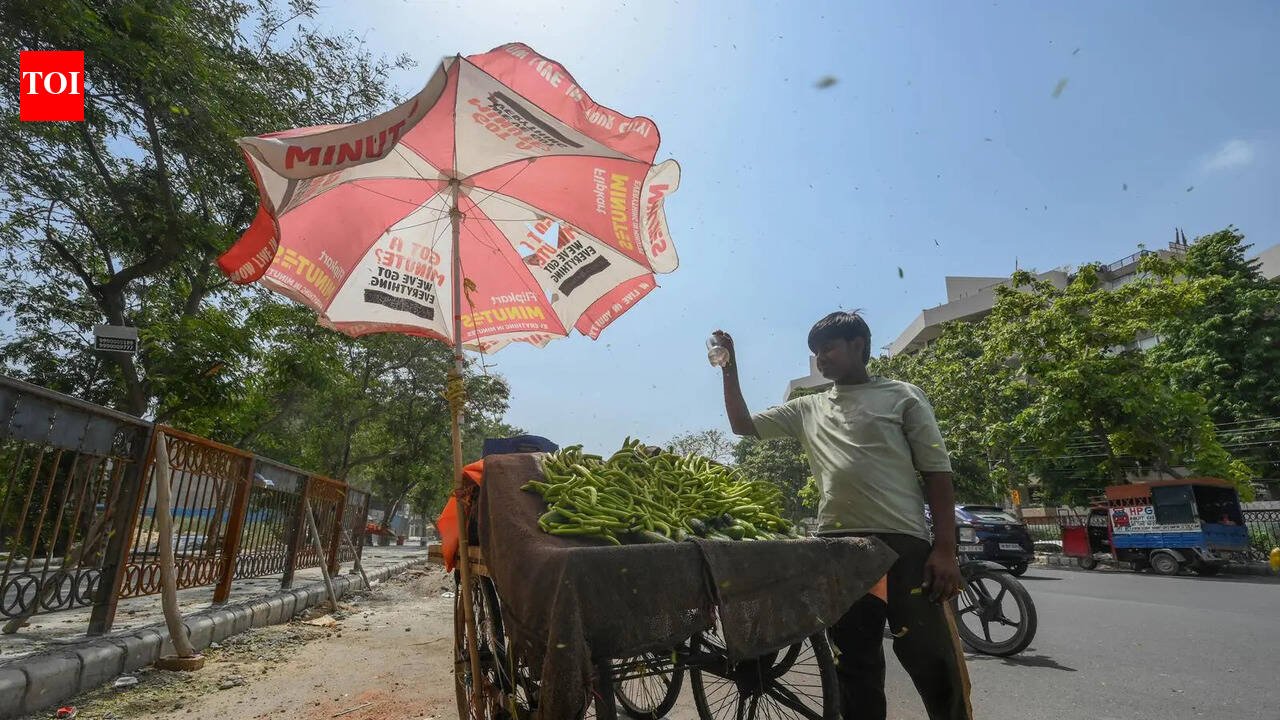
Gurgaon: The city continued to swelter under extreme heat on Friday, with daytime temperatures staying above 42 degrees Celsius, as the India Meteorological Department (IMD) issued an orange alert for heatwave to severe heatwave conditions across Haryana from May 24 to May 27.The city recorded a maximum temperature of 42.7 degrees Celsius, up from 42 degrees Celsius on Thursday. While the state’s average maximum temperature saw a marginal fall of 1.1 degrees Celsius in the last 24 hours, it continued to remain 2.2 degrees above normal.While Gurgaon AWS recorded a maximum temperature of 41.4 degrees Celsius, KVK AWS recorded 41.5 degrees Celsius, and NorthCap University recorded 42.7 degrees Celsius.Across Haryana, Rohtak remained the hottest district in the state, with a maximum temperature of 45.3 degrees Celsius, nearly five degrees above normal. Bopani AWS in Faridabad recorded 45.1 degrees Celsius, while Sirsa touched 44.4 degrees Celsius, and Hisar recorded 43.1 degrees Celsius.Night temperatures stayed high as well, adding to discomfort and limiting overnight cooling, with the minimum settling at 29.8 degrees Celsius, 1.1 notches lower than the previous day.NorthCap University recorded a minimum temperature of 28.5 degrees Celsius, as against 32.6 degrees Celsius on Thursday. Gurgaon AWS settled at 25.3 degrees Celsius, against 27.5 degrees Celsius on Thursday. The state’s average minimum temperature dipped by 0.8 degrees Celsius compared to Thursday, but remained 1.8 degrees above normal.Across Haryana, Sirsa recorded the warmest night at 30.2 degrees Celsius, while Hisar logged 28.6 degrees Celsius, Ambala 28.5 degrees Celsius, Karnal 27.6 degrees Celsius, and Narnaul 28.2 degrees Celsius.Thunderstorms, lightning, and gusty winds of 30-40 kmph are expected at isolated places on Friday, while light rainfall is likely at isolated places on May 22 and May 28. Weather conditions are expected to remain largely dry between May 23 and May 27. Strong surface winds of 20-30 kmph, gusting up to 40 kmph, are also likely over Haryana during the next seven days, according to IMD.Dr Vishwas Chitale, fellow, Council on Energy, Environment and Water (CEEW), said that according to a study, Delhi is one of the highest heat-risk-experiencing union territories, with districts where 55 and 45% fall in the very high and high categories of the heat risk index, respectively.“As per WHO, extended periods of daytime and nighttime temperatures can cause cumulative stress on the human body. Warmer nights prevent the human body from cooling down after intense daytime heat. This significantly increases health risks such as heat strokes and worsens diseases such as diabetes and hypertension,” he said.
