



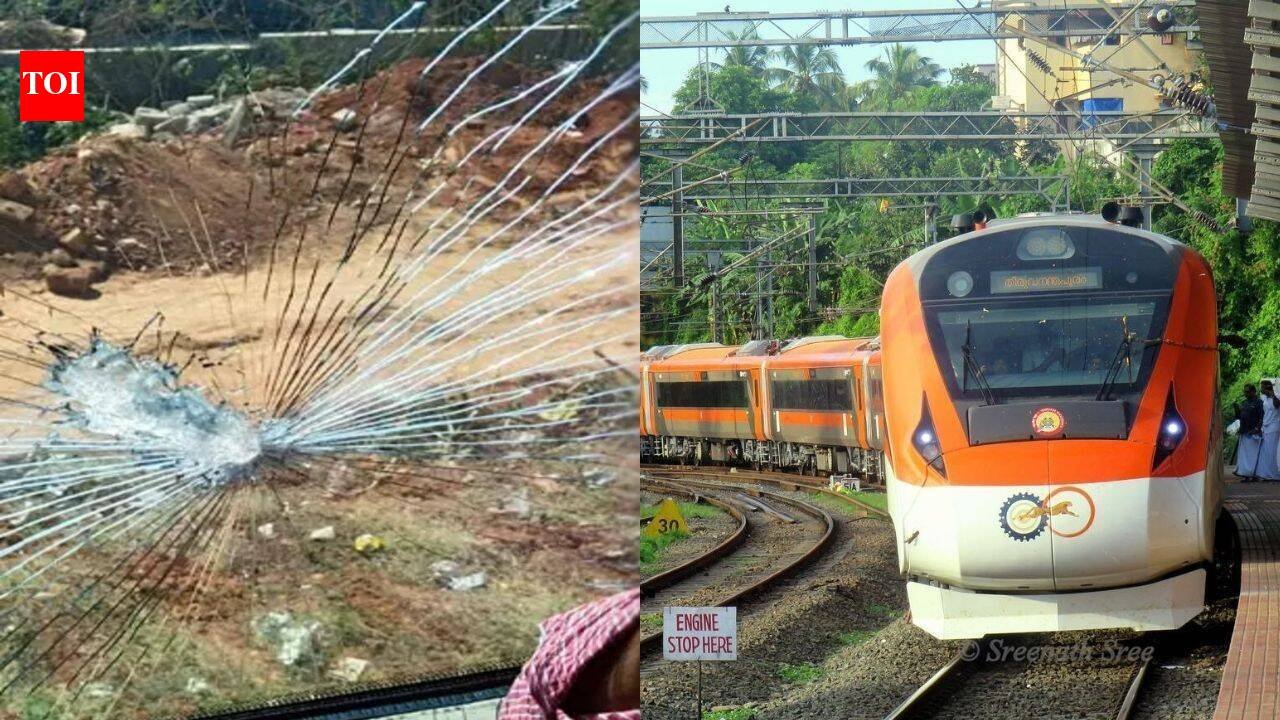
A passenger is injured after a stone crashes through a train window. An alert loco pilot spots an iron pipe on the tracks seconds before disaster. A low-intensity blast damages a freight corridor, triggering a multi-agency investigation.Different states. Different methods. But cops say they reflect a troubling trend—the nature of threats facing India’s railway network is changing rapidly.For decades, railway policing largely revolved around thefts, trespassing and occasional acts of vandalism. Now, the Railway Protection Force (RPF), Government Railway Police (GRP) and state agencies are dealing with a spectrum of threats ranging from stone-pelting by anti-social elements to carefully planned derailment attempts and, more recently, explosive attacks on critical freight infrastructure.
Stones on the tracks: The menace hiding in plain sight across Indian RailwaysRailway minister Ashwini Vaishnaw told the Lok Sabha that 7,971 stone-pelting incidents were recorded nationwide between 2023 and February 2025, leading to 4,549 arrests. Zonal railways spent Rs 5.79 crore in that period repairing damaged coaches.Almost no route has been spared. In Madhya Pradesh’s Morena district, a 20-year-old was arrested after admitting he threw stones at the Bhopal-Delhi Vande Bharat simply “for fun.” In Kerala, a Vande Bharat running between Ernakulam and Bengaluru suffered window damage near Parali, while Angamaly saw two coaches hit in a separate incident.From 2019 to 2023, Vande Bharat trains alone have suffered Rs 55.60 lakh in damage from stone-pelting, with 151 people arrested in connection with these cases, Vaishnaw told Parliament in an earlier reply.The violence isn’t always random mischief. In Aurangabad, miscreants pelted the Secunderabad-Mumbai Devagiri Express after it was held up by a deliberately cut signal wire — and in the chaos, a woman passenger’s gold chain was snatched as she tried to shut her window.In Mumbai, a man was arrested for a string of attacks on suburban trains between Reay Road and Sewri, injuring at least three women commuters in ladies’ compartments over several weeks.Anger over overcrowding has also turned violent.In MP’s Chhatarpur district, thousands of Maha Kumbh-bound passengers waiting on platforms at Harpalpur and Chhatarpur stations pelted an already-packed Ambedkar Nagar-Prayagraj Express after its doors weren’t opened for them.And in Bihar, examination aspirants clashed with police at Patna’s Pataliputra station on two separate occasions — first in June, when nearly 200 people vandalised the station over an alleged shortage of trains, and again days later when Bihar Police recruitment candidates, angry over transport arrangements, occupied tracks, pelted police and injured central range IG Jitendra Rana. Police fired eight rounds in the air and used tear gas to disperse the crowd.Why people throw stonesRailway officials point to a mix of causes rather than a single explanation. Children playing unsupervised near tracks account for a significant share of incidents — RPF officers in Delhi noted that many such children don’t attend school and throw stones “out of mischief,” with trains becoming unintended targets.In the Delhi RPF’s data, 37 children were involved in 32 incidents in one year and 11 children in six incidents the following year; no cases were registered against any of them given their age.Other drivers include people frustrated at unauthorised crossings who throw stones after being forced to wait for trains to pass; habitual offenders and anti-social elements based in unauthorised settlements and jhuggi clusters along tracks; workers from nearby factories crossing tracks illegally for their commute; and alcohol consumption.Fighting back: Drones, solar cameras and community outreachThe RPF’s response has scaled up sharply in recent years. In Delhi, two drones now monitor vulnerable stretches like the Adarsh Nagar-Narela-Panipat section in real time, feeding alerts to nearby teams — a shift credited with a 146% jump in arrests even as reported incidents fell.Delhi’s arrest numbers rose from 32 in the first five months of 2025 to 79 in the same period this year, even as cases dropped from 176 to 144.
The maximum complaints about stones being pelted at trains in 2022 were reported from these railway sections in Delhi
East Coast Railway has taken a similar tech-first approach, installing 165 solar-powered CCTV cameras in power-deprived rural stretches with 1,142 more underway, alongside five surveillance drones split across its Khurda Road, Waltair and Sambalpur divisions. Delhi’s RPF has installed 76 solar cameras across two phases with 50 more underway.Community engagement runs parallel to the technology. In Delhi, parents of children aged six to 12 caught in stone-pelting incidents are made to furnish bonds promising supervision, while RPF has partnered with NGOs to engage jhuggi-cluster children in educational activities during peak incident hours.Pipes, logs and jammed points: The calculated attempts to derail India’s trainsBeyond opportunistic stone-pelting, a more calculated threat has emerged — deliberate sabotage aimed at derailing moving trains, several attempts occurring within days of each other across multiple states.In MP’s Nepanagar, miscreants planted 10 detonators on the tracks; the driver of a special train, alerted by the resulting explosion, stopped in time. ATS, NIA and local police descended on the site, and one suspect was apprehended. The same day, a Kanpur-bound goods train’s loco pilot spotted a cylinder near Prempur station in UP.In Rajasthan’s Ajmer district, a goods train struck two cement blocks placed on the Western Dedicated Freight Corridor. Saboteurs also targeted the Bhiwani-Prayagraj Kalindi Express near Kanpur with an LPG cylinder, petrol and matchboxes — suggesting intent to ignite as well as derail.Uttar Pradesh bore the brunt: Near Dohna station in Bareilly, drivers spotted a jammed point mechanism stuffed with ballast on June 1 — the seventh sabotage attempt foiled in the state in two months, with an FIR registered under Section 150 of the Railways Act.
Locopilot spots pipe on tracks in UP, foils derailment attempt
Days earlier, loco-pilots spotted a 12-foot iron pipe near Shamli on May 31, and the Tejas Rajdhani Express was saved after ballast was found near Prayagraj on the night of May 29-30. Two more bids — targeting the Delhi-Dibrugarh Rajdhani Express and Kathgodam Express — were thwarted on May 19 near Hardoi with logs on the tracks.One especially dramatic case: A 20-foot iron borewell pipe found near Shamli on the night of May 31 — the fourth sabotage bid in UP within the single month of May — even though a train had passed the same stretch an hour earlier without incident.In Ghazipur, a wooden log dragged the loco-engine of the Delhi-bound Swatantrata Senani Express nearly 500 metres in September before the 100kmph train could stop despite emergency braking.Near Valsad, the Mumbai-Hazrat Nizamuddin August Kranti Rajdhani Express hit a deliberately placed cement fencing pole in January; police booked suspects for attempted murder and conspiracy, noting the isolated location — the nearest house was 500 metres away — pointed to premeditation.Motive has varied. In Gujarat’s Botad, two men who watched YouTube videos on derailing trains placed an iron rail piece on the tracks on September 25, intending to rob passengers while facing financial hardship; they were arrested in early October.In UP’s Jaunpur, two men were caught in early May placing a steel drum on the tracks near Aunka village before RPF action foiled the attempt.Bombs on the tracks: Punjab’s freight corridor hit twice in three monthsThe most alarming escalation has come from Punjab, where the Dedicated Freight Corridor has been targeted by explosives twice in roughly three months, raising fears of a coordinated campaign rather than isolated acts.Late one Monday night, an IED blast tore through DFC track near Bathonia village in Patiala district, between Rajpura and Shambhu — roughly three months after an earlier blast on the same corridor in January.Police believe the bomber was killed when the device detonated prematurely while he was planting it; his body was recovered severely mutilated, with parts still being collected from the site. SSP Varun Sharma called it a low-intensity explosion and identified the deceased only as a Tarn Taran resident, pending family notification.
Samba, Apr 28 (ANI): A search operation is underway on a railway track following a blast on a railway track, in Patiala, in Samba on Tuesday. (ANI Photo)
Police recovered wires, suspected explosives, two motorcycles and a damaged mobile phone from the scene. CIA units, forensic experts and a bomb disposal squad launched a coordinated probe, with state forensic teams collecting soil and chemical residue samples to identify the explosive’s composition. Freight movement was briefly suspended before traffic was restored within hours.A case was registered under Section 150 of the Railways Act, and investigators are examining potential “terror module” links and a coordinated sabotage campaign targeting the Punjab freight supply chain. No group has claimed responsibility.This followed an earlier blast near Khanpur village in Fatehgarh Sahib’s Sirhind region in January, days ahead of Republic Day, which damaged 4-5 metres of track and shattered a locomotive’s windshield, injuring the loco pilot’s face. AIG-GRP A S Ghumman said there were no confirmed signs of RDX or military-grade explosives; DIG-Ropar Range Nanak Singh called it low-intensity with no major casualties.SSP Fatehgarh Sahib Shubham Aggarwal attributed it to miscreants. Tracks were repaired by 7am the next morning and traffic restored on the Amritsar-Delhi section, with authorities warning against circulating rumours.After the Patiala blast, security was sharply heightened at Ambala Cantonment, Rajpura and Patiala, with intelligence agencies placed on high alert and inter-agency coordination activated across the state.The common thread — and the widening gap between mischief and menaceWhether it is a stone through a window, a pipe wedged into a point mechanism, or a bomb buried beside the tracks, the pattern that emerges is strikingly consistent: Split-second vigilance from loco pilots — and, in some cases, sheer luck — is often the only thing standing between routine disruption and mass casualty. The legal response has scaled with the threat.Stone-pelters are booked under Section 153 of the Railways Act, which carries up to five years’ imprisonment; those behind derailment plots face the more serious Section 150, for malicious attempts to wreck a train; and where investigators believe there was clear intent to kill, IPC charges including Section 307 for attempted murder have been added on top.The security response has scaled in parallel. At one end sits community-facing work — drones over Delhi’s black spots, solar cameras in East Coast Railway’s power-starved rural stretches, parental bonds for children caught pelting stones, NGO partnerships, street plays, and awareness pamphlets distributed by the lakh.At the other end sits a far more serious apparatus — the ATS, the NIA, state forensic labs, bomb disposal squads, and CIA units, all now engaged in a state that, until recently, was dealing primarily with stone-pelters and trespassers.What connects the three threads — and what worries officials most — is the trajectory. Stone-pelting remains overwhelmingly a story of poverty, boredom, impatience and opportunism, concentrated in specific black-spot stretches and disproportionately involving children who are, by law, beyond prosecution.Derailment attempts, by contrast, increasingly show signs of premeditation: Isolated locations chosen deliberately, materials sourced specifically to jam mechanisms rather than simply obstruct, and in at least one case, an offender who studied how-to videos before acting.And the Punjab blasts represent something categorically different again — sophisticated devices, forensic-grade investigations, and open acknowledgment from senior police officers that a coordinated, possibly terror-linked campaign against the freight corridor cannot be ruled out.For a railway network that moves more than two crore passengers every single day, the message from officials across three states and multiple agencies is consistent: Vigilance has visibly improved, and the numbers — more arrests, more surveillance, faster response times — reflect that. The investigation into who exactly is behind the more calculated attacks — and whether they are connected — remains very much open.


