


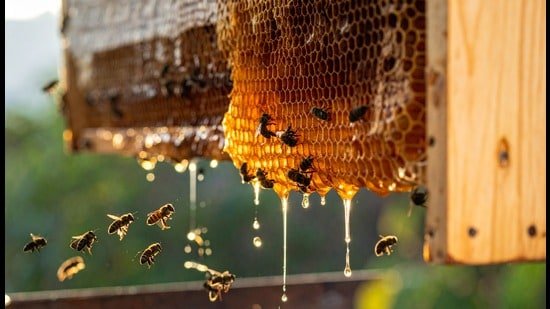
Plenty of creatures help plants procreate, so what makes bees special?
Why, in their absence, do fruits, vegetables, nuts and seeds decline in both yield and quality?
Well, bees are sort of built for pollination. While birds may pick up a few grains of pollen while sipping on nectar, the grains cling in far larger numbers to bees’ hairy little bodies. Where some birds may then chase after a bug or worm, dropping the pollen where it can do no good, bees hop from flower to flower, over distances as wide as 8 km, keeping local plant ecosystems genetically diverse and thriving.
Today, amid habitat loss, climate change, pesticides, rampant monoculture and increased vulnerability to diseases, bee numbers are famously falling. Hives are dying and species are being declared at-risk.
Interventions, even at the small-scale honey-farm level, tend to be expensive.
In the West, smart surveillance systems that monitor activity, track honey production and raise alerts about diseases cost, at the lower end, about $150 ( ₹14,000) per hive.
Three Indian professors have decided to reduce that cost, and are working to build and scale an array of cheaper options (as so many Indian researchers have done, in areas ranging from space exploration to cancer-treatment protocols).
Early results show promise. The Smart Honeycomb Monitoring Device — designed and built by Radhakrishna Pandit, who recently retired as head of the department of zoology at Savitribai Phule Pune University; Vikram Kakulte, HoD at KTHM College, Nashik; and Balasaheb K Tapale, HoD at MN Deshmukh college, Nashik — consists of a wooden beekeeping box with built-in cameras that can track activity and behaviour, identify disease early, monitor the health of the queen, and trace the impacts of shifting climate.
It can be built for as little as ₹2,000, the professors say.
The first device of its kind to be built indigenously — a tricky thing to do, since bees don’t take kindly to interference in the hive — it was granted a design patent in 2022. The professors have since been creating and testing prototypes in different price ranges. They are now looking for financial backing, with a view to eventual commercial rollout.
Gautam Demase, beekeeper and owner of Harit Seva Natural Foods in Nashik, is among those who have tested their prototypes. His farm had cameras tracking bee activity outside the hive, but not inside it, he says.
The greatest advantage of the new device was that its cameras helped him and his team track the queen’s laying habits. Based on this data, they were able to retire an older queen when her rate of laying slowed significantly, thus keeping the hive stable.
“The cameras were very useful in tracking colony health overall,” Demase adds. “When we placed a hive in a new location, we could study the response. When we saw the bees were taking to two new pomegranate saplings we planted, we were able to safely bring more hives closer to the trees and increase honey production.”
The device helps monitor activity across different parts of the hive, including the brood chamber or bee nursery. It can help beekeepers understand how these insects organise work, Kakulte says. And it can offer data on how factors such as distance from a food source, or weather, can impact foraging behaviour and honey production.
Researchers could potentially gain insight as well, Kakulte says. His colleague Ramnath Andhale, an assistant professor of genetics who consulted on the project, says the device could help monitor bees during perilous periods such as the monsoon. “Spikes in humidity can cause female moths to fly into hives, looking for a dry, nutritious spot to lay their eggs, Andhale says. “They can then lay over 200 at a time, which can hatch as larvae and cause entire hives to collapse. Such an event can be prevented too.”
