






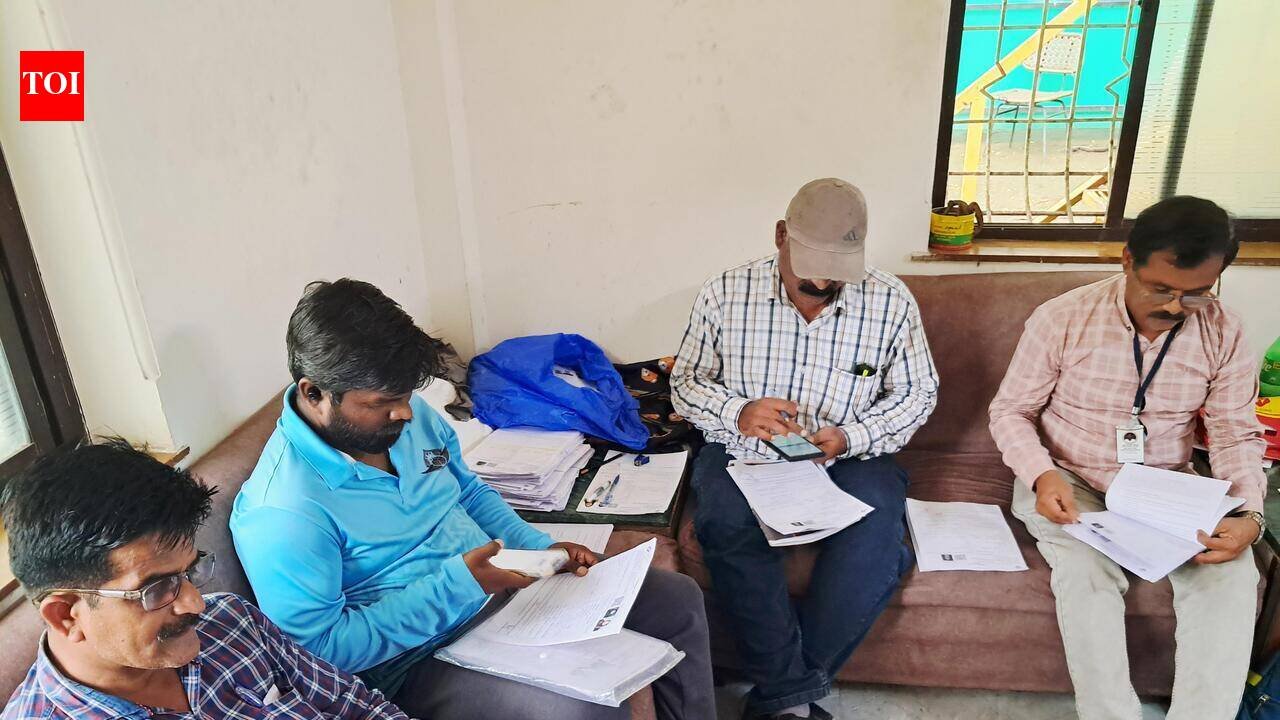
Pune: Election officials and booth-level officers (BLOs) in Pune district now have the additional exercise of verifying and updating the actual house number of every elector. The process, officials and field staff said, will be difficult to complete within the tight timeframe.The district administration has issued instructions to electoral registration officers (EROs) and assistant EROs directing them to complete polling-station rationalisation and restructuring by Aug 17.The exercise, mandated by State Chief Electoral Officer’s office as part of SIR, requires the existing notional house numbers of electors to be replaced with their actual ones. The exercise has to be completed before the technical process of restructuring polling stations begins.There are practical difficulties. In city areas, buildings in different wings have the same flat numbers, which will create confusion, a BLO said. In Pune district, the exercise will have to cover the 10 rural assembly constituencies of Junnar, Ambegaon, Khed, Shirur, Daund, Indapur, Baramati, Purandar, Bhor-Velha-Mulshi and Maval.Officials and BLOs, already neck-deep in verification and collection-related work, said the latest assignment adds another layer of field-level verification. BLOs said it would be impossible to complete it in four days.Under the new exercise, electoral-roll lists have to be shared with gram panchayats, municipalities or other local authorities, which are expected to verify the actual house numbers against individual electors.The verified numbers then have to be entered elector-wise through the ECINET system and the rolls re-serialised to facilitate family grouping.“The task could make it particularly challenging in urban areas, where buildings may have the same or similar numbers, multiple wings or flats, and several families live at the same address. In such cases, simply matching an elector’s name with a house number may not be sufficient to establish the correct family or building grouping,’’ election officials said.The State CEO’s office has prescribed two methods for the exercise. Under the hard-copy method, part-wise electoral rolls are to be printed and handed over to the relevant local authority for verification. Under the soft-copy method, the electoral data is to be shared electronically with the serial number of each elector pre-filled.Streamlining Voters’ Names In ListsWHAT I After receiving the verified information, the ERO has to log into ECINET, access Electoral Roll Management (ERONET), select the option for assigning/updating notional house numbers and enter the actual number against each elector.WHY I Members of the same family living in one house can be placed in the same part and section of the electoral roll, while electors living in the same building are grouped in the same part. Buildings on the same road should also, as far as possible, be retained in the same part.The exercise is necessary because house numbers in several parts of Maharashtra are either missing or incorrect. In some cases, an elector’s serial number has been used as the notional house number, making proper family grouping difficult and potentially showing several unrelated electors as residing in the same house.HOW I The task involves coordination between election officials, BLOs and local authorities, followed by individual data entry on the ECINET platform. The Pune district administration’s Aug 13 communication specifically directs the 10 rural constituencies to complete the rationalisation and restructuring exercise by Aug 17 and submit proposals for approval before the technical process is undertaken.


