



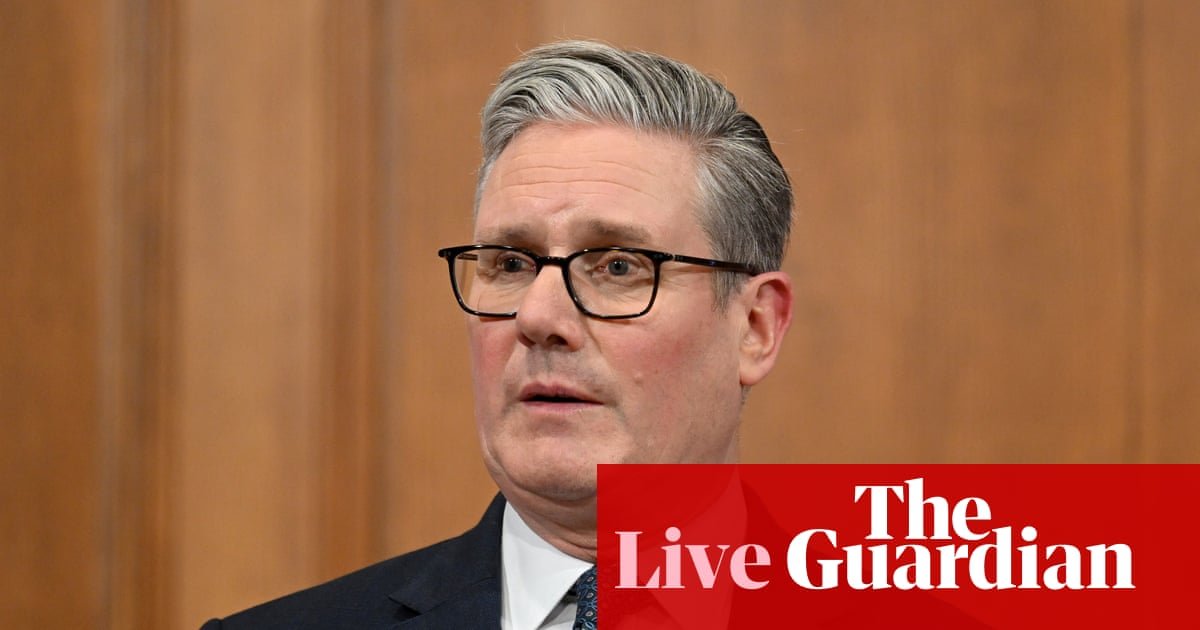
Starmer seeks to reassure public over cost of living as oil prices surge from US-Israeli war with Iran
Good morning and welcome to our live coverage of UK politics as governments around the world brace for major disruption to energy supplies as a result of the escalating US-Israeli war with Iran.
Keir Starmer is expected to promise to protect the British public from the economic impact of the war after oil prices surged past $100 a barrel for the first time since 2022.
“No matter the headwinds, supporting working people and their families with the cost of living is always top of my mind,” the prime minister said ahead of a visit on Monday to a community centre in London.
Starmer added:
People are also rightly worrying what this means for life at home – their bills, their jobs, their communities.
I want to address those concerns head on. I will always be guided by what is best for the British public. And no matter the headwinds, supporting working people and their families with the cost of living is always top of my mind.
Starmer is reportedly under pressure from unions and his backbenchers to prepare a support package to help people already grappling with a cost of living crisis in case of a prolonged conflict.
Most UK households will be protected from the impact of rising energy prices in the short term by the energy price cap, but the UK’s reliance on gas from the Middle East makes it especially vulnerable to an effective blockade of the strait of Hormuz, through which about 20% of the world’s liquid natural gas is transported.
Rising oil prices will feed through to higher costs at petrol stations, and consumers will be hit if energy costs push up inflation.
In an emergency meeting later today, G7 finance ministers will discuss a potential joint release of petroleum from reserves coordinated by the International Energy Agency, according to a report in the Financial Times.
The chancellor, Rachel Reeves, is expected to be among the finance ministers to attend the virtual meeting convened to address the crisis.
Key events
Lauren Almeida
Here is some detail on reports that G7 finance ministers are preparing to discuss the release of emergency oil reserves, courtesy of Guardian business reporter Lauren Almeida:
The emergency meeting would take place at 8.30am New York time to discuss the impact of the Iran war, the FT reported, citing unnamed people familiar with the matter.
Three G7 countries, including the US, have so far reportedly expressed support for the release of the emergency reserves, which are held by the IEA’s 32 member countries across the globe.
The IEA holds strategic reserves of petroleum as part of an emergency system designed to help countries withstand oil price crises. US officials believe a joint release in the range of 300m to 400m barrels would be appropriate, which would reportedly represent 25% to 35% of the 1.2bn barrels in reserve.
The UK month-ahead gas price jumped by 19% to 163p a therm on Monday morning. The continental European month-ahead benchmark is up 16% at €62 a megawatt hour.
Oil prices rose and stock markets in Asia, the UK and mainland Europe fell on Monday morning after continued violence in the Middle East fed investor concerns around a supply crunch, pushing Brent crude to its highest level in four years and triggering a stock market sell-off. You can read the full story here:
Starmer seeks to reassure public over cost of living as oil prices surge from US-Israeli war with Iran
Good morning and welcome to our live coverage of UK politics as governments around the world brace for major disruption to energy supplies as a result of the escalating US-Israeli war with Iran.
Keir Starmer is expected to promise to protect the British public from the economic impact of the war after oil prices surged past $100 a barrel for the first time since 2022.
“No matter the headwinds, supporting working people and their families with the cost of living is always top of my mind,” the prime minister said ahead of a visit on Monday to a community centre in London.
Starmer added:
People are also rightly worrying what this means for life at home – their bills, their jobs, their communities.
I want to address those concerns head on. I will always be guided by what is best for the British public. And no matter the headwinds, supporting working people and their families with the cost of living is always top of my mind.
Starmer is reportedly under pressure from unions and his backbenchers to prepare a support package to help people already grappling with a cost of living crisis in case of a prolonged conflict.
Most UK households will be protected from the impact of rising energy prices in the short term by the energy price cap, but the UK’s reliance on gas from the Middle East makes it especially vulnerable to an effective blockade of the strait of Hormuz, through which about 20% of the world’s liquid natural gas is transported.
Rising oil prices will feed through to higher costs at petrol stations, and consumers will be hit if energy costs push up inflation.
In an emergency meeting later today, G7 finance ministers will discuss a potential joint release of petroleum from reserves coordinated by the International Energy Agency, according to a report in the Financial Times.
The chancellor, Rachel Reeves, is expected to be among the finance ministers to attend the virtual meeting convened to address the crisis.


