



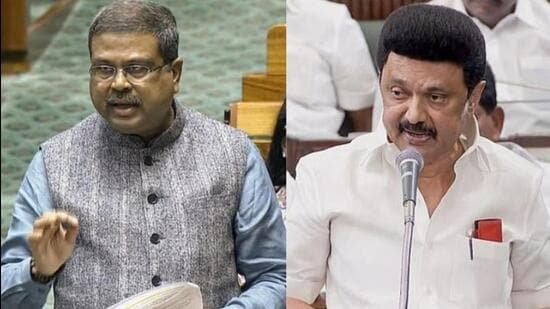
Two days after the Central Board of Secondary Education (CBSE) rolled out the three-language formula under the National Education Policy (NEP) 2020, Tamil Nadu chief minister M K Stalin accused the Centre of “linguistic imposition” and pushing Hindi through a “covert mechanism”, while Union education minister Dharmendra Pradhan dismissed the charge as politically motivated and defended the policy as a step towards multilingual empowerment.


The CBSE on Thursday announced the phased implementation of the three-language formula from Class 6 in 2026–27, set to become fully operational up to Class 10 by 2030–31 in line with NEP 2020.
Criticising the CBSE curriculum framework released on Thursday, Stalin, in a post on X, alleged that “…it is a calculated and deeply concerning attempt at linguistic imposition that vindicates our long-standing apprehensions.”
Also Read:CBSE rolls out NEP-aligned 3-language curriculum, new Class 10 board exam format
Stalin also alleged that the three-language formula under NEP 2020 is a “covert mechanism” for the expansion of Hindi. “Under the guise of promoting ‘Indian languages,’ the Bharatiya Janata Party (BJP)-led National Democratic Alliance (NDA) government is aggressively advancing a centralising agenda that privileges Hindi while systematically marginalising India’s rich and diverse linguistic heritage. The so-called three-language formula is, in reality, a covert mechanism to expand Hindi into non-Hindi speaking regions,” he said.
He questioned the lack of reciprocity, asking why students in Hindi-speaking states are not mandated to learn southern languages like Tamil.
Highlighting challenges in implementing the three-language formula, Stalin pointed to issues of teacher availability, infrastructure, and funding, while accusing the Centre of “hypocrisy” on promoting Tamil in Kendriya Vidyalayas (KVs). “India’s strength lies in its diversity—not in enforced uniformity. Any attempt to disturb this delicate balance is not just misguided; it is dangerous. #StopHindiImposition,” he added.
Responding directly by quoting Stalin’s post, Pradhan rejected the “imposition” narrative as “a tired attempt to mask political failures”, while terming NEP 2020 as “a manifesto for linguistic liberation.” He emphasised that NEP prioritises the mother tongue, allowing every Tamil child to excel in their own language while promoting flexible multilingualism.
“By misrepresenting a flexible policy as ‘compulsory Hindi’, you are not defending Tamil; you are creating barriers that deny our youth the opportunity to become multilingual global leaders. Tamil is not weakened by the learning of additional languages; it is enriched when its speakers are multilingual, confident and linguistically empowered,” he added.
Addressing Stalin’s concerns on reciprocity and resources, Pradhan said that Tamil Nadu has stalled PM SHRI schools by refusing to sign the Memorandum of Understanding (MoU) and continues to block Jawahar Navodaya Vidyalayas (JNVs) despite Supreme Court directions. “It is the DMK government that has stalled the establishment of PM SHRI schools in Tamil Nadu… This deliberate resistance is not merely administrative defiance; it is a direct disservice to lakhs of underprivileged students,” Pradhan said.
Pradhan urged the Tamil Nadu government to join the national mission: “Stop using the ‘Hindi imposition’ argument to hide administrative failures and join the national mission of empowering every Indian language.”
According to CBSE’s new secondary school curriculum, a third language (R3) will be made compulsory from Class 6 starting the 2026–27 academic session, with its implementation progressing up to Class 10 by 2030–31. This effectively sets the stage for the introduction of a mandatory third language in the Class 10 board exams from 2031, when the current Class 6 cohort appears for boards.
Under the revised framework, language learning will follow a structured three-language model organised into R1, R2 and R3 levels. R1 will be the student’s primary or strongest language studied at a higher level, while R2 will be a different language studied at a comparatively different level. The third language (R3) will be introduced from Class 6 in 2026–27 and made compulsory through secondary school. During the transition phase, students will be required to study and pass a third language to be eligible for board examinations.
The changes operationalise ideas first mooted as part of the National Curriculum Framework for School Education (NCF-SE) 2023 and are aligned with NEP 2020, which has recommended that students learn three languages up to Class 10, unlike the current system, where they study only two languages.
The curriculum specifies that R1 and R2 must be different languages, and even when the same textbook is used, the syllabus and assessment will differ across levels, meaning students may face different question papers and difficulty levels in board exams. In line with NCF-SE 2023, at least two of the three languages must be native to India, the curriculum document states.
According to CBSE chairperson Rahul Singh, 2027 will be the last Class 10 board exam under the current system where every language subject has the same levels, with 2028 introducing separate exam days for R1 and R2, and three-day language exams from 2031 for R1, R2 and R3.
This is not the first clash on the issue. Stalin has repeatedly criticised NEP in the past and accused the Centre of withholding funds as coercion for non-compliance with the three-language formula. Pradhan, meanwhile, has consistently positioned NEP as inclusive, focusing on foundational learning in the mother tongue, teacher training via schemes like Samagra Shiksha, and preparing students for global opportunities.


