






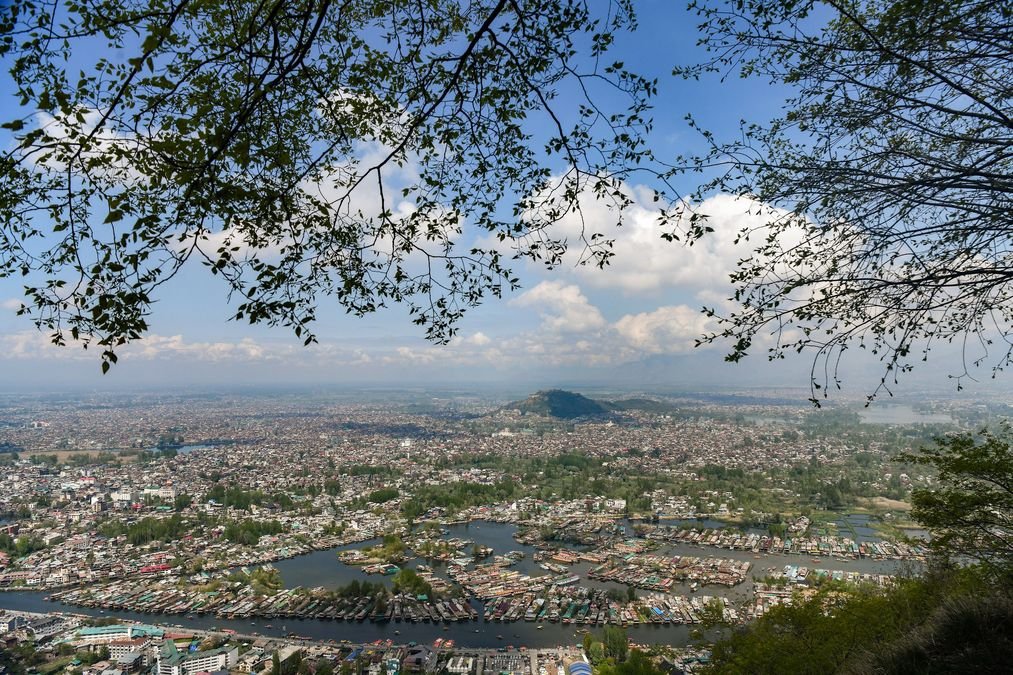
Srinagar, Oct 03: Srinagar’s rapid urban expansion over the past two decades has been accompanied by rising surface temperatures, declining vegetation cover and deteriorating air quality, highlighting the growing environmental cost of the city’s transformation, a new study published in GeoJournal has found.
The study, “Quantifying the environmental impacts of urban expansion in Srinagar City, Jammu & Kashmir, India through remote sensing and geostatistical analysis”, examines environmental changes in Srinagar between 2001 and 2021 using satellite-based observations and geostatistical techniques.
Researchers Amjed Ali, Kheraj and Arshad Ahmed of the Department of Geography, Central University Haryana found that land surface temperature (LST) increased by up to 4°C during the period, while vegetation cover showed a significant decline. “PM2.5 concentrations also increased by up to 3.9 micrograms per cubic metre, with the changes particularly pronounced in central and south-western parts of the city,” reads the study, accessed by Rising Kashmir.
The researchers used satellite-derived LST, vegetation cover derived from the Normalised Difference Vegetation Index (NDVI), and PM2.5 estimates from AOD-GEOS-Chem datasets. They combined these indicators through a grid-based analytical framework and applied Mann-Kendall trend analysis and multiple linear regression to examine their spatial and temporal relationships.
The study found a significant relationship between vegetation loss, PM2.5 and surface warming. Its regression analysis indicated that vegetation loss and PM2.5 significantly contributed to surface temperature variation, with the model recording an R² value of 0.46.
However, the researchers also caution that PM2.5 variability cannot be explained solely by surface temperature and vegetation cover, pointing to the influence of additional factors on Srinagar’s air-quality conditions.
The Environmental Quality Index developed as part of the study paints a broader picture of the city’s environmental health. More than half of Srinagar was found to fall within moderate-to-poor environmental quality categories.
The researchers attribute the changing environmental conditions to the rapid expansion of built-up areas and the replacement of natural land surfaces with impervious urban materials. “Such changes alter surface energy processes and can intensify urban heating, while the loss of vegetation reduces the natural cooling and pollution-filtering functions of green spaces,” the study reads.
“Vegetation plays a key role in regulating urban temperatures through evapotranspiration and can also help improve air quality by filtering pollutants. Its decline therefore has implications beyond the loss of green cover alone,” the study notes.
The spatial analysis showed that central and south-western areas of Srinagar experienced particularly notable changes, with increases in surface temperature and PM2.5 occurring alongside declining vegetation cover.
The researchers argue that these trends demonstrate the need to view Srinagar’s urban growth and environmental management as interconnected challenges. They call for integrated urban planning, greater emphasis on green infrastructure and stronger pollution-control strategies.
The study also places Srinagar’s experience within the wider environmental challenges faced by rapidly urbanising cities, where the pace of development can exceed the capacity of infrastructure and environmental management systems. Rather than examining temperature, vegetation and air pollution separately, the research brings the three indicators together to quantify the cumulative environmental changes associated with Srinagar’s urban expansion.
“Managing the city’s future growth will require greater attention to environmental sustainability, including the protection and development of green infrastructure and measures to address pollution, in line with the broader objectives of Sustainable Development Goal 11 on sustainable cities and communities,” the study states.


