



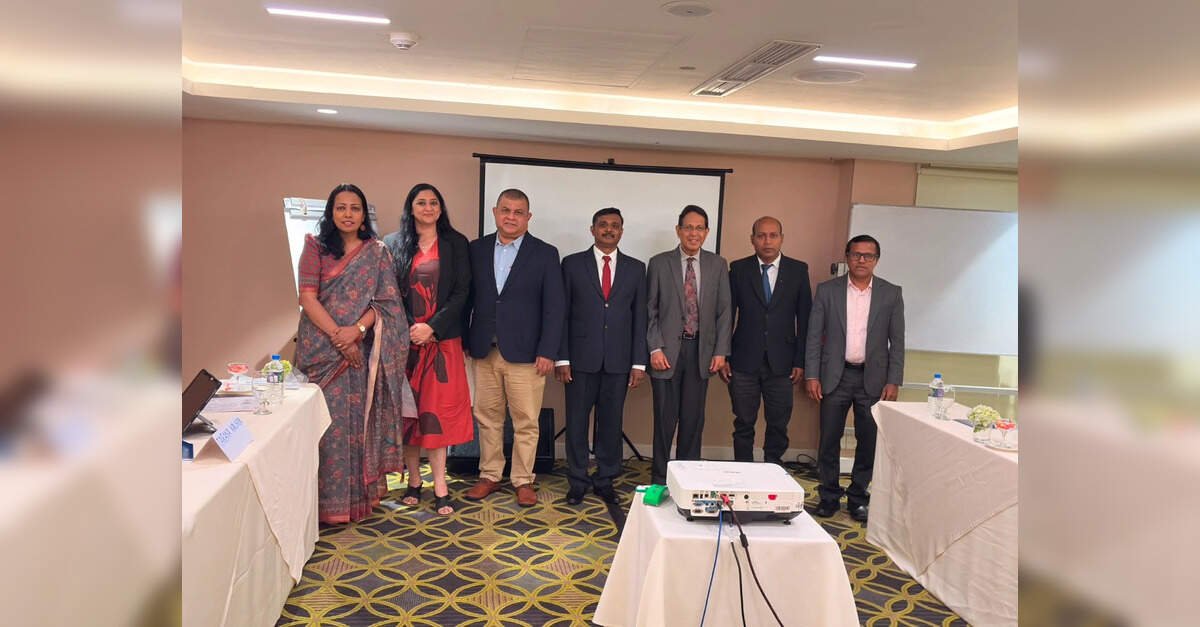
Colombo, August 2026 – Sri Lanka‘s higher education leadership converged at the Hilton Colombo on Friday for an exclusive, closed-door roundtable convened by ETEducation, bringing together vice chancellors, deans and directors general to confront a question the sector has debated in fragments for years but rarely in one room: what does it actually mean to make a graduate ready, not merely employed, in an economy being reshaped by AI.
Themed “Human-Centred AI, Education & Employability: Shaping Sri Lanka’s Future Workforce,” the discussion moved deliberately past the access-versus-enrolment framing that has dominated national education policy for a decade. ETEducation’s opening position was direct: access was the last decade’s problem; readiness is this decade’s, and readiness is now a human question as much as a curricular one. As AI absorbs the technical and procedural work graduates once competed on, the argument went, the durable differentiator for Sri Lankan talent at home and globally is shifting toward judgment, ethics, behavioural insight and adaptability.
The conversation brought together Dr DMA Kulasooriya, Director General, National Institute of Business Management (NIBM), Colombo; Dr Manjula Wickramasinghe, Dean, Faculty of Technology, Wayamba University of Sri Lanka; Dr Sajeewanie Liyana-arachchi, Vice Chancellor, Horizon Campus, Malabe; Prof Samantha Rajapaksha, Head, Department of Information Technology, Faculty of Computing, Sri Lanka Institute of Information Technology (SLIIT); Prof Rahula Attalage, Pro Vice-Chancellor (Academic), SLIIT; and Prof N Rajeshwaran, Dean, Faculty of Commerce and Management, Eastern University, Sri Lanka.
Setting the frame: A workforce already ahead of its own curriculum
Opening the discussion, ETEducation laid out the labour-market backdrop the room was being asked to respond to. Sri Lanka’s labour force now stands at roughly 8.55 million, with participation climbing toward 49.4% and unemployment falling for three consecutive years, from 4.7% in 2023 to 3.9% in 2025. Nearly 77% of the employed population works outside agriculture, most of it in the private sector by conventional measures, a labour market moving in the right direction.
The more provocative data point, however, was global positioning: Sri Lanka now carries the highest AI exposure of any country in South Asia alongside Bhutan, and AI-skilled roles already command close to a 30% wage premium among the highest in the region. Employers are hiring for AI, data science, cloud, cybersecurity and digital marketing. But what they say is missing from graduate interviews is rarely technical – it is critical thinking, communication, adaptability, leadership and sound judgment. None of those six capabilities, ETEducation noted, show up on a syllabus the way a programming language does.
Employability metrics are outgrowing the placement rate
The room’s institutional data made the point concretely. Prof Rajeshwaran, representing Commerce and Management, reported placement outcomes among the strongest in the system – more than 80% of graduates employed within six months and effectively full employment within a year, with accounting graduates clearing 99%. Final-semester internship exposure, he noted, was already converting into permanent offers before students had formally graduated.
But the discussion pushed past the headline numbers. Leaders agreed that placement percentage alone no longer captures institutional performance – the more meaningful metric is whether employment is appropriate: aligned to a graduate’s qualifications, expectations, capability and long-term career trajectory, not simply any job secured within a reporting window. Employability, several participants noted, only became a formally mandated institutional responsibility over the past decade to fifteen years, and approaches to tracking it still vary widely across universities, relying on uneven combinations of employer feedback, accreditation cycles and graduate surveys.
Industry integration exists – What’s missing is a system
There was broad agreement that Sri Lankan universities are not short on industry exposure. Internships, live client projects, industry-supervised assignments and guest faculty arrangements are already embedded across programmes, including 2+1 and 2+2 models that interleave full-time study with industrial training. Dr Kulasooriya and other leaders pointed to practices such as third-year internships that shift lecture schedules to weekends, confidential industry-supervisor evaluations, and assignments that require students to interview real employers rather than submit recycled project work.
The gap, participants agreed, is not engagement but conversion – the absence of a uniform, evidence-based system for turning industry feedback into curriculum change and then measuring whether that change worked. With formal curriculum revisions typically occurring on five-year cycles, several leaders flagged the latency between an emerging industry requirement and a graduating cohort equipped to meet it as a structural weakness the sector still needs to solve.
Micro-credentials: Valuable but not yet trusted at scale
Prof Rajapaksha and Prof Wickramasinghe, both leading computing and technology faculties, spoke to a theme that ran through the session: micro-credentials are proving useful precisely because they move faster than formal curriculum cycles, particularly for AI-related capabilities. Graduates who completed additional short courses during the pandemic years reportedly saw stronger employer interest, and IT students in particular are already gravitating toward stackable, short-form learning.
Yet degrees remain the dominant aspiration in Sri Lanka, participants noted, because social recognition and perceived value are still concentrated in full qualifications. Without common standards and formal quality assurance, several leaders cautioned, micro-credentials risk becoming inconsistent or purely revenue-driven rather than a credible, recognised complement to degree pathways.
Human-centred capabilities as non-negotiable curriculum
Dr Liyana-arachchi and Prof Attalage were among those who pressed the session’s central thesis furthest: that AI’s rapid absorption of technical and procedural work is making sustainability, ethical communication, behavioural understanding, critical thinking and problem-solving explicit learning outcomes rather than assumed by-products of technical training. With the shelf-life of “21st-century skills” now arguably shorter than a decade, the room broadly endorsed curriculum design that incorporates AI quickly while deliberately protecting the human judgment that technology cannot replicate – a position that aligned closely with ETEducation’s opening argument for psychology and behavioural science as core, not peripheral, employability disciplines.
Entrepreneurship as the other half of readiness
The conversation closed on a theme with direct national-development stakes: employability, participants agreed, should encompass entrepreneurship, remote work and technology transfer, not only conventional salaried employment. University Business Linkage initiatives have evolved into Knowledge and Technology Transfer Centres aimed at converting research into products, spinouts and jobs, yet enrolment in entrepreneurship-focused degree tracks remains low, and cultural preference for secure government or white-collar employment continues to weigh against self-employment.
Leaders noted that government support – grants, incubators, interest-free education loans – exists but remains under-accessed; one recent national programme had disbursed only a fraction of the capital available to it. A three-to-five-year pathway of industry experience followed by a transition into entrepreneurship was floated as a realistic bridge, with stronger job creation positioned as a direct lever against brain drain, without requiring graduates to forgo international careers.
The session also drew a comparative reference to India, where industry internships are increasingly mandatory from the first year of four- and five-year degree programmes, and intense competition for limited public university seats has accelerated both micro-credentialing and entrepreneurship – a dynamic several leaders suggested Sri Lanka is only beginning to replicate.
Closing the discussion, ETEducation reiterated the roundtable’s core premise: Sri Lanka’s continued competitiveness will rest not on choosing between technical skill and human judgment, but on building workforce readiness that combines both – with psychology and marketing playing a substantive role in that effort. The session marked ETEducation’s first on-ground leadership engagement in Sri Lanka, and the organisation confirmed it will develop a follow-up article from the roundtable and continue facilitating closer industry-university dialogue in the country.


