


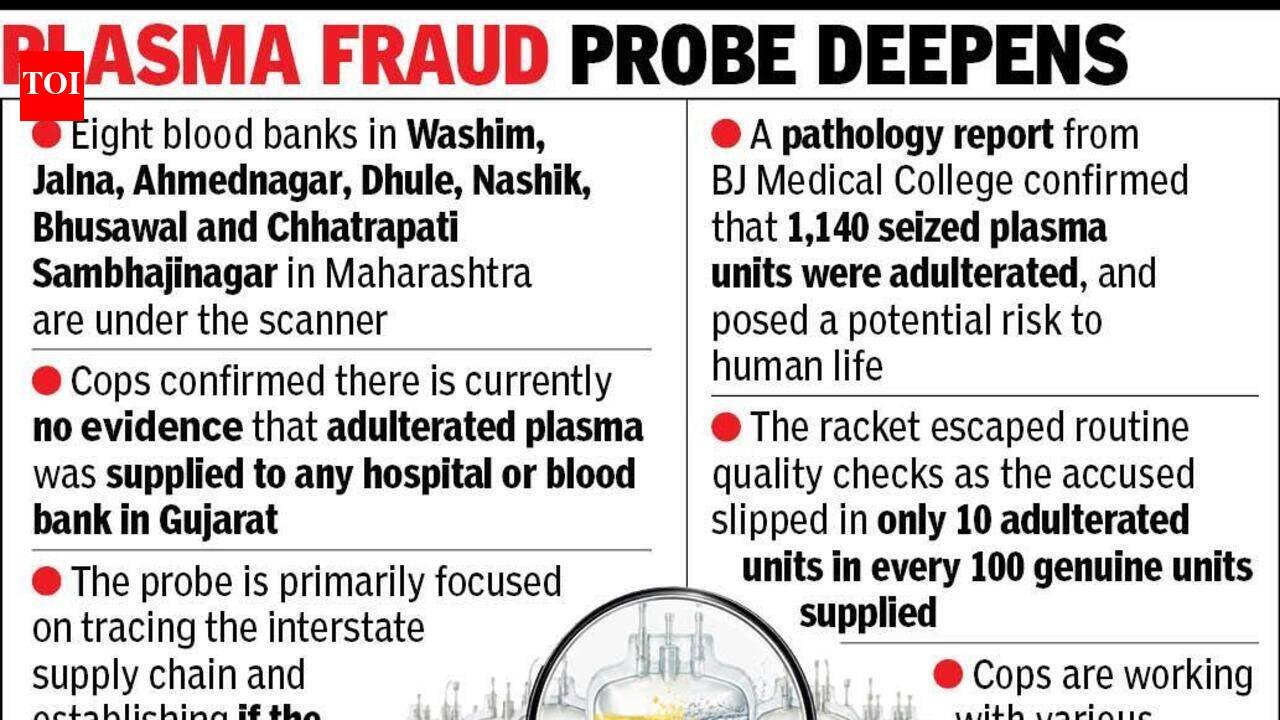
Ahmedabad: Eight Maharashtra blood banks are now under the scanner in the spurious plasma racket. Adulterated plasma has the potential to cause serious health complications among vulnerable patient groups. While there is no evidence so far that the adulterated plasma was supplied to any hospital or blood bank in Gujarat, Ahmedabad Rural police are digging further to probe a possible interstate network that the accused allegedly used to divert genuine plasma and circulate adulterated stock. Police officers said the suspected role of blood banks in Washim, Jalna, Ahmednagar, Dhule, Nashik, Bhusawal and Chhatrapati Sambhajinagar is being examined to determine whether their operators knowingly facilitated the movement of plasma or were unaware of the alleged fraud.The development comes after a BJ Medical College pathology report found that the 1,140 units seized from the house of the alleged kingpin, Dinesh Chaudhary, were adulterated and unfit to be used for treatment. According to police officers, the report concluded that the seized plasma failed to meet food and drugs standards, was of very poor quality and posed a potential risk to human life. The seized stock will now be destroyed according to the prescribed procedure. Transfusion of adulterated plasma can seriously compromise patient care or prove fatal by introducing pathogens directly into the bloodstream, which could lead to treatment failure, trigger severe immune-mediated reactions or cause life-threatening infections.Officers said whenever high-quality plasma units reached Chaudhary, he allegedly removed a portion and replaced the extracted quantity with saline water to maintain the original volume. The genuine plasma siphoned off from these units was then allegedly routed through blood banks in Maharashtra and supplied to pharmaceutical companies. The adulterated units, meanwhile, were dispatched to fulfil existing orders.The latest findings build on the investigation’s earlier revelation that the accused followed a fixed adulteration formula. Police had said the accused mixed around 150ml of saline water with about 100ml of expired plasma to prepare adulterated units, earning an estimated Rs 1,200 to Rs 1,500 on each unit. Officers believe only around 10 out of every 100 plasma units supplied were tampered with, allowing the operation to escape routine quality checks.The probe is also examining whether regulatory gaps in the functioning of blood banks, plasma procurement and transactions between blood banks and pharmaceutical companies were exploited. The investigation is being carried out with the Food and Drugs Control Administration-Gujarat, the Gujarat State Council for Blood Transfusion and the state health department to identify procedural loopholes and recommend safeguards.
