


An enriching evening celebrating the intersection of dance, history, archaeology and scholarship unfolded at the India International Centre (IIC), New Delhi, on Saturday, July 25, 2026, with the presentation of Kathak exponent Dr Shovana Narayan’s latest book, Speaking Sculptures: Karanas in Kathak, published by Shubhi Publications.The programme, held at the C.D. Deshmukh Auditorium, brought together eminent scholars, cultural administrators, dancers and lovers of the arts for a thought-provoking exploration of the historical roots of Kathak through India’s sculptural heritage.
Shovana Narayan and Dr Sandhya Purecha
The event was graced by Dr Sandhya Purecha (Chairperson, Sangeet Natak Akademi), Dr Sachchidanand Joshi (Member-Secretary, IGNCA), Dr Bharat Gupt (Vice Chairman, National School of Drama, Trustee and Executive Member, IGNCA) and Dr. Usha M. Munshi (Chief Librarian, India International Centre), who shared their perspectives on the significance of the publication and its contribution to Indian dance scholarship.
Sanjay Arya, founder of Shubhi Publications, Dr. Bharat Gupt and Dr Sachchidanand Joshi
The evening commenced with a rendition and presentation of the book, followed by an engaging panel discussion that explored the relationship between sculptural depictions of the karanas and the living tradition of Kathak. The discussion highlighted how the book draws upon archaeological evidence, the Nāṭyaśāstra and the guru-śiṣya tradition to revisit long-held assumptions about the origins and evolution of Kathak.Speaking on the occasion, Guru Dr Shovana Narayan said, “This work is an attempt to bring together the evidence preserved in sculptures, the descriptions in the Nāṭyaśāstra and the living tradition of Kathak. My hope is that it encourages meaningful dialogue between archaeology, textual studies and performance traditions, allowing these sculptures to continue speaking to contemporary audiences.”
Sunit Tandon, Sanjoy K. Roy & Leela Venkataraman
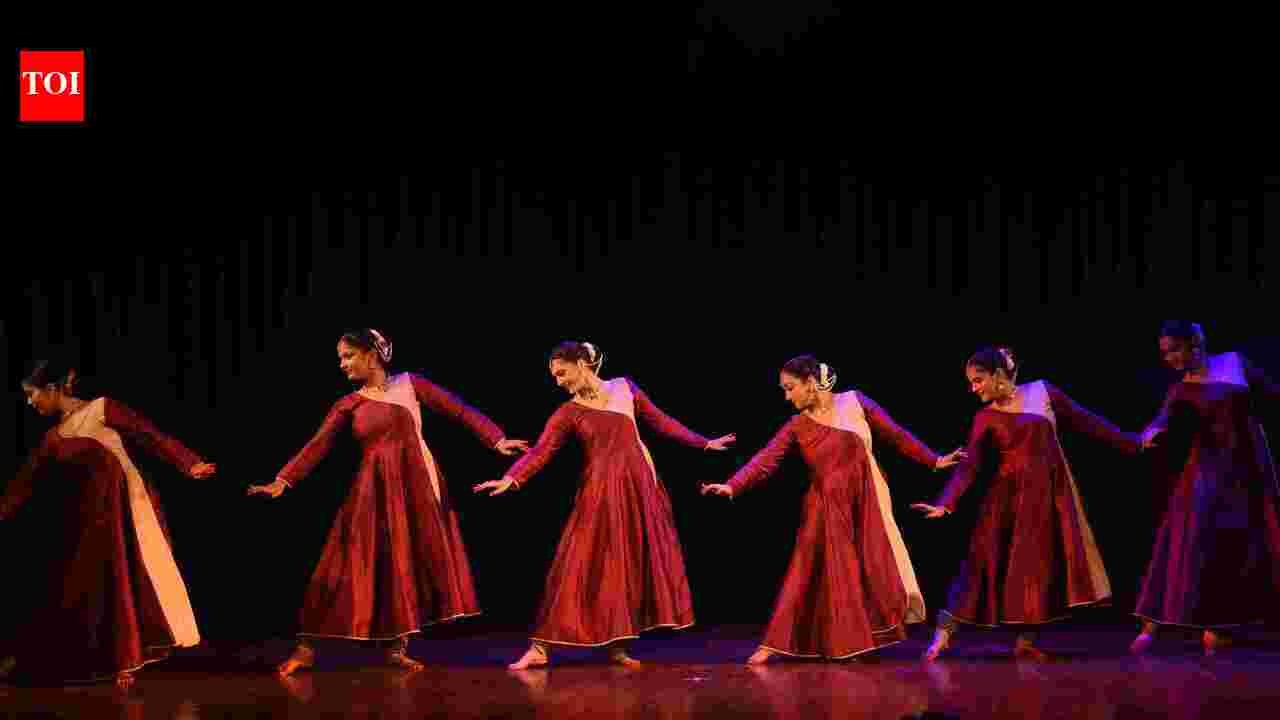
Speaking Sculptures: Karanas in Kathak examines sculptural evidence from the Indo-Gangetic and Vindhyan regions spanning the Indus Valley Civilisation through the Mauryan, Śuṅga, Gupta and later periods up to the seventeenth century. By correlating sculptural depictions with descriptions in the Nāṭyaśāstra and contemporary Kathak practice, the book presents a compelling argument that Kathak represents a continuous expression of India’s classical dance tradition rather than a form that emerged only during the medieval period.The publication also explores costume traditions, musical accompaniment and movement vocabulary through sculptural evidence, demonstrating remarkable continuity between ancient artistic representations and present-day Kathak.A major highlight of the evening was a captivating dance presentation by the disciples of Guru Dr Shovana Narayan, who brought several karanas to life through Kathak. The performance beautifully demonstrated the integration of their Sanskrit nomenclature with Kathak’s rhythmic and movement vocabulary, enabling the audience to experience the theoretical concepts discussed in the book through performance.
