



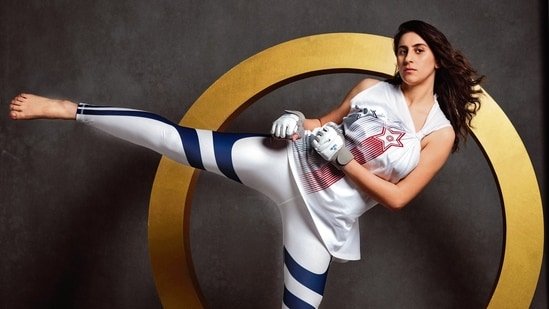
“As a 14-year-old, I was kicking away my worries for hours every day,” says Marzieh Hamidi. “I forgot the world when I was at the gym.”
At 23, the Afghani-Iranian taekwondo champion and women’s rights advocate has turned the sport into a lifeline, a way to process discrimination, exile, death threats and her quest for freedom.
Two weeks ago, she was awarded the International Women’s Rights Award by the Geneva Summit for Human Rights and Democracy. Hamidi dedicated it to the women of Afghanistan and the protesters in Iran. She has lived on both sides of that border.
Hamidi’s parents fled Afghanistan in 2000, to escape the Taliban regime, and sought refuge across the border in Iran. Marzieh was born there in November 2002, but grew up “feeling like an outsider, like someone who could never belong in Iran,” she says.
Amid bullying at school followed by restricted access to colleges, because of her complicated citizenship status, home offered solace. Her father found work in the security department of a factory; her mother was a homemaker. Together, they kept their four children’s spirits up with card games, board games, and movies.
It was through cinema, in fact, that Hamidi discovered the world of women’s sport.
Bollywood movies such as Mary Kom (2014), the biopic of the Olympic medal-winning Indian boxer, and Mardaani (2014), about a woman inspector with the Mumbai police opened her eyes to what was possible, she says. The documentary series The Last Dance (2020) about basketball legend Michael Jordan, and the Afghani film Osama (2003), about the struggles of a girl in Taliban-ruled Afghanistan, shaped her worldview.
She was 14 when she first tried taekwondo. “I had played other sports, like volleyball, but from the first day, it felt like this sport was just meant for me,” she says.
As she immersed herself in the Korean martial art, practising for hours every day, it became clear that she had real talent, and for the first time, she says, she felt a sense of purpose and belonging. Her coach, Fatimah Kheiri, provided crucial encouragement, reminding her that she had a special ability and pushing her to excel.
***
As she racked up wins locally, her family decided to return to Afghanistan, to give her a chance to join a national team. She was still not a citizen in Iran, so a move back home was the only way she could compete at this level.
The Hamidis settled in Kabul and the 16-year-old thrived for a while, clinching five golds at national tournaments between 2019 and 2021. Then, in August 2021, the Taliban reclaimed power.
“Everything changed again,” Hamidi says.
Her sport became forbidden and her victories, criminalised. She went from being a champion to a dissident. As she walked in public protests and took to social media to protest against the rescinding of women’s rights, men believed to be Taliban supporters began to visit her family home, asking questions about her. Her family moved houses, but it was no use. Her sport was out of reach again.
Three months into the new Taliban regime, the Hamidis fled, via Doha, to France.
They settled in the suburb of Vincennes near Paris. Marzieh, now 18, joined a local taekwondo club. But she wasn’t winning. And with each bout she lost, she lost a little more confidence.
***
From a talented athlete to a refugee again, “I hated being seen like that,” Hamidi says.
Long chats with Kheiri helped her regain her sense of who she was in her sport.
Finally, nearly a year after she arrived in France, “I decided that I have to fight for myself,” Hamidi says. It wasn’t a big match; just a local bout in Paris. But she entered determined to win, and she did. “The confidence to win came back like it was always there,” she says, smiling.
By December 2022, she had won bronze at a national championship in France, and was making news. She began training with the national team at a residential facility in Paris. In 2023, she competed as part of the Refugee Team at the World Taekwondo Championships in Baku.
The threats to her life continue. Hundreds of explicit messages from Taliban sympathisers, warning of rape and murder, flooded her inbox last year, after she criticised the Afghan men’s cricket team for not standing up for the country’s women. The threats led to an ongoing police investigation in France, and she has been granted police protection.
Hamidi says she prefers to focus on her own targets. Her new coach, the Portuguese-French Pedro Barroso, helps her with support and advice. “I am lucky to have him,” she says.
Their sights are set on the 2027 World Taekwondo Championships in Kazakhstan, and then the 2028 Los Angeles Olympics.
***
The Swiss award comes in recognition of her fight as a refugee marginalised at home and abroad, and her determination to use her fists and her voice to right misconceptions about what Afghani women can and should do.
Part of the speaking up has included a biography, Ils N’Auront Pas Mon Silence (They Will Not Have My Silence; 2025), co-authored in French with her manager, Baptiste Bérard-Proust. “My book is about the struggle and the journey. It is about experiences that I feel will connect with other women around the world who are fighting too,” Hamidi says. “But it is not just about my struggle. It is also about reclaiming my strength.”


