



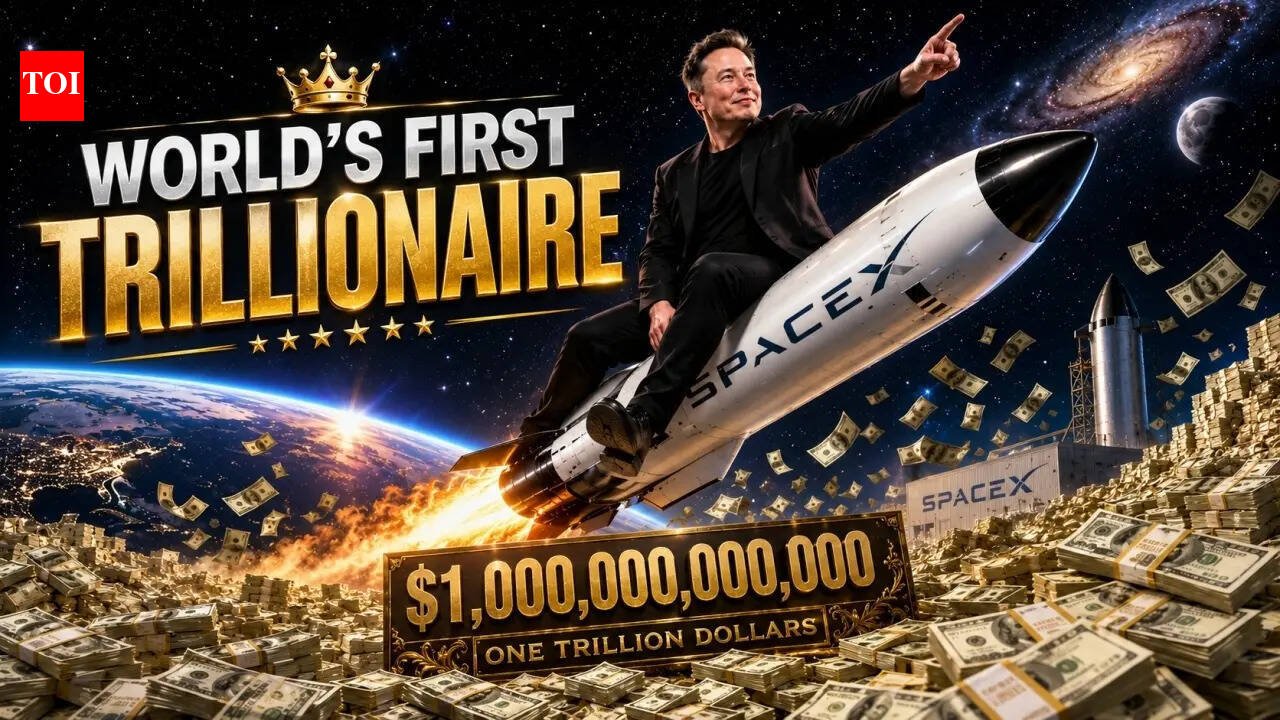
Who wants to be a millionaire? Several years ago an American show highlighted people’s aspiration of reaching the 7-digit figure. Almost three decades later, the world has got its first trillionaire – Elon Musk. A figure that has not seven, or eight – but thirteen digits! To put it simply, instead of one million, the world’s richest man has a net worth of a million millions!Elon Musk has reached this status riding on the listing of SpaceX, which started trading on Nasdaq with a valuation of around $1.96 trillion. Elon Musk’s SpaceXnow listed on the Nasdaq exchange at $150, and its ticker is SPCX.In fact, Musk’s net worth can be arrived at by combining the wealth of the world’s next four richest individuals – Alphabet co-founders Larry Page and Sergey Brin, Amazon founder and executive chairman Jeff Bezos, and Oracle founder Larry Ellison.According to Oxfam, crossing the $1 trillion threshold means Musk added more than $550 billion to his wealth in just one year, a pace that translates to well over $1 million every minute on average.
SpaceX IPO bags Musk the trillionaire status
SpaceX is the aerospace, satellite communications and artificial intelligence company that, alongside Tesla, forms the backbone of Elon Musk’s business empire. On Thursday it completed a record-breaking $75 billion initial public offering (IPO). SpaceX, the rocket company of which Starlink is a part, has plans that include building a self-sustaining settlement on Mars. It also hopes to deploy big orbital data centres and compete with artificial intelligence leaders such as Anthropic and OpenAI in the race to commercialise AI technologies.
SpaceX businesses include aerospace, satellite communication, commercial rocket launch services and space technology. These sectors are beyond the traditional tech space like manufacturing, pharmaceuticals, engineering, and hence the IPO has seen elevated interest amongst retail and institutional investors.Ahead of the listing, Elon Musk shared how he was himself doubtful about the success of the company when it was founded in 2002. “It is certainly hard to believe that a little company that started in a warehouse in El Segundo is now the largest IPO ever. I gave SpaceX less than a 10% chance of succeeding at all, to be clear. In fact, I told people, look, we’re probably gonna fail, but you know, we should give it a try,” he said.Elon Musk is known for pushing tech boundaries, thinking the unthinkable, and in some parts even missing on his timelines. Ahead of the listing, Forbes had estimated his net worth to be $982.6 billion.“SpaceX wants to be able to take you to the moon, take you to Mars, and ultimately beyond,” Musk said at the launch event in Starbase, Texas. “I’m confident at this point that with the incredible team that we have here at SpaceX, that we will do that for you,” Musk added.
The road to being a trillionaire
Elon Musk started his entrepreneurial journey with the sale of Zip2 and eventually PayPal – two things that generated around $200 million for him! That capital was divided by spending into SpaceX and Tesla. Beating odds, he built a rocket company that has ventured into reusing rockets and with Tesla electric vehicles have started becoming mainstream.Elon Musk’s net worth is tied mainly to these two companies – SpaceX and Tesla. Company stock and performance-linked rewards make up most of his net worth rather than actual cash gains. So on paper, Musk has become a trillionaire, not in cash terms. Recently Tesla approved a pay package of a trillion dollars based on him achieving several milestones for the carmaker.
Investors have also occasionally expressed concerns over his clashes with regulators, his involvement across multiple businesses and, more recently, his role within the Trump administration.Yet, Tesla’s share-price performance has overshadowed many of those concerns. Since its market debut in 2010, Tesla has generated returns of roughly 20,000% for shareholders, creating more than $1.2 trillion in investor wealth.Tesla has emerged as a transformative force in the automotive sector. And many investors believe that Musk can replicate Tesla’s success in other fields, particularly space technology and artificial intelligence. According to Forbes, that performance helped lift Musk’s fortune to about $795 billion even before the SpaceX IPO.
Can Musk sustain it?
It’s important to note that a big portion of Musk’s net worth is tied to SpaceX. His holding in the company is worth around $866 billion. According to Reuters calculations, Musk’s net worth adds up to over a trillion dollars after the listing of Space X – adding the value of his shares in Tesla and some other ventures. This estimate also factors in stock-based compensation that will vest over time.Since Musk’s fortunes are linked to Tesla and SpaceX, the performance of these companies, and therefore their stocks will determine the road ahead to the richest man’s net worth.SpaceX continues to require significant capital. A large share of its valuation is linked to projects and technologies that could take several years, or even decades, to generate any meaningful commercial returns.Pursuing objectives requires capital well beyond what SpaceX currently generates from its launch and satellite operations. Between January 2025 and March 31, 2026, the company recorded losses of $8.7 billion.
Niteen Dongare, Director & CEO, Anand Rathi International Ventures IFSC Pvt Ltd says heavy investments in both companies will be required to reap gains.SpaceX’s revenue of around $19 billion in 2025 and the net loss of $5 billion last year doesn’t justify the higher valuation of SpaceX, Dongare tells TOI.“This industry is capital intensive hence to maintain the trillionaire tag Musk will have to infuse money for continued growth in SpaceX and Starlink business that generated revenue from satellite internet service. Tesla on the other hand will have to expand its leadership in AI driven mobility that may require more capital in the long run” he says.“A correction in technology and AI stocks, competition in the EV market can bring his trillionaire tag down. Sustaining the trillionaire tag would need good numbers across all the business ventures that he is into. A mere 10-20% decline in valuation of his major stakes could get him down below the trillionaire tag,” he adds.
Valuation concerns for SpaceX
Ahead of the listing, global brokerages and experts have raised concerns about SpaceX’s valuation. Despite overwhelming investor demand and a planned $75 billion fundraising that would value SpaceX at about $1.77 trillion, several market experts have questioned whether the pricing is justified.In fact, valuation expert Aswath Damodaran actually estimates the company’s equity value at around $1.3 trillion, which is nearly $500 billion below the IPO valuation. He argues that SpaceX’s assumptions around the size of the artificial intelligence market are overly optimistic.Damodaran, who is often referred to as Wall Street’s ‘Dean of Valuation’, believes the company is assigning an exceptionally large opportunity to its AI business, particularly xAI.While SpaceX projects a total addressable market of nearly $28 trillion, he pegs the long-term AI opportunity closer to $3-4 trillion and expects margins to be lower due to rising competition and the high cost of AI infrastructure.“At the rumored pricing of $1.8 trillion for the company, it is too richly priced for my tastes, given my valuation of $1.25-$1.35 trillion for the equity in the company. That does not mean that I will never buy the stock, since the market does change its mind, and if the price does drop by enough, my decision would change accordingly,” he says.
Jefferies strategist Chris Wood has raised concerns about Nasdaq rule changes that could accelerate SpaceX’s inclusion in the Nasdaq-100 Index just 15 trading days after listing. He argues that this could force passive funds to buy large quantities of the stock, artificially boosting demand. “Such fast-tracking of new listings into indices has never happened before in America, so far as GREED & fear is aware,” Wood wrote.But, one cannot ignore that the phenomenal response to the SpaceX IPO at this juncture is also significant since the market is riding on the AI and semiconductor wave. Fellow companies like Open AI and Anthropic are also coming out with their mega IPOs targeting trillion valuations, indicating a demand for AI-linked stocks and the market’s optimistic outlook about it. Despite losses, investor demand has remained exceptionally strong. Institutional funds and retail investors alike have shown a willingness to back the company, supporting a $75 billion fundraising through the sale of 555.6 million shares. Some attribute that to a factor they call ‘Elon premium’ – seen as stemming from investor confidence in Musk’s long-term vision and ability to execute ambitious ideas.Oppenheimer became the first major brokerage to initiate coverage of SpaceX ahead of its listing.The firm assigned an “outperform” rating to the stock and set a target price of $190 per share, which is a potential gain of around 41% from the IPO price of $135.Based on that target, Oppenheimer believes SpaceX’s market value could rise to roughly $2.5 trillion over the next 12 to 18 months.Interestingly, both Wood and Damodaran remain positive on SpaceX’s core businesses, particularly Starlink, which has more than doubled its subscriber base to over 10 million users and is viewed as the company’s strongest near-term earnings driver.As Damodaran concludes: No matter what your views are about the SpaceX IPO, positive or negative, there is no denying that this company is a loaded bet on the AI and Elon Musk, and while that may concern some, there are others who will look at Musk’s track record with Tesla and feel the odds are in their favor.(Disclaimer: Recommendations and views on the stock market, other asset classes or personal finance management tips given by experts are their own. These opinions do not represent the views of The Times of India.)


