






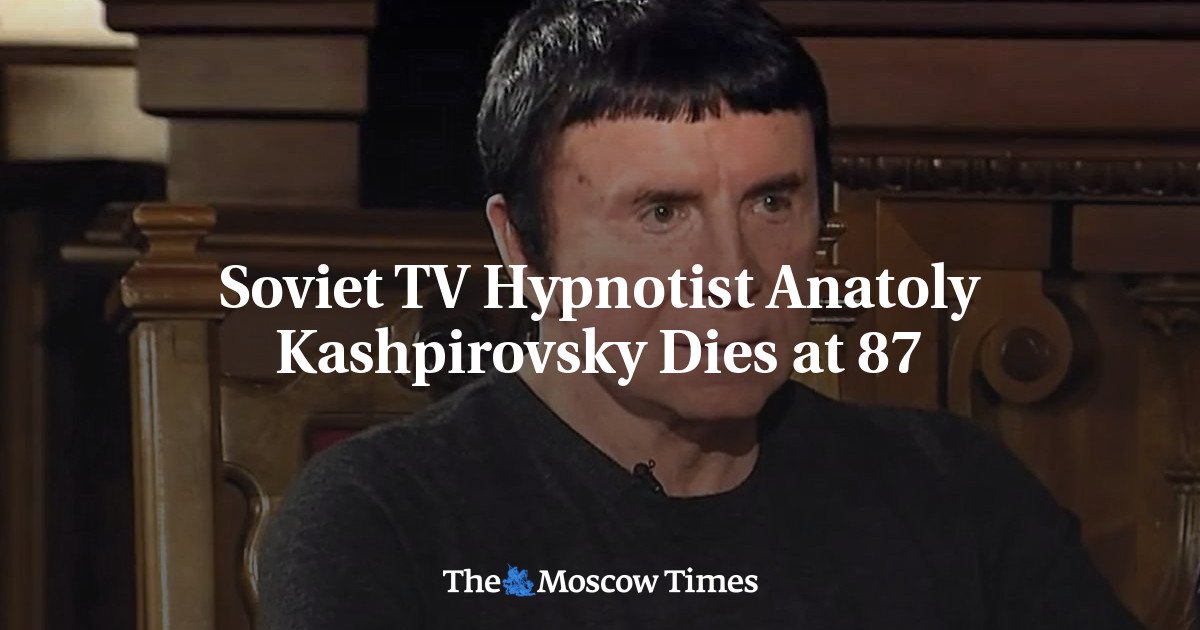
Anatoly Kashpirovsky, the Soviet-era hypnotist whose televised “healing sessions” drew enormous audiences in the late 1980s, died on Saturday in Moscow at the age of 87.
“Anatoly Mikhailovich passed away from advanced cancer that had spread to his lungs and brain,” Kashpirovsky’s nephew Yury Mamayev told state media.
“There was multiple organ failure, meaning that the affected organs simply stopped functioning as a result of the cancer,” the TASS news agency quoted Mamayev as saying.
A representative said earlier that Kashpirovsky suffered “sudden” cardiac arrest following a sharp drop in blood pressure.
Born in Soviet Ukraine in 1939, Kashpirovsky graduated from the Vinnitsa Medical Institute in 1962 and spent 25 years working as a psychiatrist in a regional psychiatric hospital.
He became a household name in the 1980s as public interest in the occult grew across the country during Soviet leader Mikhail Gorbachev’s perestroika reforms.
Soviet Central Television started airing his six-part program, “Health Sessions of Psychotherapist Anatoly Kashpirovsky,” in October 1989. Its audience was estimated at more than 200 million people.
Following the Soviet collapse, Kashpirovsky entered politics, winning a seat in Russia’s first State Duma in 1993 on the nationalist Liberal Democratic Party (LDPR)’s ticket.
In June 1995, he took part in negotiations during the Budyonnovsk hospital hostage crisis, convincing Chechen rebel warlord Shamil Basayev to release some of the 1,500 hostages but failing to persuade him to surrender.
Later in life, Kashpirovsky clashed with health regulators over allegations that he was practicing folk medicine illegally. While the Russian Academy of Sciences dismissed his methods as “absolute pseudoscience,” Kashpirovsky defended his medical credentials and won multiple defamation lawsuits.
He maintained a loyal following, touring and hosting “healing sessions” on YouTube until March this year.
His funeral will be held on Thursday, Oct. 8, at Moscow’s Troyekurovskoye Cemetery, on the anniversary of his six-part television program’s premiere.
A Message from The Moscow Times:
Dear readers,
We are facing unprecedented challenges. Russia’s Prosecutor General’s Office has designated The Moscow Times as an “undesirable” organization, criminalizing our work and putting our staff at risk of prosecution. This follows our earlier unjust labeling as a “foreign agent.”
These actions are direct attempts to silence independent journalism in Russia. The authorities claim our work “discredits the decisions of the Russian leadership.” We see things differently: we strive to provide accurate, unbiased reporting on Russia.
We, the journalists of The Moscow Times, refuse to be silenced. But to continue our work, we need your help.
Your support, no matter how small, makes a world of difference. If you can, please support us monthly starting from just $2. It’s quick to set up, and every contribution makes a significant impact.
By supporting The Moscow Times, you’re defending open, independent journalism in the face of repression. Thank you for standing with us.
Continue
Not ready to support today?
Remind me later.
×
Remind me next month
Thank you! Your reminder is set.


