



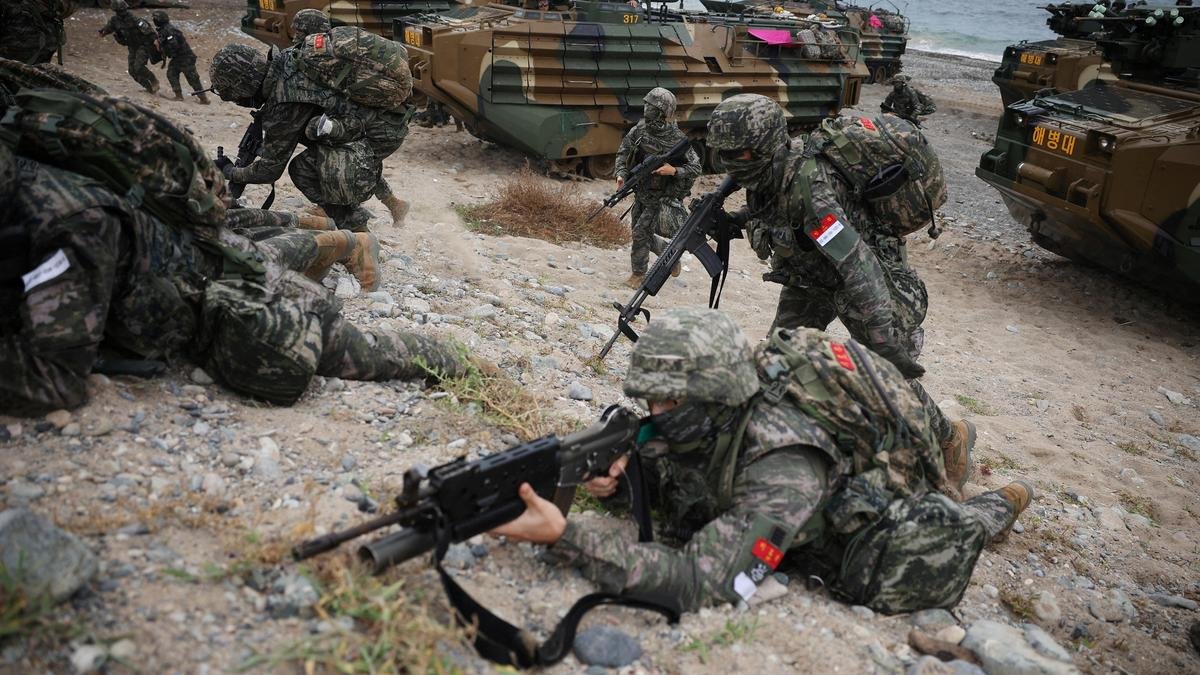
South Korea’s Marines take part in U.S. and South Korea’s marine corps combined amphibious landing drill called the ‘Ssangyong’ exercise, in Pohang, South Korea. File
| Photo Credit: Reuters
South Korea said on Monday (August 24, 2026) that the United States had cancelled a large joint amphibious landing exercise scheduled for next month due to constraints on force availability caused by the war with Iran.
The biennial Ssangyong drills involve marine forces from South Korea and the United States and are designed to strengthen combined operations, typically involving warships, aircraft and ground forces rehearsing amphibious landings.
The cancellation follows U.S. President Donald Trump’s order last week to scale down the separate annual Ulchi Freedom Shield exercises, cutting the joint drills from 11 days to five.
Mr. Trump at the time cited their high cost and said they sent an “inappropriate and hostile” signal to North Korea, while highlighting his relationship with its leader, Kim Jong Un.
“The U.S. Marine Corps formally notified our forces in June that its ability to deploy forces during this year’s Ssangyong exercise would be constrained due to the situation in the Middle East,” Han Seung-jeon, a spokesman for the South Korean Marine Corps, told reporters at a news briefing.
Seoul and Washington were continuing consultations on resuming the amphibious exercise, he said, without giving details.
The Pentagon did not immediately respond to a request for comment on Seoul’s announcement.
Mr. Trump’s order last week to scale back the Ulchi Freedom Shield exercise came as he seeks to revive the relationship he developed with Kim during his first term.
The U.S. President said Wednesday (August 19, 2026) that it was important to “get along” with Mr. Kim, adding that Pyongyang now had 57 “very powerful” nuclear weapons.
Seoul estimates that North Korea has around 80 to 120 such weapons.
Mr. Trump and Mr. Kim met three times during Mr. Trump’s first term, but Pyongyang accelerated its nuclear programmes after their second 2019 summit in Hanoi collapsed without an agreement on North Korea’s denuclearisation.
Published – August 24, 2026 10:31 pm IST


