



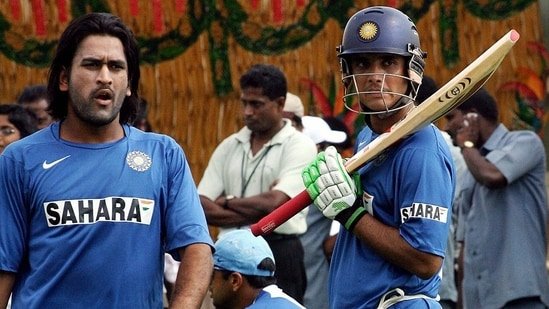
Sourav Ganguly has revealed how MS Dhoni was identified and pushed quickly through the system long before he became one of Indian cricket’s greatest captains, explaining the selection philosophy that backed raw match-winning talent over slow grooming.
Dhoni’s international career did not begin with certainty. He made his ODI debut under Ganguly against Bangladesh in Chattogram in December 2004, lasting just one ball before being run out for a duck. For many players, that could have triggered doubt. It did not in Dhoni’s case.
Months later, Ganguly made one of the defining calls of his captaincy, promoting Dhoni to No. 3 against Pakistan in Visakhapatnam. Dhoni responded with 148 off 123 balls, an innings that changed the trajectory of Indian cricket.
Ganguly explains the Dhoni call
Speaking on Raj Shamani’s podcast, Sourav Ganguly said Dhoni had already caught attention well before his India debut.
“We watch full matches. When Dhoni used to play, I had gone to Jamshedpur to watch him. He did not even know,” Ganguly said.
The former India captain revealed that former selector and wicketkeeper Saba Karim played a role in flagging Dhoni’s name. “Saba Karim told me, ‘He hits a lot of sixes.’ So we picked him straight from there for India A. He played his first match at Wankhede Stadium in my team. He made a hundred and was hitting sixes to the roof,” Ganguly said.
That performance appears to have removed hesitation. “We had to take him. Whoever is good has to be fast-tracked. You cannot leave him. If you keep cooking him slowly from behind, he will finish,” Ganguly said.
The quote offers a direct insight into how Ganguly viewed talent management during his captaincy years. India was transitioning at the time. Established stars occupied key batting roles, competition was fierce, and opportunities for newcomers were limited. Yet Ganguly repeatedly pushed aggressive young talent into big roles, whether it was Yuvraj Singh, Harbhajan Singh, Virender Sehwag or Dhoni.
He also explained the cricketing logic behind that aggressive promotion model. “This is the system. If you play with people above your level, your game will rise. If you play below, your game will go down,” he said.
He also revealed that after Dhoni was selected for the team, he stalled the final call. Sourav Ganguly explained, “I had to see him before taking the final call. So, stalled that decision for a few days.”
That philosophy was visible in the Pakistan ODI in Visakhapatnam. Rather than keeping Dhoni in a lower-order holding role, Ganguly sent him into a high-pressure batting slot against a major rival. Dhoni tore through Pakistan with 15 fours and four sixes, turning potential into certainty in a single innings.
MS Dhoni would later become India’s World Cup-winning captain, a multiple ICC trophy winner and one of the most influential figures in white-ball cricket. But Ganguly’s recollection makes one thing clear: the rise did not begin with trophies or captaincy. It began with selectors watching full matches, a trip to Jamshedpur, a recommendation from Saba Karim, and a captain willing to trust explosive talent before the rest of the system fully caught up.
And we all remember that scene from MS Dhoni, the Untold Story, “Dhoni ko try karte hain”.


