



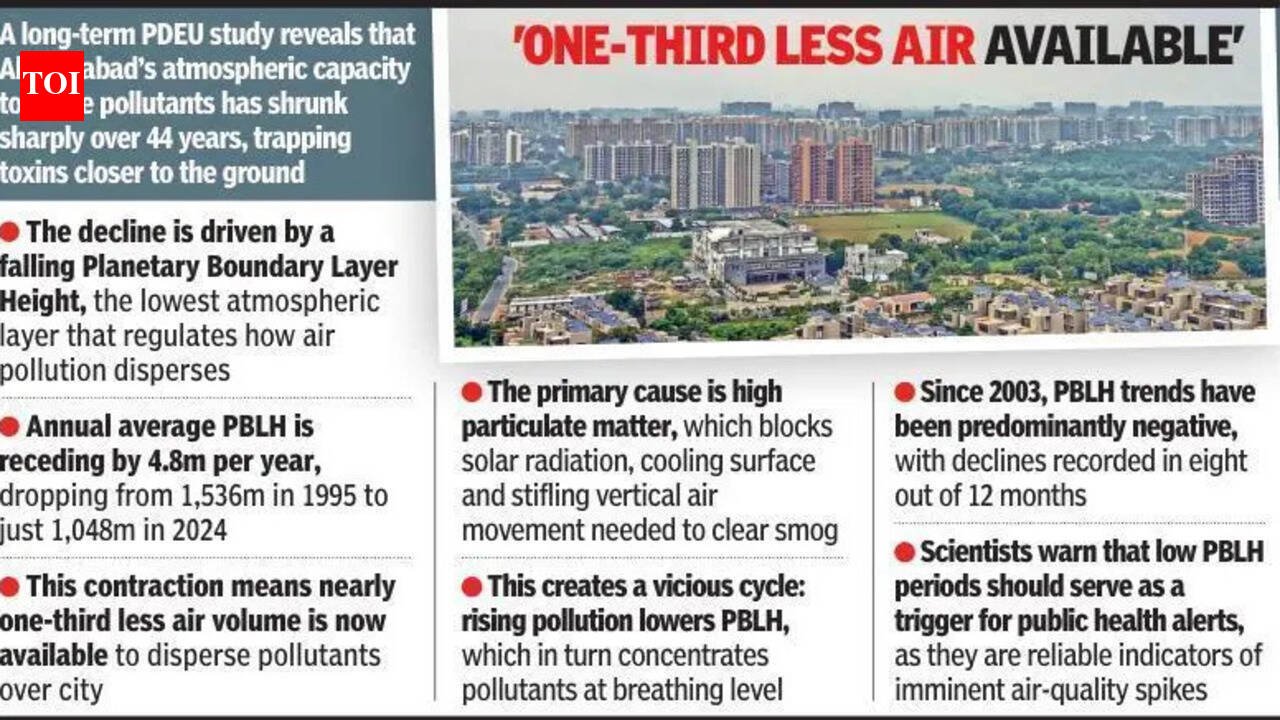
Ahmedabad: Mornings in Ahmedabad are no longer just about fresh air and bright sunlight. From western areas like SG Highway, Shela, and Jodhpur to Shah Alam and Bapunagar in the east, residents across multiple neighbourhoods say they are waking up to a mix of rotting organic stench and sharp chemical odours. For some, it smells like decay. For few, it is unmistakably industrial. But all agree that the air is making them sick.Nimish Kapadia, a high court lawyer who lives near Shyamal Crossroads, has filed a formal complaint with the Gujarat Pollution Control Board (GPCB). In his submission, he described a “dead odour that hangs in the air three to four mornings a week” and invited the authorities to “experience and breathe the polluted air” first hand for seven consecutive days.Residents say the problem has worsened over time. Kapadia claims he spends Rs 3,000 every six months refilling his air conditioner’s gas, alleging that the polluted air damages the system. Siddharth Lakhani, a resident of Orchid Legacy in Shela, said the stench intensifies late at night and early in the morning, roughly between 11pm and 7am. Despite the discomfort, he added, “many people have learned to live with it”. Anurag Kandya, an associate professor with the department of civil engineering at PDEU’s school of technology, said the Pirana landfill could be a major contributor as anaerobic decomposition doubles or triples during peak summers. “Hydrogen sulphide, a gas released during such processes, produces a strong rotten egg-like smell,” he explains.Riyaz Hussain, a 44-year-old resident near P&T colony of Shah Alam Darwaza, described what he believes is another source: industrial emissions released at night. He said air conditioners in his area now last barely three years, down from six earlier. He also describes a nightly ritual: industrial units releasing “smoke” at 3 or 4am when residents are asleep. “You become restless as the air becomes suffocating,” says Hussain. He also reported fine black particles settling on surfaces, adding to residents’ discomfort.On SG Highway, residents say the smell is “distinctly chemical”. Nihar Patel from Shantigram said, “If you leave your towel outside to dry in the evening, it absorbs the foul odour overnight.” He adds that the smell now persists year-round — no longer confined to winter. Jigar Patel of Aarohi Bungalows in Jodhpur distinguishes the landfill’s largely odourless methane from what he says is a “pungent, unmistakably chemical” smell released from factories in Vatva, Narol, and Changodar. He believes the odour is being carried into residential areas by shifting wind patterns. Timing appears to play a role. Several residents say the smell peaks between 4am and 6am and again in the evening, coinciding with sunrise and sunset when wind speeds fluctuate. Experts explain that at sunrise and sunset, atmospheric conditions trap pollutants closer to the ground. “The moment the mixing height reduces, the gas is trapped at the bottom,” says Kandya. A PDEU study had tracked changes in Ahmedabad’s planetary boundary layer height (PBLH) — the lowest part of the atmosphere that allows pollutants to disperse — over four decades using NASA satellite data. The researchers found a steady decline in this mixing layer, meaning the city now has significantly less air to dilute emissions.


