


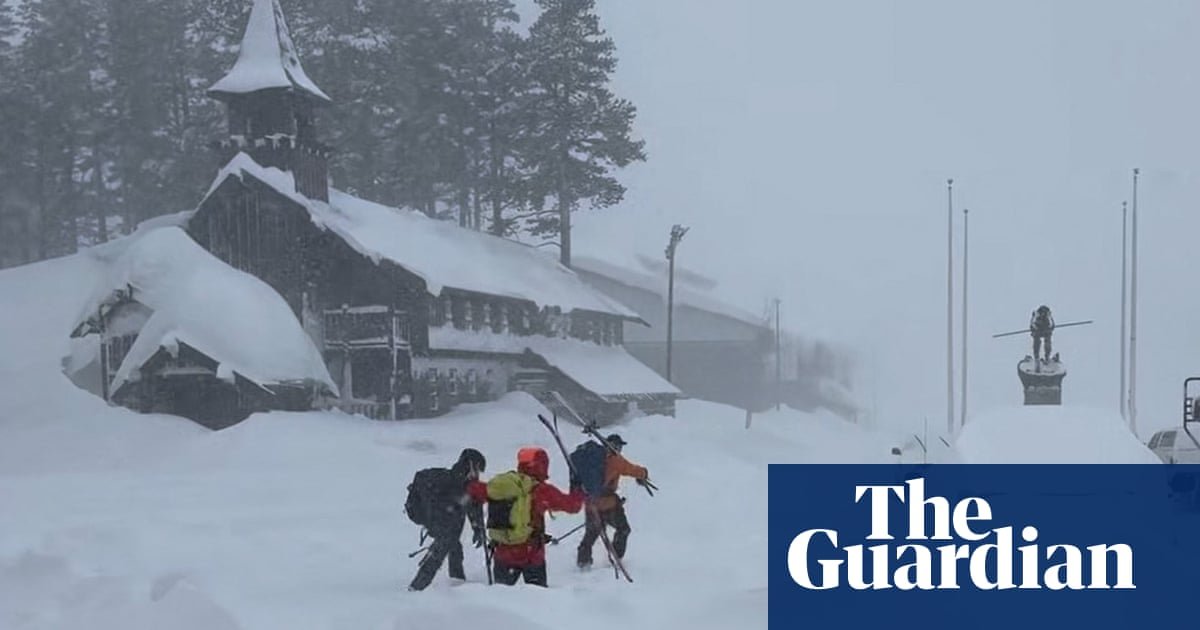
Six skiers have been found after a group of 16 went missing this morning as heavy snowfall blanketed California, prompting avalanche warnings in the Sierra Nevada mountains, closing coastal roads and causing flooding in Los Angeles.
The 10 remaining skiers are still missing, according to the sheriff’s office in Nevada county, California. The group was in the Castle Peak area, where an avalanche was reported around 11.30am.
“People go out and use the backcountry at all times,” Capt Russell Greene of the sheriff’s office told KCRA in an interview, saying his office was notified of the missing skiers by the tour company after the avalanche. “We advise against it, honestly, but I wouldn’t say that it’s uncommon, not that it was a wise choice.”
The University of California Berkeley’s Central Sierra Snow Lab, near Donner Pass, reported 28in of snow on Tuesday, with another 3ft expected in the next two days. I-80 is closed from Colfax to the Nevada state line due to snow.
The Sierra Avalanche Center issued an avalanche warning for the Central Sierra Nevadas through 4am on Wednesday. In a statement it said: “A widespread natural avalanche cycle is expected over the next 24 hours.”
Two Pacific storms are expected to bring more than 3ft of snow to the Sierra Nevadas and heavy rainfall to lower elevation parts of the state, including Los Angeles and San Diego, where flooding could occur in recent burn scars.
The National Weather Service predicts “multi-day, very heavy snow totals of more than a foot” through the southern Cascades down to southern California and east into the Rockies. The heaviest snowfall is predicted in the Sierras.
Heavy snowfall of up to 3-5ft was predicted for locations above 6,000ft elevation, with snowfall up to 7ft expected at higher elevations, according to the National Weather Service Hanford office’s winter storm warning for regions near Yosemite national park. The warning was in effect until 10pm local time on Thursday.
Some Lake Tahoe area ski resorts had already announced closures, while others warned skiers to check road conditions before heading up the mountain. All lifts at Palisades and Alpine closed at about 12pm on Tuesday “due to conditions, visibility, and wind”.
Yosemite national park remains open, with tire chain requirements and road closure warnings, although visitors hoping to see February’s Firefall at Horsetail Fall may be disappointed. The fleeting moment when the waterfall blazes golden in the rays of the setting sun will probably be obscured by weather conditions.
“Horsetail Fall is very unlikely to be illuminated at sunset due to the cloudy conditions for the next several days and possibly through the weekend,” the park said in a social media post. “Due to weather, the pedestrian route on the road to the viewing area has been taken down.”
Stanford University closed for about two hours, following a power outage. In a statement, the university said: “One of the main PG&E transmission lines feeding the campus is reportedly impacted, causing the outage.” According to the university’s website, the outage began around 9.16am local time, and campus had reopened by 11.39am.
Further south, sections of Highway 1 remained closed after Caltrans shut down a 45-mile stretch of the coastal highway on Monday following a landslide. The road is still closed in two sections: from 2.3 miles north of Lucia to 16.3 miles south of Big Sur, and from 1.8 miles north of the junction of Route 135 and Soloman Road to 7.4 miles south of Guadalupe at Black Road.
Caltrans had reopened a section of the highway just weeks earlier, after three years of repairs caused by a landslide due to heavy rains.
In southern California, the National Weather Service Los Angeles/Oxnard office said heavy snow was “possible” along the I-5 and I-14 corridors, with wind gusts “up to 60 to 70mph possible”.
Flood watches were in effect in Los Angeles, where the county had issued an evacuation warning in regions affected by the Palisades, Eaton and other fires because of potential flooding in the burn scars.
Floodwaters on Monday had already engulfed parts of Los Angeles, causing havoc for even the non-human, as the local NBC outlet noted that a local food delivery robot had become stuck in flooding in West Hollywood.
A separate weather pattern in the Central Plains has brought high wind warnings to large portions of Colorado, Nebraska and Kansas. On Tuesday morning, “brown-out” conditions caused crashes involving over 30 vehicles, killing four on an interstate in Colorado where gusting dirt lowered visibility. Twenty-nine people were taken to the hospital with minor to severe injuries, Maj Brian Lyons of the Colorado state patrol told the Associated Press.
At a National Weather Service briefing in Pueblo, officials said gusts could reach up to 85 miles per hour in the mountains, and up to 65 miles per hour at lower elevations – creating critical wildfire conditions.


