



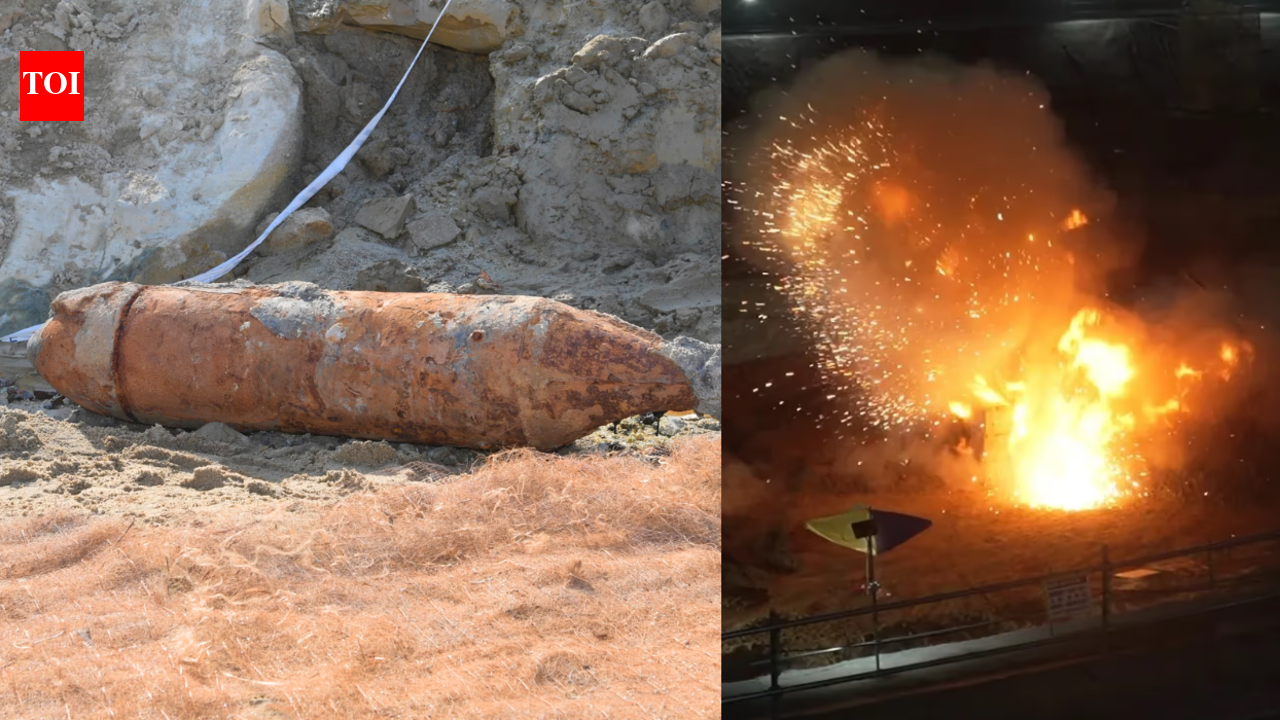
A 250kg World War II-era aerial bomb discovered at a construction site near Changi Airport has been safely disposed of following a carefully coordinated overnight operation involving multiple Singapore agencies, with authorities confirming there was no impact on airport operations. The unexploded ordnance (UXO), found during works along Tanah Merah Coast Road within the Changi East development zone, was assessed by the Singapore Armed Forces (SAF) as too unstable to be moved, requiring a controlled on-site detonation instead.
Discovery, assessment and risk
According to the Singapore Police Force, officers were first alerted to the war relic at 4.55am on March 31 during construction works. The SAF’s Explosive Ordnance Disposal team later identified it as a 250kg World War II aerial bomb, likely a Type 3 “skipping bomb”, historically used to strike maritime targets such as ships. Given its condition, the SAF determined the device was unsafe to transport. A disposal window was scheduled between 2.30am and 4.30am on April 2, with the detonation eventually carried out at approximately 2.23am.
The bomb was safely detonated at a construction site flanked by two runways at Singapore’s Changi Airport./PHOTO: SINGAPORE POLICE FORCE
Authorities had earlier warned the public to expect loud sounds during the operation, which was contained entirely within the construction site. The disposal site, flanked by two runways at Changi Airport (including Runway 2), lies near Changi Jurassic Mile and the Tampines Course of Tanah Merah Country Club, within the Changi East development zone earmarked for Terminal 5, Singapore’s largest aviation expansion to date.
How the bomb was neutralised
In a detailed statement, the Ministry of Defence (Singapore) said personnel from its Chemical, Biological, Radiological and Explosives Defence Group constructed extensive protective works around the bomb. These included “compacted sandbag overhead cover and reinforced concrete barriers” designed to contain both blast pressure and fragmentation.
Authorities safely detonated the bomb using compacted sandbags and reinforced concrete barriers to contain the blast and fragmentation/ Image: Ministry of Defence, Singapore (MINDEF)
“The ordnance was subsequently disposed (of) through a controlled detonation in the early morning, minimising disruption to the public and airport operations,” MINDEF said. The agency added that “safety cordons were established and protective measures implemented to safeguard personnel, infrastructure, and the public.” Visuals from the scene described a bright flash followed by a loud explosion seconds later, with a plume of smoke rising over the site.
A bright flash lit the site, followed by a loud explosion and a rising plume of smoke/ Image: Ministry of Defence, Singapore (MINDEF), Asiaone
Coordination across agencies
The operation involved close coordination between multiple bodies, including the SAF, the Defence Science and Technology Agency (DSTA), the Civil Aviation Authority of Singapore, the police, and Changi Airport Group. Lieutenant Colonel Tay Jun Jie, Commanding Officer of the 36th Battalion Singapore Combat Engineers, emphasised the operational approach, saying: “We maintain a high level of operational readiness and remain committed to safeguarding Singapore’s security. For such incidents, we respond swiftly, plan thoroughly and work closely with partner agencies to mitigate risks effectively and execute operations safely.” From a technical standpoint, DSTA’s senior principal engineer Ng Chor Boon explained how modelling shaped the response: “We applied advanced numerical modelling techniques to determine the effects of the fortified structure’s blast leakages on the surroundings… These enabled us to compute the safety zones which enabled the SAF commanders and planners to better balance operations and mitigate risks to the surroundings.”
No disruption to flights or infrastructure
Despite the scale of the operation, airport activity continued largely uninterrupted. In response to queries from outlets including CNA and The Straits Times, CAG confirmed the disposal was completed “successfully early this morning” and that “the infrastructure and systems in the vicinity of the site were checked, and no issues were observed.” As a precaution, Runway 2 was temporarily closed, but flights continued via Runway 1. Vincent Hwa, director of air traffic services at CAAS, said: “Since flight paths did not traverse over the disposal site, no airspace restrictions were imposed. There was no impact to flight operations.” At the time, there were 10 inbound and 18 outbound flights scheduled during the disposal window.
One of the largest found in Singapore
Singapore’s Defence Minister Chan Chun Sing later said in a Facebook post that the bomb was “one of the largest ever discovered in Singapore”, thanking all agencies involved for ensuring the operation caused minimal disruption. Unexploded ordnance discoveries are not uncommon in Singapore due to its wartime history, though they are not always handled on-site. A 100kg bomb found in 2023 in Upper Bukit Timah required evacuations and caused structural damage to nearby homes, while a 227kg bomb in 2016 was disposed of on Pulau Senang. This time, however, the combination of precise engineering, inter-agency coordination and controlled execution ensured a high-risk operation concluded without incident, in one of the busiest and most sensitive locations in the country


