



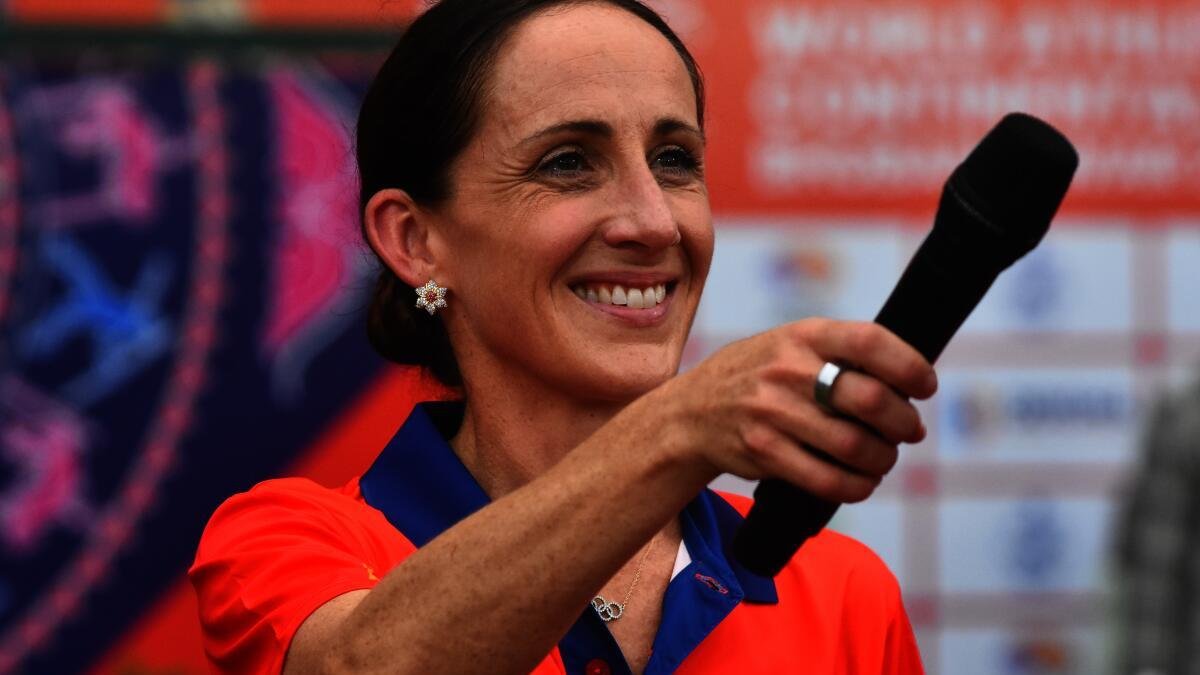
Born about a month after the 1984 Los Angeles Olympics, former American middle-distance runner Shannon Rowbury is eagerly awaiting her women’s 1500m bronze medal at LA28. She richly deserved a podium finish 14 years ago, but was robbed of the honour due to the drug-induced performances of some competitors. Thanks to the International Olympic Committee’s (IOC) ceaseless war against doping, the tainted athletes, who finished ahead of her, have been disqualified, and Rowbury stands to formally receive her medal more than a decade-and-a-half after winning it.
As part of an Athletics Federation of India (AFI) initiative, Rowbury, now a commentator who also actively participates in anti-doping drives, was in India to train the country’s athletics commentators and work during the World Athletics Continental Tour Silver meet at the Kalinga Stadium in Bhubaneswar last month. She shared her compelling story, full of mixed emotions. Excerpts:
How was your first visit to India?
I was so excited for my first trip to India to be for such a meaningful event — to be part of the Indian meet, to do the in-stadium commentary, and to work with aspiring Indian broadcasters. It has been a really magical first visit. Hopefully not my last.
Could you tell us how you shifted from athletics to broadcasting?
I started while I was still competing. I stopped competing in 2021, but I had started broadcasting in 2017 for smaller meets, mostly distance events where I had experience. I could provide analysis and colour commentary, with insight into what might be going through the athlete’s head and the tactics. Over the years my roles have grown. I get tingles when I smell the track and hear the sounds. It has helped me stay connected to the sport.
There is always a gap between the broadcaster/media and the athletes. Do you think misunderstanding creates a gap?
My experience as an athlete helps me be a better broadcaster, not just because I understand what it’s like to be in those races, but because I have compassion. Our athletes work for 365 days, but they only get maybe 15 or 20 opportunities to race. It’s hard to maintain a high level year after year. When I cover a race, I try to share the effort and the meaning within the season, and to understand that these are humans who seem like superheroes.
Heartbreak: Rowbury, second from right, was beaten by dope-tainted athletes in the 1500m final at London 2012. ‘If I could change the past, I would make that race fair,’ she says.
| Photo Credit:
Getty Images
How do you look back at your career?
I’m most proud of my longevity. I spent a decade ranked in the top ten in the world, which is not an easy feat. Unfortunately, during much of my career, many athletes who were ultimately caught for doping were competing. The story of my Olympic medal is still ongoing. I will receive it physically at the LA Olympics in 2028. It was heartbreaking to compete in a time that wasn’t as clean or fair as it should have been, but it gives me passion to fight for fair sport and excitement to cheer for athletes in races that feel level.
Could you elaborate on your wait for the medal?
In London 2012, I finished sixth but in the 12-13 years since, five women from my race have been disqualified, including the gold and silver medallists [Asli Cakir Alptekin and Gamze Bulut] from Turkey and a Russian athlete [Tatyana Tomashova], who was ahead of me and was disqualified just last year. That officially moved me into bronze. The IOC’s policy now is to offer medal ceremonies, so I will have a ceremony in LA. It’s nothing like London, but I’m grateful to have the opportunity to celebrate in front of friends and family. I’m grateful to a system that committed itself to clean sport.
It will be 16 years by the time I get it. When I found out, my entire body started shaking. I started sobbing. I had carried so much frustration about the unfairness. But I am an optimistic person…I got justice and I will receive my medal in front of my two children. They’ll see their mother being recognised for winning with integrity, winning the right way. Hopefully that will reinforce lessons, not only for them but for others, that truth can triumph. If I could change the past, I would make that race fair. Since I cannot, I channel those hard moments into advocacy, change and hopefully inspiration. I have a choice to live with gratitude or anger, and I choose gratitude.
At the Olympics, my highest finish after London was fourth in Rio, so it was very challenging to know London had a lot of cheats. I had a medal at the World Championships, but an Olympic medal is on another level.
How has the middle-distance field changed in the last few years?
There has been a lot of innovation around shoe technology, kind of fuelling the way athletes train, the lifting and recovery they do. Those developments have created a new wave of world records and personal bests. In the United States we call it trackflation — times across the board are so much quicker. It’s exciting because it creates new stories and exciting moments when a record is broken and an athlete improves. It’s a good sign…because it means our sport is growing.
Staying power: Rowbury is proud of her longevity in a gruelling business. ‘I spent a decade ranked in the top ten in the world, which is not an easy feat,’ she says.
| Photo Credit:
Getty Images
You spoke about doping. India is among the countries with the most doping-related violations. How should the AFI approach this?
Part of it for me was how I was raised — it wasn’t just about winning, it was about sportsmanship and how you win. It’s important to create an ecosystem that incentivises performance but prioritises fairness, and enforces penalties for those who cheat. Once there is a clear directive that cheats will lose eligibility, that will disincentivise it.
India has high-achieving athletes and international figures. There’s so much more that can be done to develop younger talent and build strong foundations so they have a career not just as professional athletes but also as coaches, broadcasters or in other roles beyond their athletics career.
Since you have been affected by doping, do you do anything on education?
I work with the US Anti-Doping Agency (USADA) to share my story. I’ve attended conferences. It has been about explaining the human side of doping. At events about education around drug testing, I meet people working to improve testing technology and give them a sense of who they are doing it for. There’s a large group committed to clean sport, and I get to thank them in person and help them understand how impactful their work is.
LA is two years away, and the World Championships is next year. How do you look forward to the middle-distance events?
The depth, especially in the 1500m on both men’s and women’s sides, is astonishing. It makes for great racing when more than half the field in an Olympic or World final could potentially be on the podium. I love a close, exciting race, because it makes for drama.
Published – September 05, 2026 06:00 am IST


