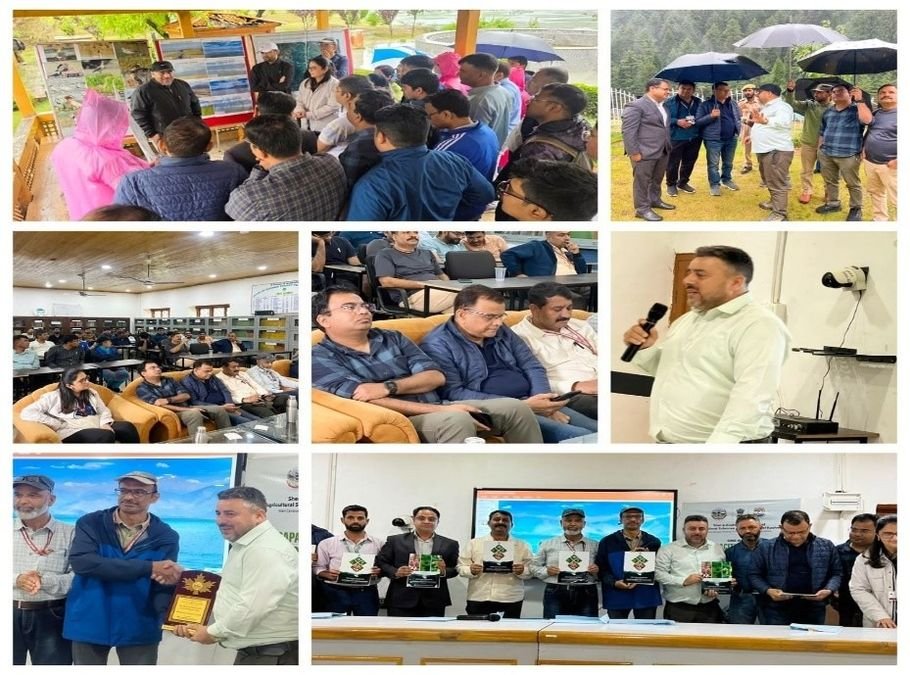
Bandipora, Jul 22: The Jammu & Kashmir Forest Department, in collaboration with the Sher-e-Kashmir University of Agricultural Sciences and Technology of Kashmir (SKUAST-K), the Wular Conservation and Management Authority (WUCMA), the Kashmir Forest Training School, Chitternar, and the Forest Protection Force, on Wednesday organized a field exposure visit to the Bandipora Forest Division under the One Week Capacity Building Programme on “Smart Conservation: Technological Solutions for Forest and Wildlife Protection.”
The programme brought together a distinguished delegation of senior Indian Forest Service (IFS) officers from various States and Union Territories of the country. The exposure visit was aimed at promoting knowledge exchange and showcasing innovative approaches towards biodiversity conservation, wetland restoration, sustainable forest management, and community-based natural resource governance.
The delegation commenced its visit at the iconic Wular Lake, Asia’s second-largest freshwater lake and one of India’s most ecologically significant wetlands. The officers were briefed on the conservation and restoration initiatives being implemented by the Wular Conservation and Management Authority (WUCMA) in collaboration with the Forest Department.
They were apprised of various scientific interventions, including wetland restoration, catchment area treatment, habitat improvement, shoreline stabilization, biodiversity enhancement, and sustainable ecosystem management undertaken to restore and conserve the lake’s ecological integrity.
The delegation later visited the historic Kashmir Forest Training School, Chitternar, established in 1911, one of the country’s oldest forest training institutions. The visiting officers were acquainted with the institution’s rich legacy and its significant contribution towards forestry education, professional training, and capacity building over the past century.
A technical session held at the Kashmir Forest Training School featured a comprehensive presentation on the Biodiversity Management Committee (BMC) Model of Bandipora by Mr. Waseem Farooq Mir, DCF, Divisional Forest Officer, Bandipora.
The presentation highlighted the Division’s innovative approach towards community-based biodiversity conservation, participatory environmental governance, preparation of People’s Biodiversity Registers (PBRs), and sustainable natural resource management.
The BMC Model has emerged as one of the finest examples of participatory biodiversity conservation in Jammu & Kashmir and is increasingly being recognized as a model worthy of replication.
On the occasion, a booklet on the Biodiversity Management Committee (BMC) Model, documenting its objectives, implementation process, achievements, and best practices, was formally released by the visiting dignitaries, reaffirming the Department’s commitment to promoting documentation, knowledge sharing, and replication of successful conservation initiatives.
The delegation also viewed a documentary on the Chandaji Eco-Restoration Park, highlighting the successful restoration of a degraded landscape through scientific planning, ecological interventions, and community participation. The initiative was appreciated as a noteworthy example of ecosystem restoration and sustainable environmental management.
The visiting officers appreciated the innovative conservation initiatives undertaken by the Jammu and Kashmir Forest Department Bandipora Forest and WUCMA commended the integrated approach adopted towards biodiversity conservation, wetland restoration, ecological sustainability, and community participation.
They observed that the initiatives being implemented in Bandipora offer valuable learning experiences and serve as inspiring models for sustainable forest management across the country.