



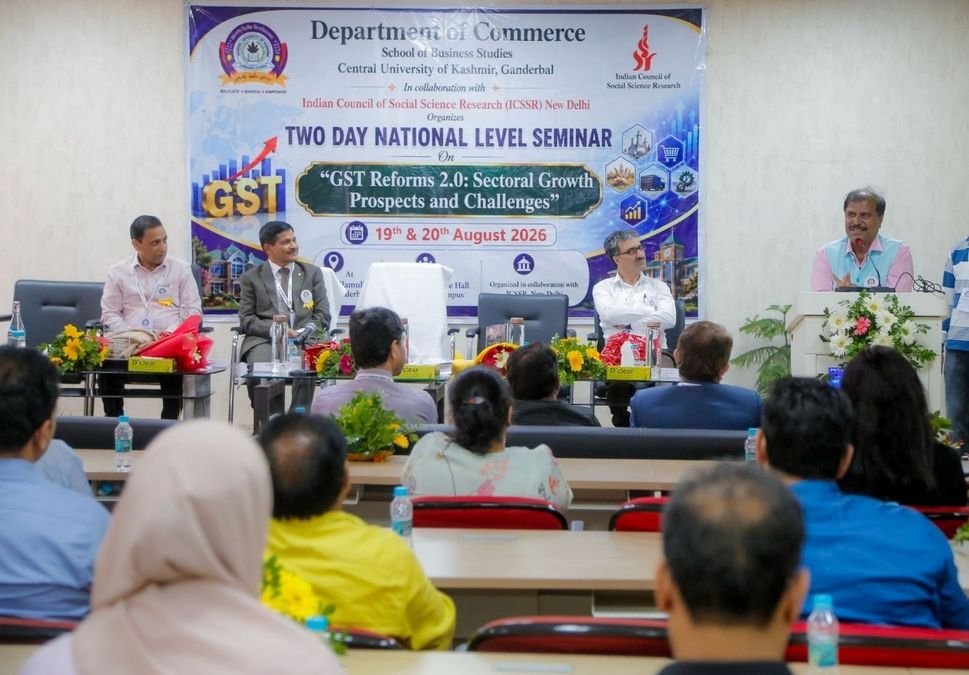
Ganderbal, Aug 19: Department of Commerce, School of Business Studies, Central University of Kashmir (CUKashmir) in collaboration with the Indian Council of Social Science Research (ICSSR), New Delhi, began a two-day national seminar on “GST Reforms 2.0: Sectoral Growth Prospects and Challenges”, at the Tulmulla campus here Wednesday.
Speaking on the occasion, Vice-Chancellor, Prof. A. Ravinder Nath, said the introduction of GST represented a significant transformation of India’s indirect tax system, while the subsequent reforms were aimed at addressing emerging challenges and making the system more responsive to the needs of citizens and businesses.
He called for a balanced approach in which taxation supports economic activity while encouraging environmental consciousness, social responsibility and responsible consumption.
Prof. Nath highlighted the importance of examining GST reforms from the perspective of different income groups and sectors, particularly agriculture, manufacturing and services.
CUK VC expressed hope that the deliberations would result in substantive recommendations capable of contributing to policy discourse and could eventually be placed before the appropriate authorities, including the GST Council.
Vice-Chancellor, Ravenshaw University, Prof. (Dr.) Arka Das Mohapatra, who was the chief guest on the occasion, appreciated CUK for creating a platform where academic knowledge, policy experience and field-level perspectives could converge.
He noted that taxation ultimately affects the everyday lives of citizens and, therefore, the success of tax reform should be assessed not merely by the sophistication of its structure but by whether its benefits reach ordinary people.
Prof. Mohapatra called for greater attention to affordability, quality of services, environmental responsibility and socially conscious taxation. He suggested that taxation policies could encourage environmentally responsible manufacturing and healthier consumption patterns, while ensuring that essential goods remain affordable for economically vulnerable sections of society.
Additional Commissioner, Sales Tax, J&K, Parvez Ahmed Raina, explained the practical dimensions of implementing GST Reforms 2.0. He identified three key features of the reform process—simpler rate architecture, sectoral rationalisation and a new phase of compliance.
Raina said that while the rationalisation of rates could enhance affordability and purchasing power, its implementation also presented challenges relating to rate transitions, classification, input tax credit (ITC), refunds and registration. He emphasized that tax administration had to respond to these challenges through technological intervention, analytical tools and stronger monitoring mechanisms.
Dean Academic Affairs, Prof. Shahid Rasool, said that GST has evolved into a significant component of India’s economic architecture and that the reforms under GST 2.0 needed to be assessed not merely as a rate-rationalisation exercise but in terms of their wider impact on economic growth, consumption, businesses and households.
Dean, School of Business Studies, Prof. Syed Zahoor Ahmad Geelani, observed that GST was conceived with the objective of creating a unified national market and simplifying the complex indirect taxation structure that had previously confronted businesses with multiple taxes and compliance requirements.
Head, Deptt of Commerce and seminar Convenor, Dr. Mehraj-ud-Din Shah, said the seminar was conceived as a platform to critically examine the immediate and emerging implications of GST Reforms 2.0 through a research-oriented and interdisciplinary approach.
Prof. Nisar Ali Head, Deptt of Economics, KU and Prof S. M Shafi Former Head, Department of Commerce, KU were present. Asst Prof. Dr. Rizwana Rafiq, conducted the programme and Dr. Arfa Zahoor, proposed the vote of thanks.


