



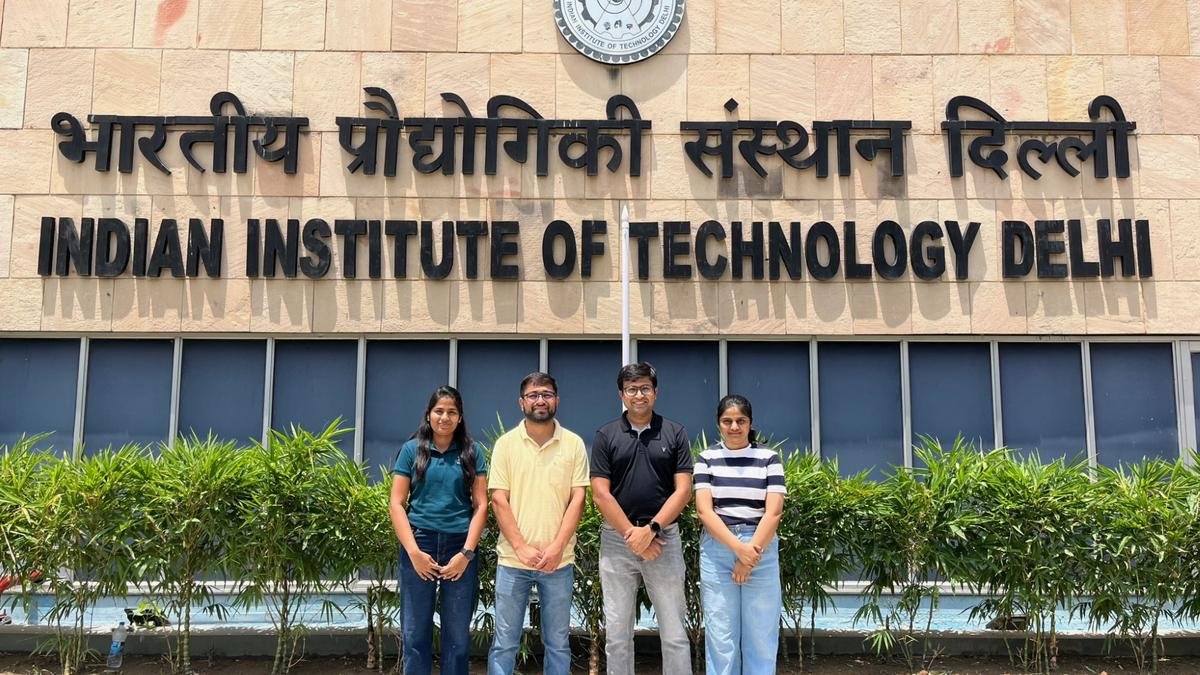
IIT-Delhi researchers have found that the Klemens model has ‘important limitations when applied to metals’.
| Photo Credit: Special arrangement
When a team at IIT-Delhi recently compared the members of a family of minerals called rutile oxides, they found a significant difference between metals and insulators that a well-known mathematical model could not explain. Understanding why is a necessary precursor to design next-generation electronics and efficient industrial catalysts.
While rutile oxides have the same crystal structure, titanium dioxide is an insulator whereas ruthenium dioxide is a good conductor.
The study itself was driven by a long-standing debate over whether ruthenium dioxide possesses a rare, unconventional type of magnetism called altermagnetism. To settle this, the team looked closely at the interplay between the material’s electrons and the lattice, i.e. the grid of its atoms.
Like photons carry light, phonons carry vibrations through a material. By studying how heat affects the phonons of the lattice, scientists can work backwards to see what the electrons are doing. If the electrons were interacting strongly with the phonons, it would leave a specific sign in the data.
The team used a technique called Raman scattering. They shone a laser at the materials and measured how the light changed as it bounced off the vibrating atoms. They simultaneously cooled the samples from room temperature down to –262.15° C.
“All measurements were performed using an indigenously developed low-temperature Raman scattering facility at IIT-Delhi, built at roughly one-third the cost of comparable commercial systems,” IIT-Delhi assistant professor and study co-author Kaushik Sen said.
As they cool, the lattice of most materials becomes stiffer and the vibrations speed up. In insulators, this stiffening follows a well-known mathematical rule called the Klemens model. However, the researchers found that the lattice of the metallic rutile oxides stiffened more and the Klemens model couldn’t explain why.
“While the Klemens model has been successfully used for decades, we show that it has important limitations when applied to metals,” Dr. Sen said.
The findings were published in Physical Review B.
While atoms in an insulator vibrate based only on the chemical bonds’ stiffness, atoms in a metal are surrounded by a sea of electrons that pull on them. The team found that as the metals cooled, the electrons reorganised into different energy states, changing the tension between the atoms and thus how the lattice vibrated.
“The study demonstrates how Raman spectroscopy can identify signatures of electron-phonon interactions, which play a central role in phenomena such as superconductivity,” Dr. Sen added.
Published – July 01, 2026 08:00 am IST


