



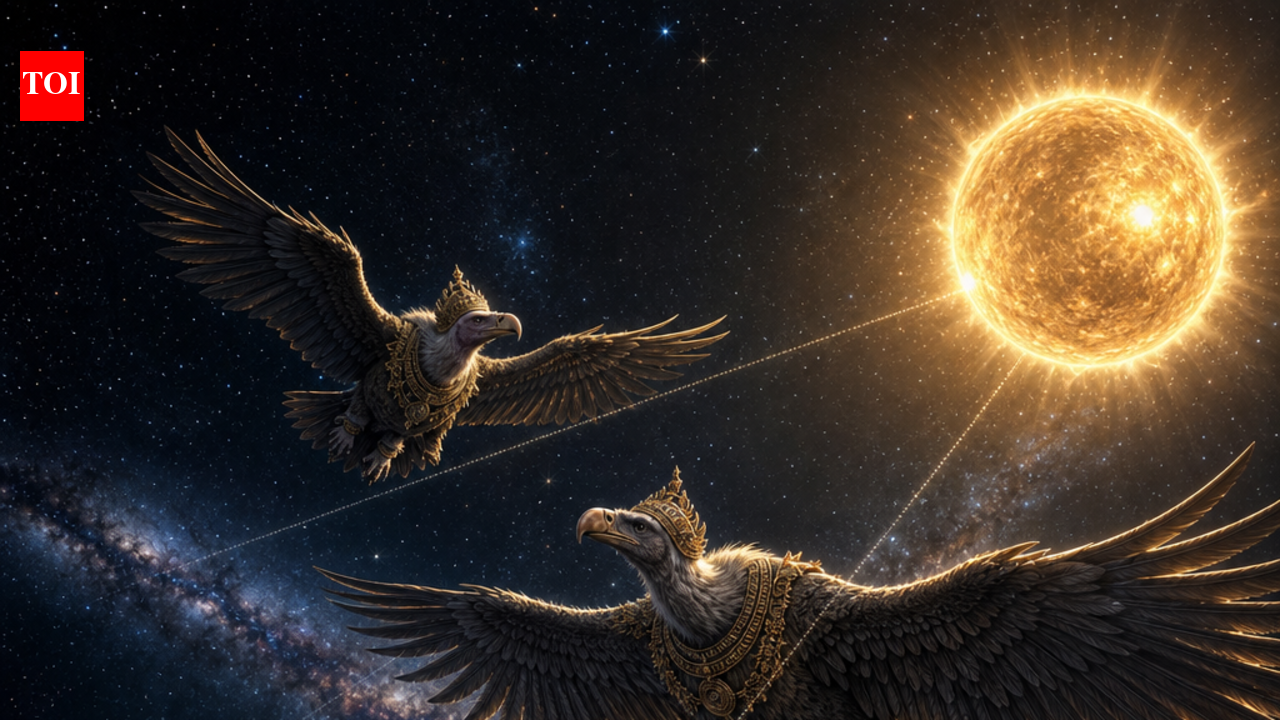
Patna: A recent research paper has attempted to estimate how far the vulture brothers Jatayu and Sampati may have travelled during their legendary flight, using modern geometry, visual-angle theory and astronomical calculations. Published in an open access peer-reviewed journal, the study estimates the distance at nearly 1.3 million km from Earth’s centre — more than three times the distance between the Earth and the Moon.The research, based on findings by Raj Kishore Prasad and Shivanshu Raj of city-based B N College under Patna University, stresses that the Ramayana gives “no numerical altitude” for the journey. The 1.3-million-km figure is a modern estimate derived from the epic’s description, rather than a measurement recorded by Valmiki.The calculation centres on a passage in which Sampati describes focusing his sight on the Sun and seeing it appear almost equal in size to the Earth. Using the apparent angular sizes of the Sun and Earth, the researchers calculated that the two would subtend nearly identical visual angles at a distance of roughly “212-213 Earth radii”. One calculation puts the distance at approximately “1.35 million km”.The researchers also used Earth-centred inertial coordinates and planetary ephemeris data to independently locate the proposed “J-S points”. This produced a distance of the order of “10⁶ km, approximately 1.3 million km”, lending mathematical consistency to the geometrical estimate.Such a distance lies far beyond conventional aviation and satellite orbits, in a region with virtually no breathable atmosphere, where radiation and solar particles would make unaided survival impossible. The paper acknowledges that the altitude is “unbelievable” and the survival of the two birds at such a height remains unexplained.The study also examines more than 20 Sanskrit verses describing mountains shrinking into tiny forms, rivers appearing like threads and the Earth changing perspective as the brothers climbed higher. The authors argue these descriptions represent an unusually early literary account of observing Earth from increasing heights.The researchers, however, caution that their calculations assume avian perception of size and distance can be treated geometrically in a manner broadly comparable to human vision. They acknowledge that bird vision remains insufficiently understood for the assumption to be definitive.
