



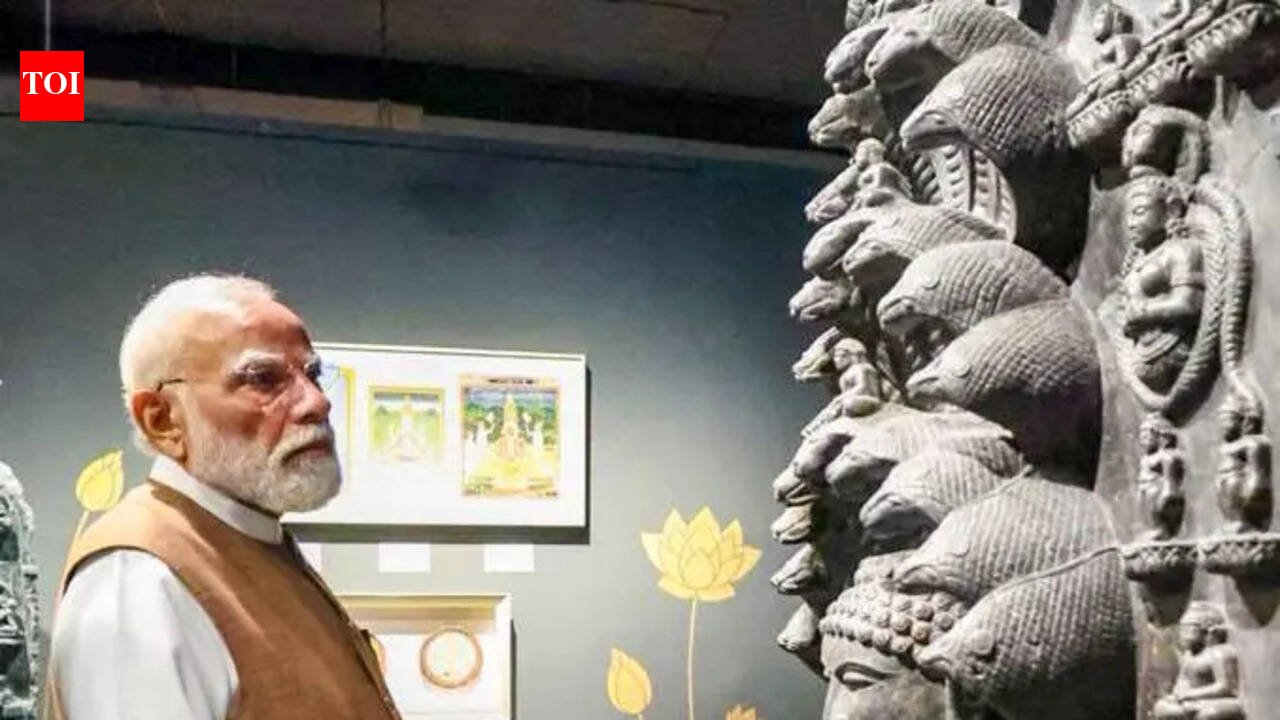
Ahmedabad: PM Narendra Modi on Tuesday said that the newly built Samrat Samprati Museum sends a strong message of peace and non-violence at a time when the world is “engulfed in flames of instability and unrest”. The PM was speaking at the Jain Aaradhana Kendra at Koba, where the museum is built based primarily on the collection painstakingly put together by Jain Acharya Padmasagarsuri.“Given the current global scenario — the way the world is being scorched in the fires of instability and unrest — the legacy and message of this museum hold immense significance,” the PM said. “They are significant not just for India but for humanity.” PM Modi also said that they are correcting the mistakes of previous govts “which failed to preserve valuable manuscripts”.Regarding the museum, named after Samrat Samprati — the grandson of Samrat Ashoka and a patron of Jainism — PM Modi said that it represents the link between philosophy and governance. “In India, rulers like Samrat Samprati treated power as service and sadhana, expanding ahimsa from the throne, and propagating satya (truth), asteya (non-stealing), and aparigraha (non-possessiveness) with utmost detachment and selflessness,” he said.The museum construction got financial support from UNM Foundation of the Torrent Group, which will also manage and maintain it. Torrent Group chairman emeritus Sudhir Mehta, along with monks from Shree Mahavir Jain Aaradhana Kendra, showed the PM the seven galleries of the museum after the inauguration. Gujarat governor Acharya Devvrat, CM Bhupendra Patel, deputy CM Harsh Sanghavi, and other dignitaries were present on the occasion.PM Modi said that the museum reflects the country’s core strength of diversity and unity, and also has scriptures from other religions and philosophies. “This is something that could happen only in India,” he added. He said that the country lost a vast treasure of knowledge at ancient centres of learning such as Nalanda and Takshashila to foreign invaders.In later years, people protected whatever remained by passing manuscripts from one generation to another, said the PM. “After Independence, this should have been a national priority. Regrettably, due to a colonial mindset, no attention was paid to this vital cause,” he said. He added that they are rectifying mistakes committed by previous govts by caring for these manuscripts. He pointed to the “Gyan Bharatam Mission” as a step in this direction.“Under this mission, manuscripts are being digitized, scientifically preserved and archived. People are also uploading manuscripts kept in their personal custody,” he said.Modi said the govt is making large-scale efforts to promote India’s cultural heritage globally, including the restoration of temples, the development of pilgrimage sites, and the promotion of traditional knowledge systems like ayurveda and yoga. He also cited projects such as the maritime museum at Lothal and plans for a national museum in Delhi to present India’s history comprehensively.Taking a swipe at previous regimes, Modi said earlier efforts to present history were influenced by political considerations. “You may recall that in the past, such endeavours were often viewed through a political lens. Everything revolved around setting a specific narrative for a particular political family,” he said, in an apparent reference to the Gandhi-Nehru family. “We have put an end to this mindset,” the PM said, adding the govt is working with the vision of ‘Sabka Saath, Sabka Vikas’.Modi also called for encouraging students and researchers from across the world to visit the museum and carry India’s message of non-violence and knowledge globally.“When we rise above personal aspirations and work for the nation, the pace of progress increases,” he stressed. The museum houses rare artefacts, ancient manuscripts and sculptures spread across seven galleries, offering a glimpse into India’s spiritual and cultural legacy, a release by the Jain Aradhana Kendra said.It showcases centuries-old Jain art, including stone and metal idols, illustrated manuscripts, coins and traditional artefacts, while also using modern audio-visual technology to create an immersive experience for visitors.


