


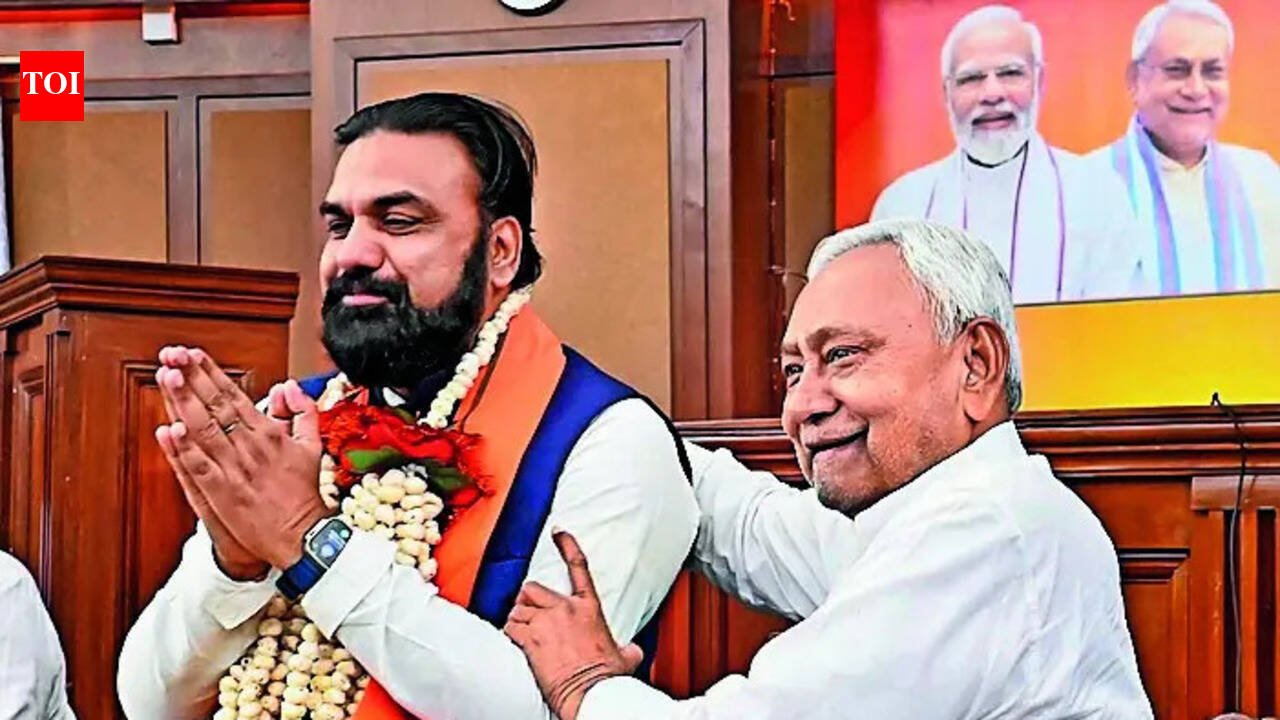
Patna: “Andhera chhatega, suraj niklega, kamal khilega (The darkness will vanish, the Sun will rise and the lotus — BJP’s poll symbol — will bloom),” former PM late Atal Bihari Vajpayee had said while addressing the first convention of the BJP at Mumbai’s Shivaji Park on April 6, 1980.Those impassioned words returned to mind as the party reached the stage of forming its govt in Bihar for the first time in this Hindi heartland, leaving the saffron camp jubilant. However, the journey to this point has been long and arduous. The party, which began with just 21 seats in Bihar after contesting the 1980 assembly polls, now holds 89 seats in the 243-member Bihar assembly.
Senior BJP leaders credited the party’s rise to figures such as Kailashpati Mishra, Ashwini Kumar, Jagdambi Yadav, Nand Kishore Yadav and Sushil Kumar Modi, among others, who laid the groundwork while battling adverse circumstances. “We had to struggle a lot to reach this stage. On the one hand, we aggressively raised people’s issues, on the other we tried to reach out to all sections of society,” said senior BJP leader Prem Ranjan Patel.The BJP’s ascent did not happen overnight but followed a steady and systematic trajectory. The party, which came into being in April 1980, contested the Bihar assembly elections the same year and secured 21 seats out of 246 contested in the then 324-member assembly. In the 1985 polls, its tally dropped to 16, but it rebounded in 1990, winning 39 seats and supporting the Janata Dal to form the govt in Bihar.However, the alliance did not last. The BJP withdrew support over the Ram temple issue after then CM Lalu Prasad ordered the arrest of BJP leader Lal Krishna Advani and stopped his Rath Yatra when it reached Bihar en route to Uttar Pradesh.In the 1995 elections, the BJP secured 41 seats, followed by 67 in 2000 and 37 in the Feb assembly polls. A turning point came later in Oct the same year, when the party won 55 seats and, with JD(U) support, formed the NDA govt in Bihar.The party’s influence grew further in the 2010 assembly polls, when it won 91 seats and the NDA retained power. However, CM Nitish Kumar later parted ways with the BJP and formed his own govt with opposition support.A similar pattern unfolded after the 2015 assembly elections. Although Nitish formed the govt with Grand Alliance partners, he switched sides midway and returned to power with BJP support. The cycle repeated after the 2020 polls as well — Nitish formed the govt with BJP backing but later broke the alliance to align with the opposition. That arrangement lasted just 17 months before his return to the BJP-led NDA ahead of the 2024 Lok Sabha polls.Following his return, Nitish contested both the 2024 LS and 2025 assembly polls alongside the BJP, delivering strong performances. Since then, both parties have functioned in close coordination, with no visible signs of internal discord. Against this backdrop, Nitish’s decision to hand over power to the BJP has taken many by surprise.“The BJP struggled a lot to reach the throne. At one point we travelled by horse carts, rickshaws and bullock carts to reach the people, fought against Lalu’s Jungle Raj, raised the fodder scam as a major issue and joined hands with Nitish. We tried every possible experiment to succeed,” said senior BJP leader and former governor Ganga Prasad on Tuesday. “Milkar ladne se fayda hua (we benefited a lot after fighting elections together with Nitish),” he added.
Poll
Do you think Nitish Kumar’s partnership with the BJP has strengthened governance in Bihar?
A former minister said the party’s rise in Bihar was once difficult to imagine. “We benefited a lot from Lalu’s misrule. The number of caste conflicts, Lalu’s slogan of ‘Bhu-Ra-Bal saf karo,’ his involvement in the fodder scam, and the lawlessness during the RJD rule created a strong ground for the BJP’s growth. In the end, the RJD was left with only Muslim and Yadav communities while the majority supported us,” he said.
