



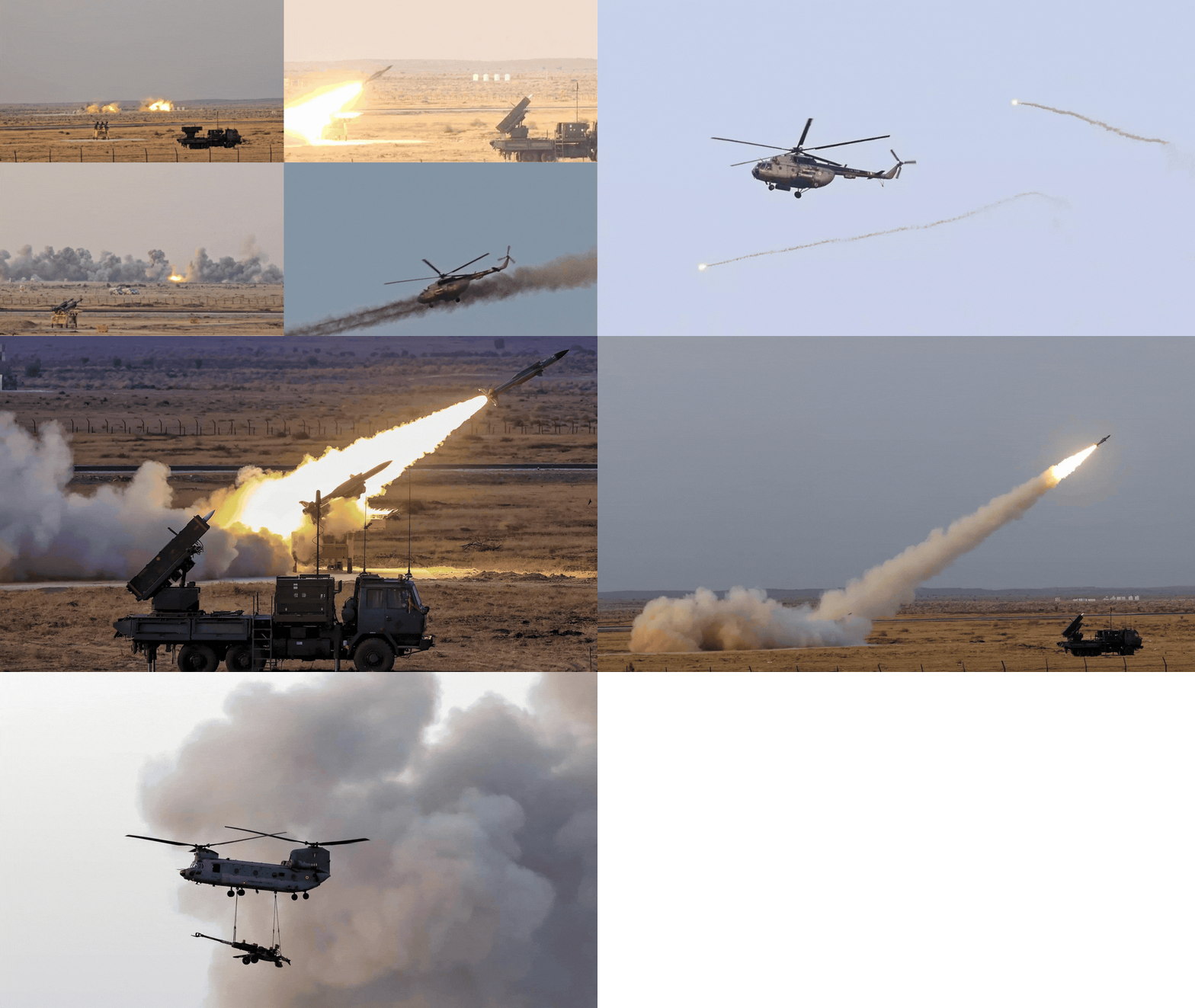
In the vast expanse of the Pokhran Air-to-Ground Range in Rajasthan’s Thar desert, the Indian Air Force (IAF) turned the spotlight on its expanding combat architecture during Vayu Shakti-2026. Held in the presence of President Droupadi Murmu, defence minister Rajnath Singh, and senior military leadership, the exercise was more than a ceremonial show of firepower. It was a calibrated message on preparedness, integration and deterrence.The day-to-dusk-to-night demonstration recreated near-realistic combat conditions. Simulated targets included enemy runways, radar clusters, bunkers, fuel depots, armoured convoys, command-and-control centres and terror camps spread across a three-kilometre layout. The sequence mirrored operational templates used during Operation Sindoor, offering carefully curated glimpses into how the IAF plans, coordinates and executes precision strikes in a live conflict scenario.A presentation on Operation Sindoor opened the exercise, followed by synchronised fighter strikes, suppression of enemy air defence (SEAD) missions, decoy manoeuvres, loitering profiles and rapid reinforcement drills. The night phase showcased low-visibility targeting, integrated helicopter–fighter coordination and surface-to-air missile engagements, including the firing of an Akash missile.The centrepiece of public attention, however, was the S-400 ‘Sudarshan’ long-range air defence system — a platform the IAF has credited with delivering one of the longest-range intercepts in military history and playing a decisive role during Operation Sindoor.
.
Vayu Shakti-2026 was thus not merely an exercise. It was a layered demonstration of India’s aerial strategy — blending imported high-end systems, indigenous missile shields, network-centric warfare and multi-platform air operations.
S-400 ‘Sudarshan’: The long-range shield and Operation Sindoor’s game-changer
The Russian-origin S-400 Triumf, developed by Almaz-Antey and inducted into Indian service under a 2018 agreement, represents the outermost and most powerful layer of India’s air defence grid. Known domestically as ‘Sudarshan’, the system is designed to detect aerial threats at ranges of up to 600 km and engage them at distances of up to 400 km, depending on the missile variant used.
.
Multi-layered interception within a single systemWhat sets the S-400 apart is its ability to fire multiple interceptor types from a single battery:
- Long-range interceptors (up to 400 km)
- Medium-range missiles (around 250 km)
- Shorter-range engagement missiles (120 km and below)
This creates a layered engagement envelope within one regiment, allowing operators to tailor responses based on target type, speed and altitude.
.
The system can track dozens of targets simultaneously and engage multiple threats at once — a critical feature in scenarios involving saturation attacks by drones, cruise missiles or fighter aircraft formations.Operation Sindoor and the 300 km interceptAccording to IAF briefings and released footage ahead of Vayu Shakti-2026, the S-400 system achieved what has been described as the “longest ever kill recorded in military history”. During Operation Sindoor, it reportedly engaged hostile aerial assets approximately 300 km inside adversary territory.
.
While operational details remain classified, the broader implication is strategic: the S-400 extends India’s defensive and deterrent envelope deep beyond its borders. It compels adversary aircraft to operate at safer distances, reduces the probability of surprise air strikes and enhances protection of key airbases, command centres and metropolitan regions.In a two-front threat scenario involving Pakistan and China — both possessing advanced aircraft and missile arsenals — the S-400 provides:
- Wide-area protection of strategic nodes
- Capability against high-altitude aircraft and certain ballistic threats
- Early engagement of cruise missiles
- Psychological and deterrent impact
However, the system’s effectiveness depends on integration with India’s Integrated Air Command and Control System (IACCS), long-range radars and airborne early warning platforms. Technology alone is insufficient; networked situational awareness is the true force multiplier.
Akash missile system: Indigenous backbone of medium-range defence
The Akash missile system is one of India’s most important indigenous air defence platforms, forming the core of the country’s medium-range surface-to-air missile shield. Developed by the Defence Research and Development Organisation (DRDO) and produced by Bharat Dynamics Limited, Akash was designed to provide area defence against a wide spectrum of aerial threats.
.
With an operational range of roughly 25–30 kilometres in its initial variants, Akash is capable of intercepting fighter aircraft, helicopters, cruise missiles and unmanned aerial vehicles. It operates through a sophisticated command-and-control network anchored by the Rajendra phased-array radar, which can track multiple targets simultaneously and guide several missiles in quick succession. This multi-target engagement capability is critical in scenarios involving coordinated or saturation attacks.
.
One of Akash’s key strengths lies in its mobility. Mounted on wheeled and tracked platforms, the system can be rapidly deployed to protect forward airbases, mechanised formations and vital installations. Its integration into the Indian Air Force and Indian Army’s air defence grid ensures seamless coordination with long-range systems such as the S-400 and shorter-range quick reaction platforms.The newer Akash-NG (New Generation) variant enhances the system’s effectiveness with an improved active seeker, better accuracy, greater resistance to electronic countermeasures and an extended engagement envelope. This evolution reflects India’s push towards technological self-reliance in critical defence sectors.
.
Barak missile family: Bridging land and sea defence
The Barak-8 missile family represents one of India’s most successful defence collaborations with Israel and forms a crucial bridge between land-based and maritime air defence. Developed jointly by DRDO and Israel Aerospace Industries, the system is designed to counter a wide range of aerial threats, including fighter aircraft, helicopters, drones, anti-ship missiles and cruise missiles.
.
MR-SAM: Land-based area protectionThe Medium-Range Surface-to-Air Missile (MR-SAM) variant is deployed by the Indian Air Force and Indian Army to defend airbases, strategic assets and field formations. With an engagement range of over 70 kilometres, MR-SAM provides a protective ring beyond short-range systems like Akash but below long-range platforms such as the S-400.
.
Equipped with an active radar seeker and vertical launch capability, MR-SAM can engage targets in a 360-degree envelope. Its advanced command-and-control architecture allows simultaneous tracking and interception of multiple threats, making it effective against coordinated attacks and low-flying cruise missiles.LR-SAM: Naval fleet shieldThe naval version, often referred to as LR-SAM, is deployed aboard Indian Navy destroyers and aircraft carriers. It protects high-value maritime assets from incoming anti-ship missiles and hostile aircraft. Integrated with shipborne radars and combat management systems, the missile can be launched vertically from onboard cells, enabling rapid response in high-threat environments.
.
Air power on display: Fighters, helicopters and transport fleet integration
Vayu Shakti-2026 was not merely a missile showcase; it was a demonstration of how the Indian Air Force integrates fighters, attack helicopters, special forces and transport aircraft into a seamless combat framework. The exercise underlined a central doctrinal shift — modern air warfare is about networked, multi-platform coordination rather than isolated strikes.At the forefront were frontline fighters such as the Sukhoi Su-30MKI, which executed precision strikes on simulated terror camps and high-value ground targets. The SEPECAT Jaguar carried out deep-penetration attack profiles, targeting runways and hardened bunkers, replicating coordinated patterns seen in recent operations. The Dassault Mirage 2000 demonstrated synchronised multi-aircraft strike missions, reflecting calibrated escalation and high-accuracy targeting.
.
Rotary-wing platforms added tactical depth. The indigenously developed HAL Prachand showcased agility in high-threat zones, striking simulated refuelling points and forward positions. The Boeing AH-64 Apache reinforced close air support capability, while the Mil Mi-17 enabled slithering operations by Garud commandos and special forces units in hostage-rescue simulations.Equally critical was the transport and logistics backbone. The Airbus C-295 demonstrated rapid troop induction and reinforcement operations, while assault landings by heavy transport aircraft illustrated casualty evacuation and battlefield mobility.
.
Sukhoi Su-30MKIThe Su-30MKI forms the backbone of the Indian Air Force’s air superiority and multi-role strike capability. A twin-engine, long-range fighter with thrust-vectoring engines, it combines manoeuvrability with heavy payload capacity. The aircraft can carry a diverse weapons mix, including beyond-visual-range air-to-air missiles, precision-guided munitions and cruise missiles. Its powerful radar and electronic warfare suite allow it to detect and engage multiple targets simultaneously. In exercises such as Vayu Shakti, the Su-30MKI typically undertakes deep strike missions, suppression of enemy air defence (SEAD) roles and long-endurance combat air patrols. With aerial refuelling capability, it provides reach across vast operational theatres, reinforcing India’s deterrent posture in both western and northern sectors.Dassault Mirage 2000The Mirage 2000 remains one of the IAF’s most trusted precision strike platforms. Known for its accuracy and reliability, the aircraft gained prominence in high-altitude and cross-border strike roles. Its delta-wing design ensures stability and agility, while upgraded avionics and radar systems enhance targeting precision. Armed with laser-guided bombs and advanced air-to-air missiles, the Mirage 2000 is particularly suited for surgical strikes against fortified targets. In large-scale demonstrations, it often executes synchronised attack profiles, showcasing coordinated multi-aircraft operations. Despite being an older platform compared to newer inductions, continuous upgrades have kept it operationally relevant, making it a key component of India’s precision offensive capability.SEPECAT JaguarThe Jaguar is a dedicated deep-penetration strike aircraft designed for ground-attack missions. Built for stability at low altitudes, it excels in flying under radar coverage to strike strategic infrastructure such as airfields, fuel depots and logistics hubs. The aircraft can carry a variety of conventional and precision-guided munitions, and its robust airframe allows sustained operations in harsh environments, including desert sectors. Although inducted decades ago, avionics and engine upgrades have extended its service life. During exercises, Jaguars typically simulate runway denial operations and hardened bunker strikes, reflecting their specialised role in degrading enemy warfighting capacity during the opening phases of conflict.HAL PrachandHAL Prachand, India’s indigenously developed Light Combat Helicopter, represents a milestone in domestic aerospace engineering. Designed for high-altitude warfare, it is capable of operating in mountainous terrain where air density challenges conventional helicopters. Equipped with air-to-ground rockets, anti-tank guided missiles and a chin-mounted cannon, Prachand provides close air support and battlefield interdiction capability. Its narrow fuselage, stealth features and advanced avionics improve survivability in contested airspace. In exercises such as Vayu Shakti, Prachand demonstrates precision strikes on forward enemy positions and logistics nodes, underlining India’s growing self-reliance in rotary-wing combat platforms tailored to its unique terrain requirements.
.
Boeing AH-64 ApacheThe AH-64 Apache is among the world’s most advanced attack helicopters and significantly strengthens India’s close air support capability. Equipped with the Longbow radar, it can detect, prioritise and engage multiple ground targets even in adverse weather or low-visibility conditions. Armed with Hellfire missiles, rockets and a 30mm chain gun, the Apache is designed to neutralise armoured formations and fortified positions. Its advanced sensors and data-link systems enable integration with ground forces and other aircraft. In desert and border exercises, the Apache demonstrates precision engagement and rapid target acquisition, serving as a force multiplier for mechanised and infantry formations.Mil Mi-17The Mi-17 V5 is a versatile medium-lift helicopter widely used for troop transport, logistics, casualty evacuation and special operations. Its ability to operate in diverse terrains — from deserts to high-altitude regions — makes it indispensable to the IAF. The helicopter can carry armed personnel, equipment and even light artillery, and it supports slithering and para-drop missions for special forces. In combat simulations, the Mi-17 V5 often undertakes insertion and extraction roles, reinforcing rapid deployment capability. Its adaptability also extends to humanitarian assistance and disaster relief operations, underscoring its dual military-civil utility.
.
Airbus C-295The Airbus C-295 is a modern tactical transport aircraft inducted to strengthen India’s airlift and logistics network. Designed for short take-off and landing operations, it can operate from semi-prepared or austere airstrips, making it suitable for forward-area deployments. The aircraft supports troop transport, cargo movement, medical evacuation and special operations missions. Its fuel efficiency and modern avionics enhance operational flexibility, while domestic production under India’s defence manufacturing initiative marks a step towards aerospace self-reliance. In large-scale exercises, the C-295 demonstrates rapid reinforcement of combat zones, highlighting the logistical backbone essential to sustained air and ground operations.


