



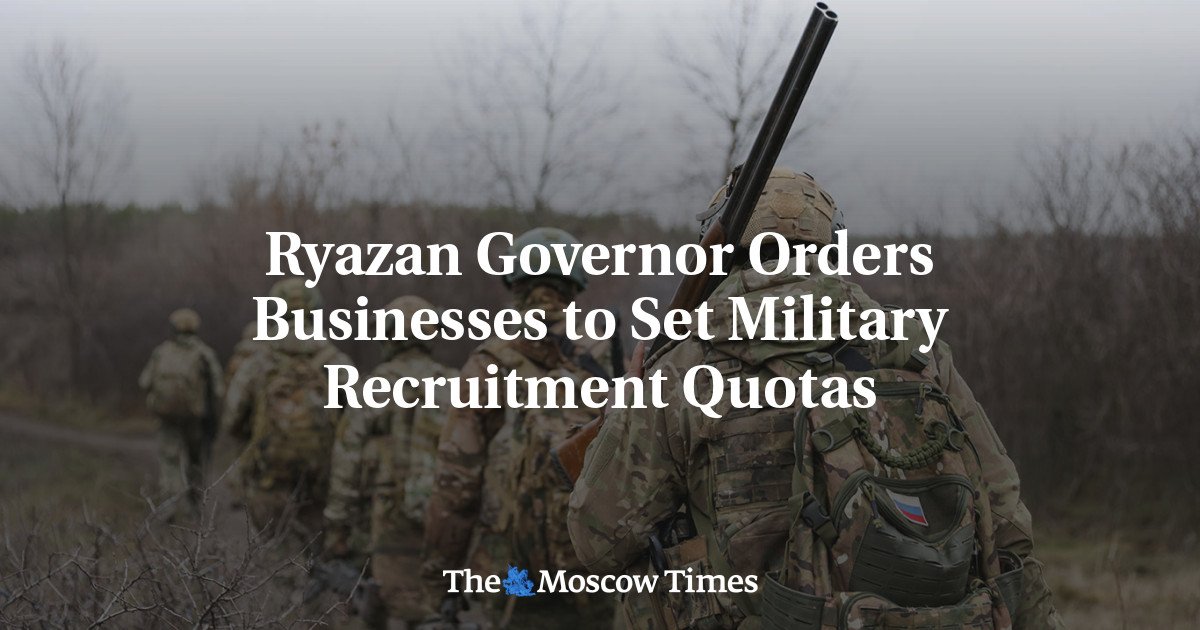
Authorities in the Ryazan region have ordered businesses to nominate a minimum number of employees for contract military service, marking the latest iteration of government efforts to maintain a steady flow of troops to the front line in eastern Ukraine.
The directive, signed by Ryazan region Governor Pavel Malkov on March 20, instructs “entities regardless of their form of ownership” to set recruitment quotas by Sept. 20.
It appears to apply primarily to private businesses, but also to broadly defined “organizations” and “institutions,” which likely include non-profits and state-funded entities.
Quotas are based on company size. Firms with up to 300 employees are asked to nominate two “candidates” for contract service, while those with 500 or more employees must put forward five.
The directive, published last week on Russia’s official legal portal, cites President Vladimir Putin’s executive orders introducing martial law in occupied Ukrainian territories and related measures across Russian regions.
The news outlet Mozhem Obyasnit reported that regional laws in Ryazan may allow authorities to fine companies up to 1 million rubles ($12,200) for non-compliance with the new military recruitment quota, though the directive itself does not specify penalties.
Independent war monitor Conflict Intelligence Team (CIT) said it was the first known case of an official document publicly outlining recruitment quotas for companies.
“Other regions, even if they formalize such orders in writing, probably don’t make them public,” a CIT spokesperson told the investigative outlet Agentstvo.
Agentstvo reported that other regions, including Tula south of Moscow, have adopted plans to recruit contract soldiers through local government bodies.
Timofey Vaskin, a lawyer who represents military conscripts, criticized the directive in the Ryazan region for what he described as its overly broad interpretation of Putin’s executive orders and said it would be “legally unenforceable.”
The Ryazan directive comes amid reports that the Russian military is losing soldiers in Ukraine more quickly than it can replace them.
Moscow has repeatedly denied plans for a new wave of mobilization.
A Message from The Moscow Times:
Dear readers,
We are facing unprecedented challenges. Russia’s Prosecutor General’s Office has designated The Moscow Times as an “undesirable” organization, criminalizing our work and putting our staff at risk of prosecution. This follows our earlier unjust labeling as a “foreign agent.”
These actions are direct attempts to silence independent journalism in Russia. The authorities claim our work “discredits the decisions of the Russian leadership.” We see things differently: we strive to provide accurate, unbiased reporting on Russia.
We, the journalists of The Moscow Times, refuse to be silenced. But to continue our work, we need your help.
Your support, no matter how small, makes a world of difference. If you can, please support us monthly starting from just $2. It’s quick to set up, and every contribution makes a significant impact.
By supporting The Moscow Times, you’re defending open, independent journalism in the face of repression. Thank you for standing with us.
Continue
Not ready to support today?
Remind me later.
×
Remind me next month
Thank you! Your reminder is set.


