



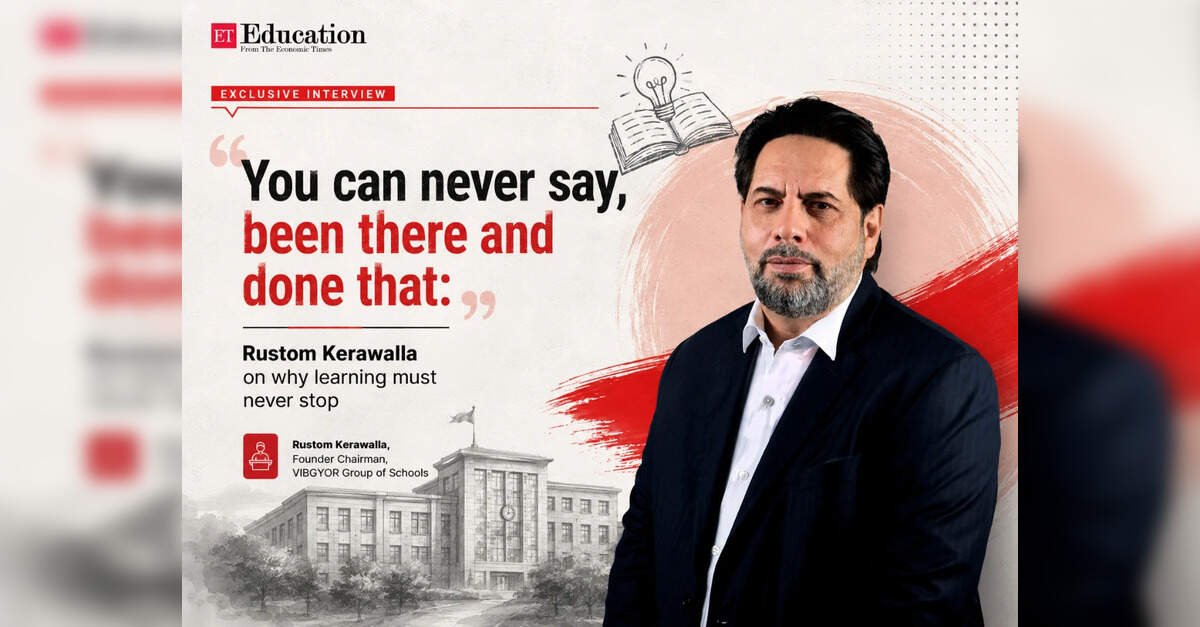
As technology reshapes classrooms and the expectations from schools continue to evolve, education leaders are being pushed to rethink how students and teachers prepare for the future. Rustom Kerawalla, Founder Chairman, VIBGYOR Group of Schools, has spent more than two decades in school education, since the first VIBGYOR school was established in Mumbai in 2004. The group now has 41 schools across 15 cities and more than 60,000 students.
In an exclusive conversation with ETEducation, Kerawalla reflects on the shifts Indian school education needs to make as the pace of change accelerates, the challenges of maintaining quality and consistency across a growing school network, and the need to continuously equip teachers to work with new-age technologies.
He also discusses how schools should approach AI, why training and development deserve greater investment, the importance of stronger collaboration between parents and schools, and his vision of schools evolving into facilitators of learning rather than merely providers of prescribed knowledge.
Here are the edited excerpts from the interview.
Q What is the biggest shift Indian school education needs to make today to prepare students for a world that is changing faster than ever?
Rustom Kerawalla: The answer lies within your question: we are preparing students for a world that is changing faster than ever. So, no longer is it just good enough to gain knowledge. The whole idea is how do you continuously gain knowledge and continuously update yourself?
With the way things are changing, what you knew and the way you did things yesterday may not be the way you do things tomorrow.
While having a strong foundation is important, the willingness to keep changing, evolve and learn becomes critical. More than anything, I think curiosity about how things can be is what becomes essential.
Q VIBGYOR has grown into a large network of schools, with 41 schools across 15 cities. What are the biggest challenges in maintaining quality, culture and consistency as a school network scales?
Rustom Kerawalla: When you talk about quality and consistency, the first thing is to reach a certain level of quality, and then we can get into the consistency part of it.
Today’s children evolve far faster, learn far faster and are more exposed. The faculty belongs to a relatively different generation, and they need to evolve and cope with these changes. It is far easier for children to adapt, but for faculty who have been doing things in a certain manner for decades, they need to move up the ladder.
Many times, students are far more familiar with the latest technology, how it works, how to use it and how to make the best out of it. That is one area where we need to have a lot of focus.
Then, of course, being a chain, you need consistency across schools. There is a lot of dependence on people. It is not a single object or something that you are selling. The learner as well as the faculty are both people. Getting all of them aligned on the same platform is the biggest challenge.
Infrastructure is the easy part. You can make things look the same and change them. But when you are dealing with people, that is where the challenge is.
Q As AI becomes part of everyday learning, how should schools rethink teaching, assessment and the skills students need to develop?
Rustom Kerawalla: Dealing with this situation isn’t necessarily about looking at it as something completely new. In the past, when computers came into the picture, there was a similar situation: moving from pen and paper towards computers, computer education and their usage. I think this is just one more step. In a way, history is repeating itself.
Once people get used to AI and understand how it is going to help them and make life easier, things will evolve. It is just that initial push that is required.
Today’s generation is far ahead in picking up these technologies, learning them and using them. Whereas people who have been used to doing something in a certain way for decades need more time to adapt.
Q How do you ensure AI does not become a dependency for students, but remains a helping tool?
Rustom Kerawalla: What we have is a scripted curriculum, designed centrally by a team to ensure that the way things are done in schools remains standardised and centralised.
The project work, curriculum and the kind of work given to students are designed with this in mind. We ensure that students don’t need to depend too much on AI, and certain projects are given where there is limited dependency on AI.
At the same time, there are many projects where there is a dependence on AI, and why not? If it is a tool that is available to use, then why should they not use it to make things simpler?
We are clear about this, and the team that designs the curriculum is cognisant of it. They have segregated areas where AI is to be used and where it is not to be used.
Q Teachers remain at the heart of any school. What needs to change in the way schools recruit, develop and retain teachers for the future?
Rustom Kerawalla: When you are talking about recruiting, I don’t think the process changes. The important part is developing teachers.
You need to develop them to adopt new-age technologies and to keep up with the changes happening on a day-to-day basis. I think the key is in the development part of it.
With that, retention also comes in. The recruitment processes remain largely the same. Finally, it is about people.
It is not that there is too much available in the market in terms of people who are already conversant with AI and the newest technologies. So, at the end of it, a lot of focus on development is what is required.
Q As schools prepare for the future, where should they be investing more, and where do you think schools sometimes spend without creating enough impact?
Rustom Kerawalla: I think the largest investment needs to be in training and development.
We have repeatedly touched on the same thing through this conversation: there needs to be a lot of focus on training and development because things are evolving, and they are evolving fast.
Even if you have some training and development happening today, six months later you may realise that something more is required because something new has come up. So, it needs to be a continuous process.
In fact, that is also what has been called out in NEP 2020: learning needs to be continuous, and professional development needs to be a continuous process.
The major investment needs to go into that.
Q Academic performance often dominates the conversation around schools. How should schools balance academic achievement with student wellbeing, creativity, character and life skills?
Rustom Kerawalla: I think things are changing. If you ask me, academic performance based only on numbers and marks is no longer the entire conversation.
Today, parents are also realising that there is far more to success than just the numbers that students get in Class 10 or 12.
It is not just the schools. You also require the parents and the entire community because it is not useful for the school to make a certain change while the parent is asking for something else.
Schools need to align with parents and meet their expectations. Fortunately for us, parents are also evolving and giving priority to the overall development of a child rather than just numbers and marks.
So, we need to partner with them, and fortunately, their expectations are also moving along with time.
Q Parents today have higher expectations from schools than ever before. Where do you think schools and parents need to work differently together to give children the right environment to thrive?
Rustom Kerawalla: As long as one looks at it as a partnership with the same objective, I think it works.
As long as those goals are common and one looks at it as a partnership, it becomes easier. The minute one gets into the mindset that this is their job and not my job, that is where the problem starts.
Aligning with parents and getting clarity on where the child ultimately needs to reach and how we need to work on that together becomes very critical.
When you ask how a school is going to meet expectations, I think it requires more collaboration, closer collaboration and deeper collaboration with parents, as is required in any partnership.
We should not be sitting on opposite sides of the fence.
Q What is your long-term vision for VIBGYOR Group of Schools, and how do you see the role of schools evolving over the next decade?
Rustom Kerawalla: We have been a growing chain, and we will continue growing. I don’t think that is something that takes up a lot of time or effort. The growth and the numbers are coming and will come.
The larger effort is more about how things are going to evolve over the next 10 years.
I think schools will increasingly become facilitators for creating change and for being able to cope with this ever-evolving situation. They will need to align with people: students, faculty and parents.
A larger amount of focus would need to be there on that in the future, rather than focusing only on knowledge and limited knowledge as prescribed by the curriculum.
I think that is something that is going to get diluted over a period of time. Students are going to be more free-thinking, and that is what needs to be encouraged. Together, as a community, we need to work on that.
Q If you were given the opportunity to start a school from scratch today, what would you do differently, what would you retain from your experience of building VIBGYOR, and what is the one thing you would never compromise on?
Rustom Kerawalla: The last one is easy to answer: I would never compromise on quality.
That is what we have been built on, and that is what we have been doing right from the beginning. That is what has got us to where we are today.
There is a lot of focus on quality and on the promise that is made to parents. That is where a lot of focus is.
When you ask what we would do differently, I would again come back to people. I would come back to training people and faculty. A lot more of that is required than it was probably a decade or two ago.
While we are doing it differently, and we will need to do it even more differently, I think that is where the focus is.
It is not that we did not do a good job initially and that is why now we have to do things differently. It is simply that the environment is evolving so fast that it demands a different way of thinking and dealing with the situation.
Beyond the Interview: Rustom Kerawalla, Unscripted
Q One decision that shaped your journey in education?
Rustom Kerawalla: Having a central team and a scripted curriculum.
Q A school memory you still carry with you?
Rustom Kerawalla: My Hindi teacher, Mr Swamyu, made learning Hindi far more enjoyable than normally learning languages is.
Q One quality you always look for in a school leader?
Rustom Kerawalla: Team management.
Q One book every educator should read?
Rustom Kerawalla: The 7 Habits of Highly Effective People.
Q One person in education you are excited about?
Rustom Kerawalla: There are quite a few. It is difficult to name one. Probably Mr Rajod Rajan.
Q One message you would like to give today’s students?
Rustom Kerawalla: Evolution is a continuous process, and it requires us to do it even faster today compared to the past.
Keeping pace with an evolving world
Across the conversation with ETEducation, Rustom Kerawalla returns to one recurring idea: education cannot remain static when the world around students is changing rapidly.
For him, preparing students for the future is not simply about introducing new technology into classrooms. It is about creating a culture where students and teachers are willing to continuously learn, adapt and evolve.
The same principle applies to AI. Rather than treating it as something schools should resist, Kerawalla believes students should learn to use it appropriately, with curriculum design helping distinguish where AI can support learning and where independent thinking remains essential.
For school networks, he argues that the greater challenge is not infrastructure but people. Maintaining quality at scale requires teachers, students and parents to remain aligned, while continuous professional development becomes an integral part of the education ecosystem.
Ultimately, his message is straightforward: the future belongs to institutions that can keep evolving without losing sight of quality.
And for students, the most important lesson may be to keep doing exactly that: continue learning, continue being curious and never stop evolving.


