



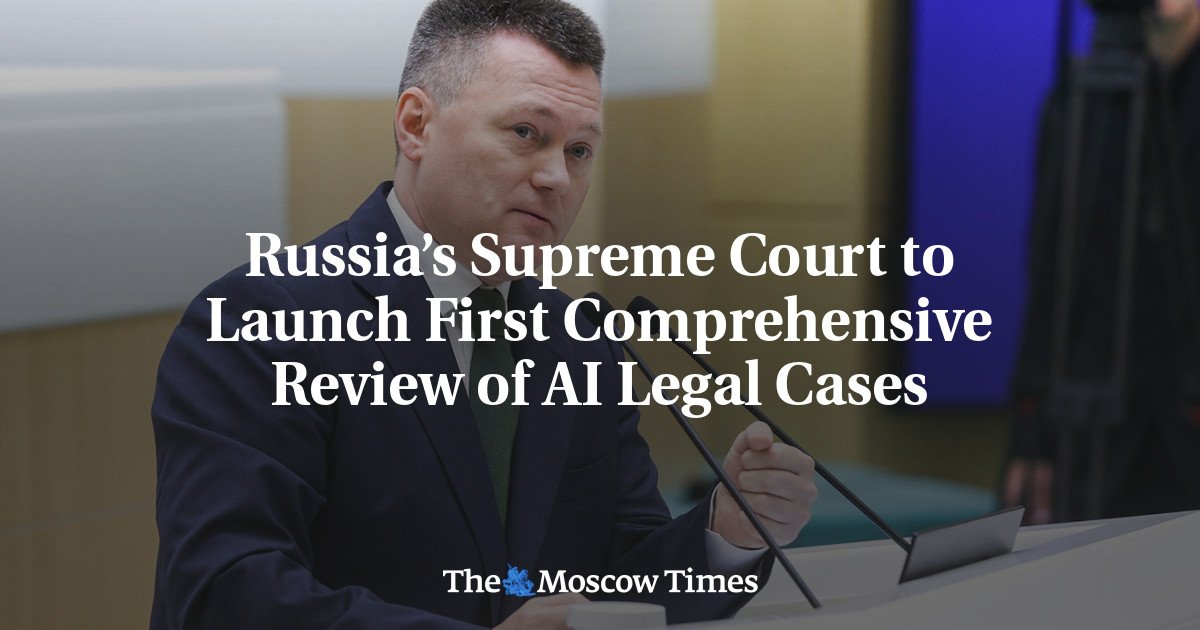
Russia’s Supreme Court on Wednesday announced a nationwide assessment of lower court rulings involving artificial intelligence to establish unified guidance for the judicial system.
The review focuses on determining liability and damages in AI-driven lawsuits, alongside addressing claims of intellectual property theft by tech firms scraping copyrighted material when training AI models. It will also outline protocols for prosecuting deepfakes, chatbot scams and online impersonation.
“This is the first such analysis to be conducted nationwide and takes into account all types of legal proceedings,” the Supreme Court said in a statement. “First and foremost, [it] will assess the frequency with which the use of AI is the subject of litigation or offenses.”
A dedicated section will cover defamation and public reputation management involving AI-generated content. In addition, the court plans to evaluate “government decisions that were made based on AI recommendations.”
Evidentiary standards will also face scrutiny, including how courts admit AI-generated documents and handle infractions flagged by automated facial recognition and public video analytics.
Russia’s Supreme Court will issue formal clarifications following the audit to guarantee consistent interpretations across all jurisdictions.
The timeline for the review’s completion was not disclosed.
Unlike common law systems that rely heavily on judicial precedent, such as in the United States, Russia operates under a civil law system built on statutory codes. A judicial practice review by the Supreme Court serves as the primary mechanism for it to issue binding instructions to lower courts on how to interpret statutory law.
Supreme Court Chief Justice Igor Krasnov has called for the fast-tracked integration of AI technology across Russia’s court system since taking office last autumn.
A Message from The Moscow Times:
Dear readers,
We are facing unprecedented challenges. Russia’s Prosecutor General’s Office has designated The Moscow Times as an “undesirable” organization, criminalizing our work and putting our staff at risk of prosecution. This follows our earlier unjust labeling as a “foreign agent.”
These actions are direct attempts to silence independent journalism in Russia. The authorities claim our work “discredits the decisions of the Russian leadership.” We see things differently: we strive to provide accurate, unbiased reporting on Russia.
We, the journalists of The Moscow Times, refuse to be silenced. But to continue our work, we need your help.
Your support, no matter how small, makes a world of difference. If you can, please support us monthly starting from just $2. It’s quick to set up, and every contribution makes a significant impact.
By supporting The Moscow Times, you’re defending open, independent journalism in the face of repression. Thank you for standing with us.
Continue
Not ready to support today?
Remind me later.
×
Remind me next month
Thank you! Your reminder is set.


