


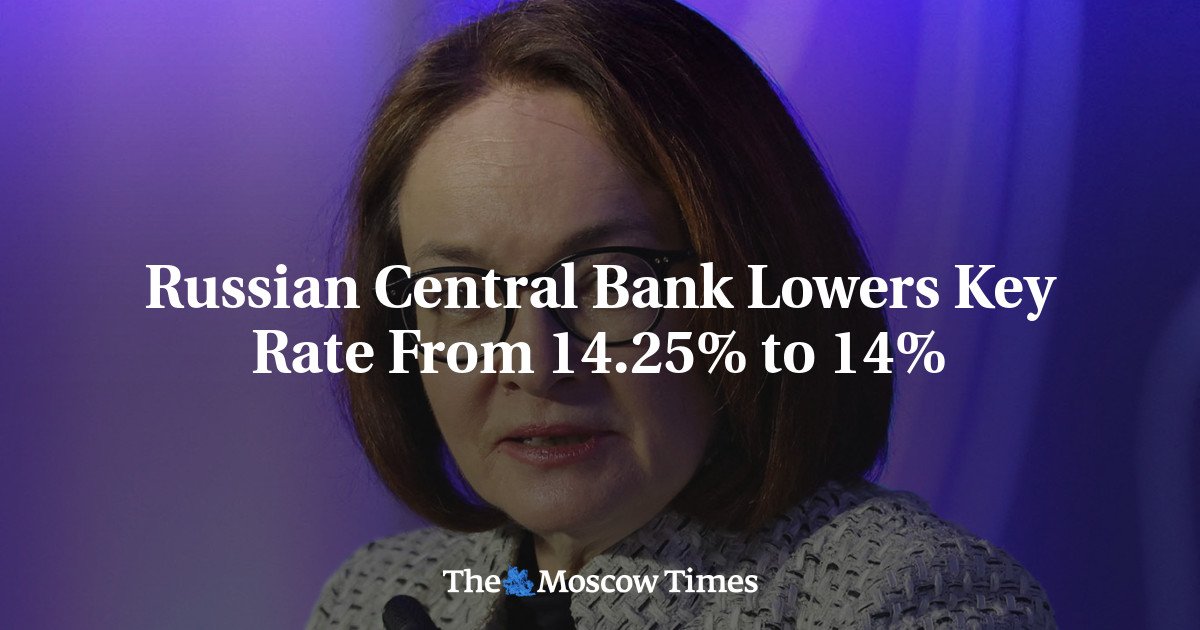
Russia’s Central Bank lowered its key interest rate from 14.25% to 14% on Friday as it continues down a cautious path of monetary easing despite concerns that Ukrainian attacks on Russian oil refineries and commercial sites will fuel a renewed inflation surge.
The 25-basis-point cut was not guaranteed. While some analysts had predicted what they described as a “cosmetic” lowering, others leaned toward the possibility of the Central Bank leaving its key rate unchanged due to disruptions to domestic oil refining capacity and higher fuel costs, as well as a tightening labor market.
Policymakers said in a press release that annual inflation rose to 5.9% as of July 20. The Central Bank also significantly revised its inflation outlook, warning that it now expects consumer prices to climb to between 6% and 7% later this year.
“Given the direct and second-round effects of the temporary decline in production capacities in certain sectors and more expansionary fiscal policy over a three-year horizon than projected in April, a smoother key rate decrease is required,” the press release read.
It said it still aims to bring inflation back to its 4% target in 2027.
Policymakers also downgraded their economic growth projection, forecasting annual GDP growth of 0% to 1% by the end of 2026, down from an earlier estimate of 0.5% to 1.5%.
Since hiking borrowing costs to a two-decade high of 21% to tame wartime inflation, Russia’s Central Bank has gradually eased its key rate amid mounting signs of an economic slowdown. Friday’s rate cut marks the tenth since October 2024.
Russia has been grappling with weaker oil and gas revenues and rising government spending, largely linked to its wartime economy. The growing deficit has fueled concerns about the sustainability of state finances after the government missed its budget targets by a wide margin last year.
This is a developing news story.
