



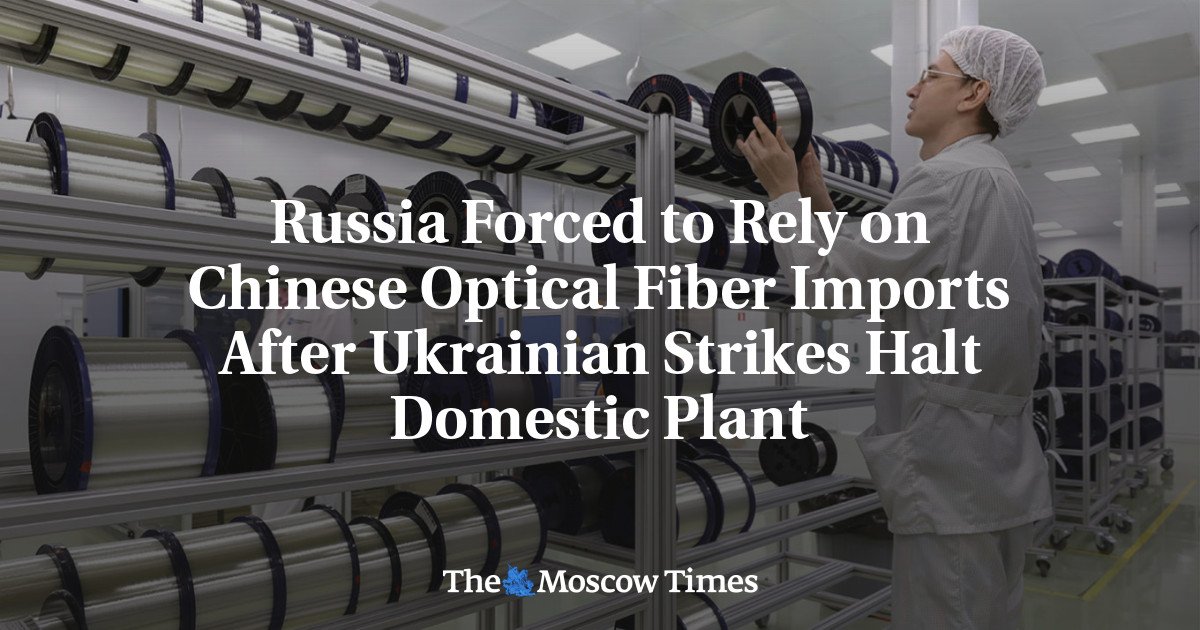
Russia’s only domestic producer of optical fiber has been offline since May 2025 following Ukrainian attacks, industry officials told the Vedomosti business daily on Thursday.
The halted operations have left Russia fully dependent on Chinese supplies for a key component for telecommunications networks and military drone systems.
The plant, operated by Optic Fiber Systems in the city of Saransk, was damaged in a series of Ukrainian strikes in April-May 2025 and has yet to resume operations, Leonid Konik, CEO of telecoms consultancy ComNews Group, told Vedomosti.
Before the shutdown, the facility produced about 4 million kilometers (2.5 million miles) of optical fiber annually, supplying roughly 20 Russian cable manufacturers that used the material to produce fiber-optic cables.
Those companies now rely entirely on imports from China.
Chinese suppliers have meanwhile hiked prices for Russian buyers since the start of 2026, representatives of cable makers Evrokabel-1 and Incab, as well as major backbone operator TransTelecom, told Vedomosti.
According to Konik, the price in China of G.652D fiber, widely used in telecommunications cables, rose from 16 yuan ($2.33) per kilometer in early 2025 to 25 yuan ($3.60) by the end of the year and reached 40 yuan ($5.80) in January.
Industry figures attribute the surge to rapidly growing demand, including military use.
Both Russia and Ukraine have increasingly deployed fiber-optic cables to control drones operating at distances of up to 50 kilometers (31 miles), making them resistant to electronic warfare jamming.
Russia accounted for 10.5% of global optical fiber consumption in 2025, up from less than 1% previously, said Chun Sheng, an analyst at the Beijing University of Posts and Telecommunications’ Fiber Optic Cable Research Center.
In absolute terms, Russia purchased nearly 60 million kilometers (37 million miles) of fiber last year.
Rising prices also reflect a broader global shortage driven by expanding artificial intelligence infrastructure and related data-network construction, telecom analyst Alexei Boyko said.
Industry executives warn that supply availability, rather than cost, now poses the main risk.
Incab CEO Alexander Smilgievich told Vedomosti that suppliers have already moved to requiring full prepayment amid higher procurement costs.
As a result, Russian cable manufacturers are unlikely to maintain current pricing and will be forced to raise prices, Boyko said.
Anastasia Bidzhelova of Telecom Exchange added that higher costs are expected to feed through to increased prices for dark fiber leasing services and the construction of long-distance telecommunications networks across Russia.
Read this story in Russian at The Moscow Times’ Russian service.
A Message from The Moscow Times:
Dear readers,
We are facing unprecedented challenges. Russia’s Prosecutor General’s Office has designated The Moscow Times as an “undesirable” organization, criminalizing our work and putting our staff at risk of prosecution. This follows our earlier unjust labeling as a “foreign agent.”
These actions are direct attempts to silence independent journalism in Russia. The authorities claim our work “discredits the decisions of the Russian leadership.” We see things differently: we strive to provide accurate, unbiased reporting on Russia.
We, the journalists of The Moscow Times, refuse to be silenced. But to continue our work, we need your help.
Your support, no matter how small, makes a world of difference. If you can, please support us monthly starting from just $2. It’s quick to set up, and every contribution makes a significant impact.
By supporting The Moscow Times, you’re defending open, independent journalism in the face of repression. Thank you for standing with us.
Continue
Not ready to support today?
Remind me later.
×
Remind me next month
Thank you! Your reminder is set.


