


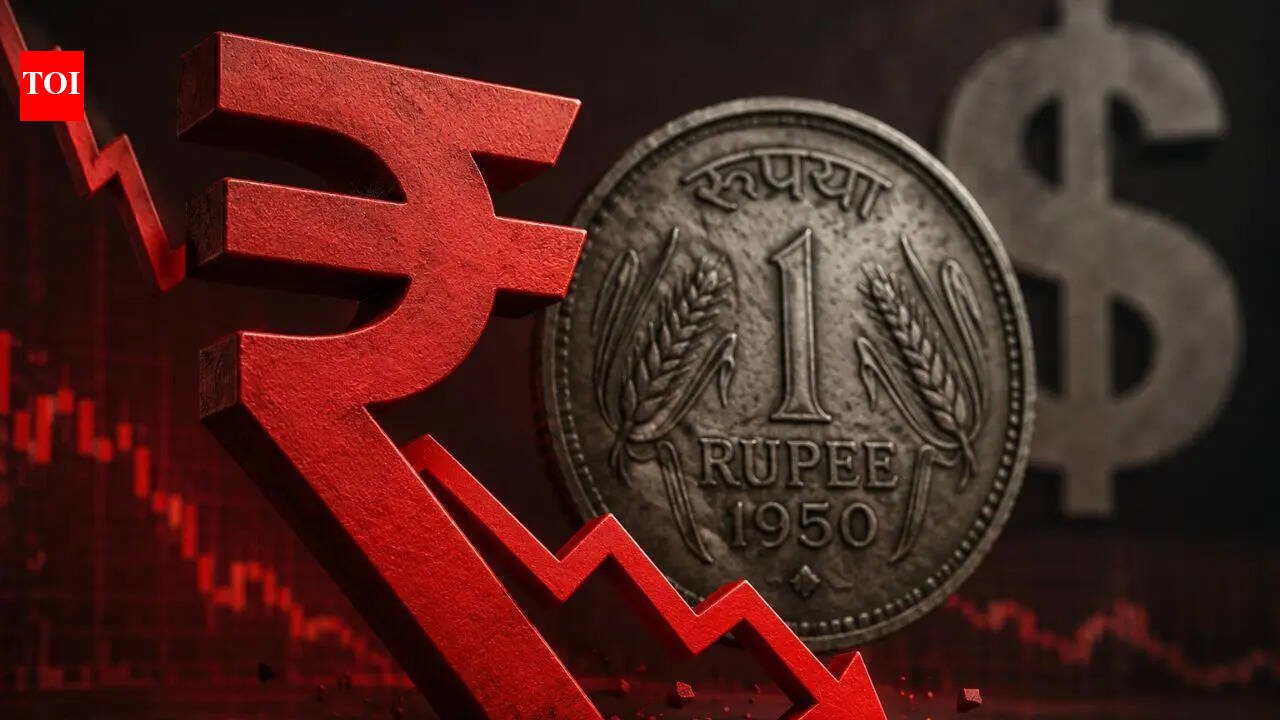
If the rupee had a fitness tracker, 2026 would probably show it running a marathon uphill. A dollar that once bought less than four rupees around Independence now costs nearly Rs 95.After briefly flirting with the crucial Rs 90-per-dollar mark earlier last year, the rupee is now under pressure near the Rs 94-95 range, weighed down by soaring crude prices, global uncertainty, and relentless pressure on India’s external balances, prompting analysts to caution that the worst may not yet be over. The currency has already slipped more than 5% this year after posting a similar decline in 2025, making it one of the weakest-performing major emerging market currencies globally.However, what is worrying economists is that the rupee’s slide is happening even as several Asian peers have strengthened. While currencies such as the Taiwan dollar, Thai baht and Malaysian ringgit have gained amid a softer US dollar environment, the Indian rupee has continued weakening.India continues to be the world’s fastest growing economy with its macroeconomic fundamentals seen to be robust to tide over global shocks. The Reserve Bank of India has said that it is not targeting any level of rupee and its intervention moves will continue to be aimed at curbing volatility.So, why does the rupee continue to be under pressure and which way is it headed?
Why the rupee is under pressure
The latest pressure on the currency comes from the escalating conflict involving the US, Israel and Iran, and the renewed crisis around the Strait of Hormuz, one of the world’s most critical oil shipping routes. India, which imports more than 85% of its crude oil requirements, remains highly vulnerable to rising energy prices and supply disruptions.This week, the rupee touched a record intraday low of 95.43 against the US dollar on Tuesday before recovering marginally after reports emerged of possible diplomatic talks between Washington and Tehran. A day later, the currency recovered 69 paise to close at 94.49 after oil prices eased slightly following reports that the US and Iran were exploring a possible memorandum of understanding to reduce tensions and reopen negotiations.Rupee weakened on Friday depreciating 25 paise to close provisionally at 94.47 against the US dollar, snapping its two-session recovery amid renewed tensions between the US and Iran over the Strait of Hormuz.
Why oil matters so much
Oil remains the single biggest macroeconomic risk for the rupee because India imports most of its crude requirements.According to a Morgan Stanley report, “as of early 2026, India imported about 85% of its crude oil and roughly 50% of its natural gas requirements. Such reliance on foreign energy makes India’s economy vulnerable to commodity price spikes and supply disruptions arising from geopolitical conflict.”When crude prices rise sharply, India’s import bill balloons. That increases demand for dollars, widens the current account deficit, raises inflationary risks and weakens the rupee further. Brent crude, which was once trading near $73 per barrel before the Middle East conflict intensified, has now surged above $100 per barrel, reigniting fears of imported inflation and slower economic growth.The crude prices briefly cooled to around $98 after reports of a possible US-Iran understanding, however it later climbed back above $100 as tensions resurfaced.Forex traders say the rupee’s movement has become closely tied to developments in the Gulf region. Every fresh escalation involving Iran, the US or Israel now immediately reflects in oil prices and currency markets.The Indian currency weakened sharply after renewed clashes in the Gulf and reports of attacks near the Strait of Hormuz raised concerns over global supply chains and energy disruptions.
Foreign investors also hold the key
The pressure on the rupee has also intensified due to persistent foreign fund outflows. Overseas investors have already pulled more than $21 billion from Indian equities this year, surpassing the total outflows seen in 2025, Reuters reported.Analysts say this has become one of the biggest stress points for the currency.Foreign investors typically sell rupees and buy dollars when they exit Indian markets, putting additional pressure on the domestic currency. High US bond yields, expensive Indian stock valuations, slowing earnings growth and rising geopolitical uncertainty have all contributed to the outflows.Anitha Rangan, chief economist at RBL Bank, said markets may be underestimating the impact of these capital outflows.“Rupee risks are more than what is actually understood by the market because people are discounting capital outflows,” she told Reuters.“They’ve been focusing only on RBI intervention and on headline reserves. All of this has been misplaced, and now the problem is the RBI has run out of ammunition,” she added.
RBI’s battle to defend the rupee
The Reserve Bank of India has repeatedly intervened in currency markets over the past few months to slow the rupee’s decline. The central bank has reportedly sold billions of dollars from its reserves while also tightening speculative activity in the foreign exchange market.India’s foreign exchange reserves remain substantial at nearly $700 billion, enough to cover roughly 11 months of imports. However, some analysts note that the comfort level appears lower after accounting for the RBI’s sizable forward book commitments.Last year, RBI Governor Sanjay Malhotra reiterated that the central bank does not defend any fixed exchange-rate level.Addressing reporters after the monetary policy announcement on Dec 5, 2025 Malhotra said that, “we don’t target any price levels or any bands. We allow the markets to determine the prices. We believe that markets, especially in the long run, are very efficient. It’s a very deep market.”Why the RBI doesn’t fully control rupeeAccording to the fundamental economic principle known as the “impossible trilemma”, every modern central bank faces a difficult trade-off: it cannot simultaneously maintain free capital flows, an independent monetary policy, and a fixed exchange rate.Economists Robert Mundell and Marcus Fleming first articulated this framework in the 1960s, and it continues to shape how central banks respond to global financial shocks.In simple terms, a country can only fully achieve two out of these three goals at any given time. It can allow capital to move freely and maintain an independent monetary policy, but then the currency must be allowed to fluctuate.The RBI has largely chosen to preserve monetary policy independence and open capital flows rather than defend any rigid rupee level. That means the currency is allowed to weaken gradually when external pressures rise.Also read: Rupee’s spectacular fall: Why RBI isn’t targeting a price band, but inflation — the ‘Impossible Trilemma’ explainedHowever, the RBI has taken several steps this year to curb volatility in the currency market.On March 27, for the first time in nearly 15 years, the central bank imposed restrictions on the size of currency bets banks can take in the forex market.The RBI capped banks’ net open position in the rupee at $100 million from April 10, 2026, citing prevailing “market conditions”. Earlier, banks’ boards had the authority to decide these limits.However, the RBI’s initial measures did not fully stabilise the rupee. According to reports, banks began shifting some of their positions to corporates and related entities, reducing the effectiveness of the restrictions.The central bank then tightened norms further on April 1. It barred banks from offering non-deliverable forwards to clients and stopped companies from rebooking forward contracts, as part of a broader crackdown on arbitrage trades that were worsening volatility in the rupee market.The tougher restrictions helped the rupee recover nearly 2% after it had slid beyond the 95-per-dollar mark in late March. But as market conditions improved marginally, the RBI partially rolled back some of these emergency measures on April 26. The central bank withdrew restrictions on non-deliverable forwards and eased norms around related-party derivative transactions, allowing cancellation and rollover of existing contracts conducted on a back-to-back basis with non-resident entities.“The rollback suggests the RBI wanted to restore normal hedging activity while continuing to curb speculative trades which made the currency vulnerable,” an FX trader with a private bank told Reuters.According to Reuters, the RBI is now exploring additional measures to attract dollar inflows and stabilise the currency. Among the options under discussion is reviving a 2013-style scheme to encourage dollar deposits from non-resident Indians.The central bank is also reportedly considering removing withholding taxes on foreign investments in Indian government bonds to encourage greater inflows.These discussions have revived memories of 2013, when the RBI introduced extraordinary measures during the “taper tantrum” crisis after the rupee plunged past 60 per dollar for the first time.At the time, the RBI opened special forex swap windows for oil marketing companies, tightened gold imports and mobilised dollar deposits from expatriate Indians to stabilise the currency.
Analysts say a similar toolkit could now return if pressures intensify further.Divya Mandaliya, Commodity Research Analyst at Anand Rathi Share and Stock Brokers Limited, said the rupee’s direction in 2026 would depend primarily on four global variables, crude oil prices, US Federal Reserve policy, dollar movement and foreign capital flows.“The rupee’s direction in 2026 will largely hinge on four global variables: crude oil prices, US Federal Reserve policy, dollar movement, and foreign capital flows. India imports over 85% of its crude requirement, making oil the single most critical macro variable for INR stability,” she said.“A softer US dollar environment driven by Fed rate cuts could support Asian currencies, including the rupee. However, persistent geopolitical tensions in the Gulf continue to pose upside risks to energy and freight costs,” Mandaliya added.According to Mandaliya, the RBI’s focus now appears to be on controlling excessive volatility rather than defending a specific exchange rate.“We expect intervention activity to increase if USD-INR moves persistently toward the Rs 95.50-96 zone,” she noted.
How does a weak rupee affect the broader economy?
While a weaker rupee can help exporters by making Indian goods cheaper overseas, it also has several negative effects on the broader economy and household budgets.Imported goods become costlierIndia imports a large share of its electronics, machinery, crude oil, and industrial components. A weaker rupee increases the cost of these imports, making smartphones, laptops, appliances, and even cars more expensive.Inflation risesBecause India imports most of its crude oil, fuel prices can increase when the rupee weakens. Higher fuel costs raise transportation expenses, which eventually increases prices of everyday goods such as groceries and packaged items. While the retail rate of petrol and diesel prices has for now been kept unchanged, prices of commercial LPG cylinders have been hiked.Overseas education and travel get more expensiveStudents studying abroad and families travelling internationally need more rupees to buy the same amount of foreign currency. Tuition fees, hotel expenses, airline tickets, and shopping abroad become significantly costlier.Gold prices riseIndia imports most of its gold requirements. Even if global gold prices remain stable, domestic gold prices rise when the rupee weakens because imports become more expensive in rupee terms.Pressure on stock marketsA weaker rupee can reduce returns for foreign investors in dollar terms, prompting them to pull money out of Indian markets. This can increase volatility in equities.At the same time, a weaker rupee does offer some advantages.Indian exports become cheaper globally, improving competitiveness in sectors such as IT services, pharmaceuticals, textiles and manufacturing. Remittances from Indians working abroad also increase in rupee terms, helping families receiving money from overseas.Economist Arun Kumar, retired professor at Jawaharlal Nehru University, said the rupee’s decline creates a mixed economic impact.“When the rupee slides it does affect the broader economy. Because on one hand exports are held while imports are reduced… therefore, the sliding rupee would help somewhat positively in the growth rate of the economy but the inflation would rise, which will be negative for the economy,” he said.He added that a gradual depreciation is easier for the economy to absorb compared to a sudden hit.
India’s economic journey
Around Independence, one US dollar was valued at roughly Rs 4.16. Back then, India’s currency was indirectly linked to the Bretton Woods system through the British pound, which itself was pegged to gold.Over the decades, wars, oil shocks, fiscal crises, liberalisation, capital flows and globalisation steadily weakened the rupee against the dollar.The decline accelerated in recent years as India’s import dependence, especially on energy, increased while global financial markets became more interconnected.The current depreciation began building gradually through 2025 before accelerating sharply this year. The rupee had initially shown signs of stability earlier in 2025 amid hopes of a trade deal with the United States. By May, the currency had strengthened to around 83.75 per dollar.But sentiment deteriorated rapidly after US President Donald Trump unveiled aggressive tariff measures and warned of penalties on countries continuing energy trade with Russia.The situation worsened further when Washington imposed steep tariffs on Indian exports and additional penalties linked to India’s trade ties with Moscow.Foreign investors began aggressively pulling money out of Indian markets, accelerating demand for dollars and deepening pressure on the rupee.The Middle East conflict then added another layer of pressure through surging oil prices. Analysts now expect the rupee to remain structurally weak through the rest of the year.
So where is the rupee headed?
Currency experts say the rupee may witness brief recoveries, but the broader trend remains weak unless geopolitical tensions cool significantly or oil prices correct sharply.The vice president of EBG, Commodity & Currency Research at JM Financial Services Ltd., Pranav Mer said that the rupee’s rebound from record lows remains fragile.“The rupee has recovered slightly from an all-time low of 95 to around 94 following reports of a possible peace deal between the US and Iran. However, we don’t expect much upside in the rupee.”“We may see a period of consolidation but the bias remains negative till USD-INR is holding above 94-level and can move further up towards 96.5-98 levels,” he added.According to Mer, the rupee’s trajectory this year will be shaped by a combination of global shocks and domestic vulnerabilities.“Persistent liquidation among FPIs, elevated gold, silver and oil prices affecting the current account deficit, muted domestic equity performance, narrowing interest rate spreads between India and the US, and uncertainty over US trade tariffs will remain key factors,” he said.Despite the sharp currency weakness, analysts believe India’s domestic macroeconomic fundamentals remain relatively stable compared to many emerging markets.“The rupee in 2026 will trade less on domestic weakness and more on imported global volatility,” Mandaliya said.Mandaliya also said that the USD-INR pair could remain in the Rs 95-97 range by the end of 2026 if crude prices stay elevated and the dollar remains firm.“A bullish rupee scenario toward Rs 91–93 would require crude prices to sustain below $85, meaningful Fed rate cuts, and a recovery in foreign inflows. Conversely, renewed geopolitical tensions or oil moving above $100 could push USD/INR beyond Rs 97 temporarily,” she said.Pranav Mer echoed similar concerns, saying, “We don’t expect much upside in the rupee. We may see a period of consolidation but the bias remains negative.”Apoorva Javadekar, chief economist at Muthoot Fincorp, reportedly sees the rupee touching 99.50 within the next 12 months.“I have been a little bit more pessimistic than other economists, who immediately jump to say, look, the domestic story and the consumption story are quite strong in India. That’s not true,”Apoorva told Reuters.The Indian economy continues to be in a position of strength, but for now the rupee remains caught in the middle of multiple global storms, rising oil prices, geopolitical tensions, capital outflows and an uncertain global economy.And unless those pressures ease meaningfully, India’s currency may continue inching closer toward levels that once seemed unimaginable.
