



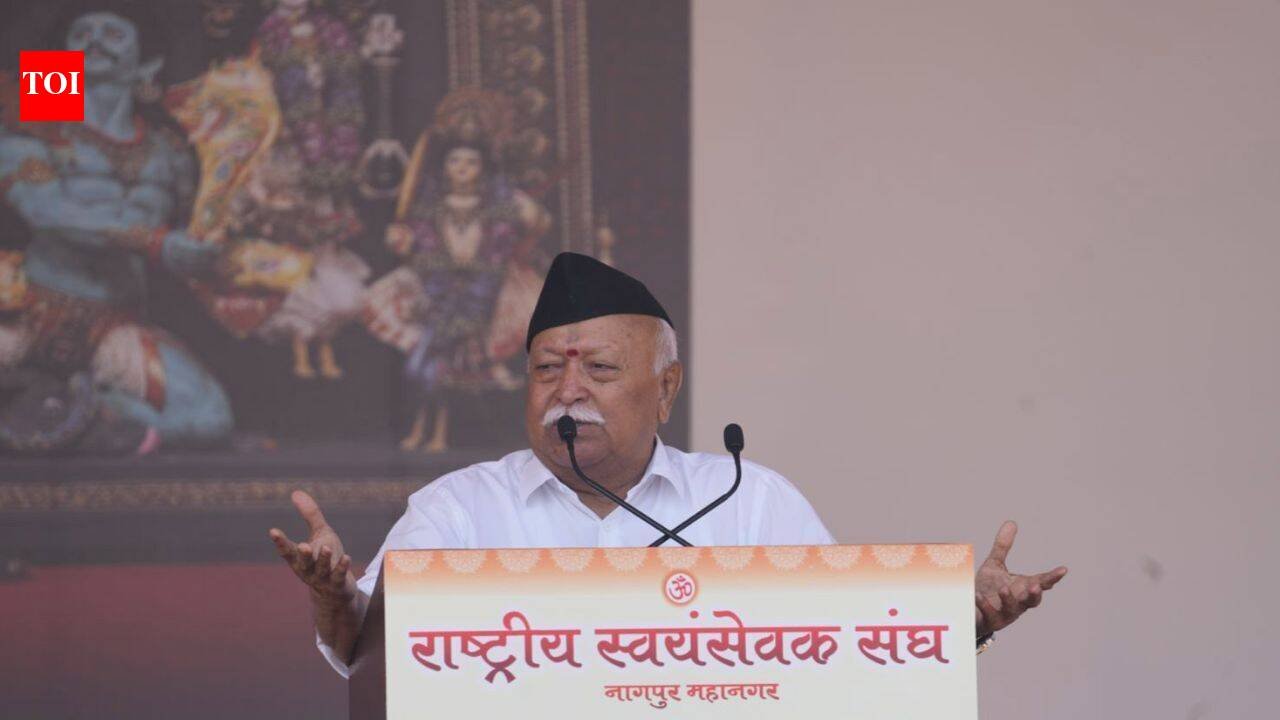
Bhagwat Lauds Capt Machchhar’s Rescue Attempt, Calls For Restraint On OTT & Invokes Vande Mataram As Symbol Of UnityNAGPUR: RSS chief Mohan Bhagwat on Tuesday cited political upheavals in France, Albania, Nepal and Bangladesh to question the quest for regime change in India too, saying it did not improve conditions in those countries and warned any move to destabilise India would be thwarted. Bhagwat alleged India’s growing strength had made it a target of global forces.Taking an indirect dig at the opposition, including Congress, Shiv Sena (UBT) chief Uddhav Thackeray, senior lawyer Prashant Bhushan and others, he emphasised regime change won’t happen in India.Speaking at the annual Vijayadashmi festival at Reshimbagh ground here, which marks the conclusion of Sangh’s centenary year celebrations, he alleged that forces from the West were trying to weaken India by exploiting social divisions and installing “proxies” in positions of influence.
“A storm has swept in from the West, driven by a demonic resolve to destroy and devastate all that is decent, auspicious, and rooted in cultural and human values, both in Bharat and across the world. Even the so-called developed nations across the world are affected by this storm,” he said.Applauding the govt led by Prime Minister Narendra Modi without naming him, Bhagwat said Bharat has gradually carved out a place for itself in the world through its own strength and sound policies. “The collective endeavour of Bharat’s society is bearing fruit in every sphere, driven by strong policies, leadership, national pride, and an awakening of its awareness of its responsibilities towards the world.”Indirectly targeting a series of protests by Cockroach Janta Party (CJP) and the combined opposition led by Congress in Delhi recently, Bhagwat said protests and public movements should seek solutions within the Constitution and law. He cautioned political leaders and protesters against allowing bitterness, discord or the pursuit of popularity to deepen divisions.The RSS chief cited Flydubai pilot Captain Smit Machchhar’s rescue attempt during an alleged mid-air attack as an example of values expressed through conduct. “The captain’s willingness to risk his life to protect others reflected his Hindu values passed down through generations,” he said.Bhagwat also linked development choices to the recent tragedy in Nepal, which claimed thousands of lives. He attributed it to one-sided development across the Himalayan region, which stretches across several countries, including Bharat, Bhutan, Tibet and China. He called for a holistic approach that weighs environmental limits alongside economic growth. “What happened in Kolkata (Durga Pandal) that recently claimed lives cannot be linked to any natural calamity,” he said.The RSS supremo said India had strengthened its place in the world through its policies, leadership and growing national confidence. Referring to the ongoing war between the United States and Iran in the Gulf, he argued that geopolitical tensions, economic uncertainty and environmental crises stemmed from an incomplete, materialistic view of development. “India should draw on its civilisational values to offer the world a more balanced model rooted in harmony and restraint,” he said.On technology, Bhagwat said scientific advances should be welcomed but guided by ethical judgment. Warning about the potential misuse of artificial intelligence to mislead people and spread falsehoods, he urged govt to consider the impact of over-the-top (OTT) content.Describing drug addiction among young people as a serious national concern, Bhagwat called for coordinated action by govt, administration and society. Families and elders, he said, had an important role in developing discernment among the young, while RSS would seek to bring together organisations and individuals working to address the problem.The RSS chief also invoked Vande Mataram as a symbol of unity during the anti-Partition movement in Bengal. Recalling the opposition to Lord Curzon’s proposal to partition Bengal along communal lines, he said the British govt had been compelled to withdraw the plan.“When Lord Curzon sought to partition Bengal along communal lines, the society firmly opposed the division of one land, one people on communal grounds,” Bhagwat said. He added that Vande Mataram had emerged as a symbol of unity and patriotism during the movement.Bhagwat concluded that India’s emergence as Vishwaguru would depend on the collective efforts of its citizens and its ability to offer a development path that contributes to global happiness and peace.
