



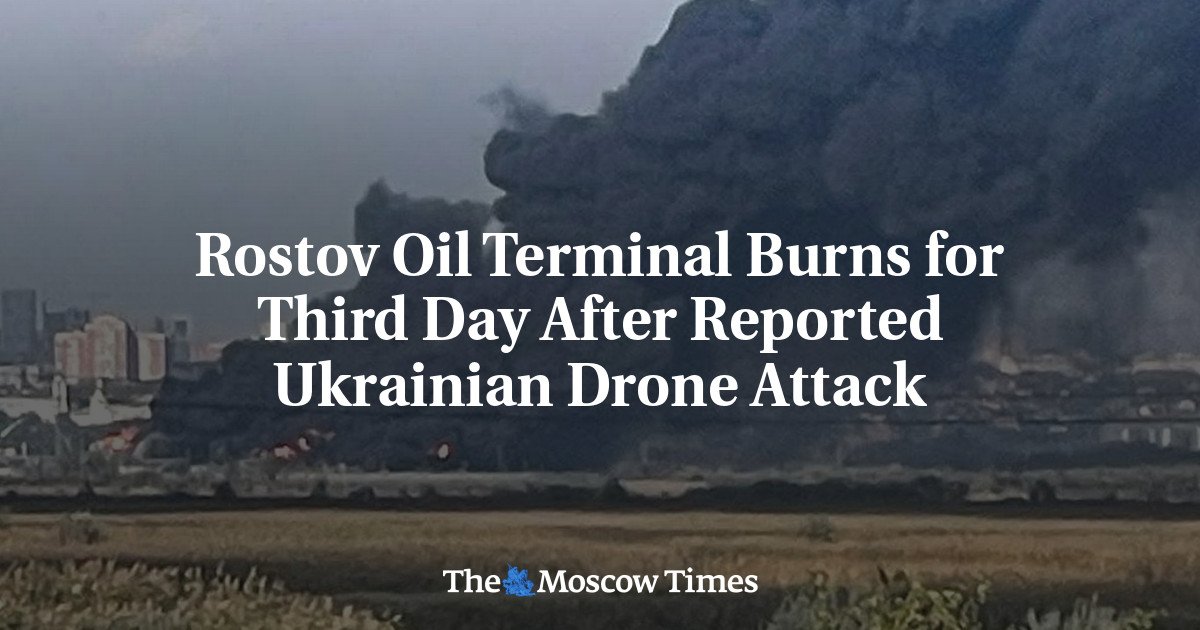
A fire at an oil terminal in the southern Russian city of Rostov-on-Don continued to burn for a third day Monday after a reported Ukrainian drone attack over the weekend, according to independent media and Ukrainian monitoring channels.
Footage published by Astra and Exilenova+ showed flames and thick smoke rising from the terminal’s fuel storage tanks. The facility, owned by the Novoshakhtinsk oil refinery, has a total storage capacity of 60,000 cubic meters and can handle 3.5 million metric tons of petroleum products a year, according to publicly available data.
Authorities had not announced that the fire had been extinguished as of midday Monday.
The Ukrainian monitoring channel Supernova said preliminary information indicated that seven of the terminal’s 12 tanks had burned and another showed signs of fire damage. Footage it published showed blackened tanks alongside others still engulfed in flames. The reported extent of the damage could not be independently confirmed.
The local Telegram channel Rostov Glavny also published footage of the blaze, saying the city had been shrouded in smoke for a second day. Its post suggested that reeds might be burning, citing rumors, but Astra’s analysis placed the fire at the oil terminal.
The facility, formerly known as Yug Rusi, was reportedly struck overnight into Saturday in Rostov-on-Don’s Zheleznodorozhny district. NASA’s FIRMS satellite monitoring system detected a fire at the site.
The terminal transfers petroleum products onto sea and river tankers for export and has reportedly been used to supply fuel to the Russian military.
Rostov region Governor Yury Slyusar said air defenses had shot down more than 100 drones over the region that night. He reported several fires following strikes and said six people had been injured, but did not mention damage to the terminal.
Ukraine had not publicly claimed responsibility for an attack on the facility.
The overnight attacks also damaged a railway drawbridge on the line between Rostov-on-Don and nearby Bataysk, causing lengthy delays to dozens of trains, according to Russian Railways.
Slyusar said two vessels were also damaged in the nearby city of Azov.
This article was translated with the help of artificial intelligence and was reviewed by a Moscow Times editor before publication. Learn more about our newsroom’s AI policy here.
Read this article in Russian at The Moscow Times’ Russian service.
A Message from The Moscow Times:
Dear readers,
We are facing unprecedented challenges. Russia’s Prosecutor General’s Office has designated The Moscow Times as an “undesirable” organization, criminalizing our work and putting our staff at risk of prosecution. This follows our earlier unjust labeling as a “foreign agent.”
These actions are direct attempts to silence independent journalism in Russia. The authorities claim our work “discredits the decisions of the Russian leadership.” We see things differently: we strive to provide accurate, unbiased reporting on Russia.
We, the journalists of The Moscow Times, refuse to be silenced. But to continue our work, we need your help.
Your support, no matter how small, makes a world of difference. If you can, please support us monthly starting from just $2. It’s quick to set up, and every contribution makes a significant impact.
By supporting The Moscow Times, you’re defending open, independent journalism in the face of repression. Thank you for standing with us.
Continue
Not ready to support today?
Remind me later.
×
Remind me next month
Thank you! Your reminder is set.
