



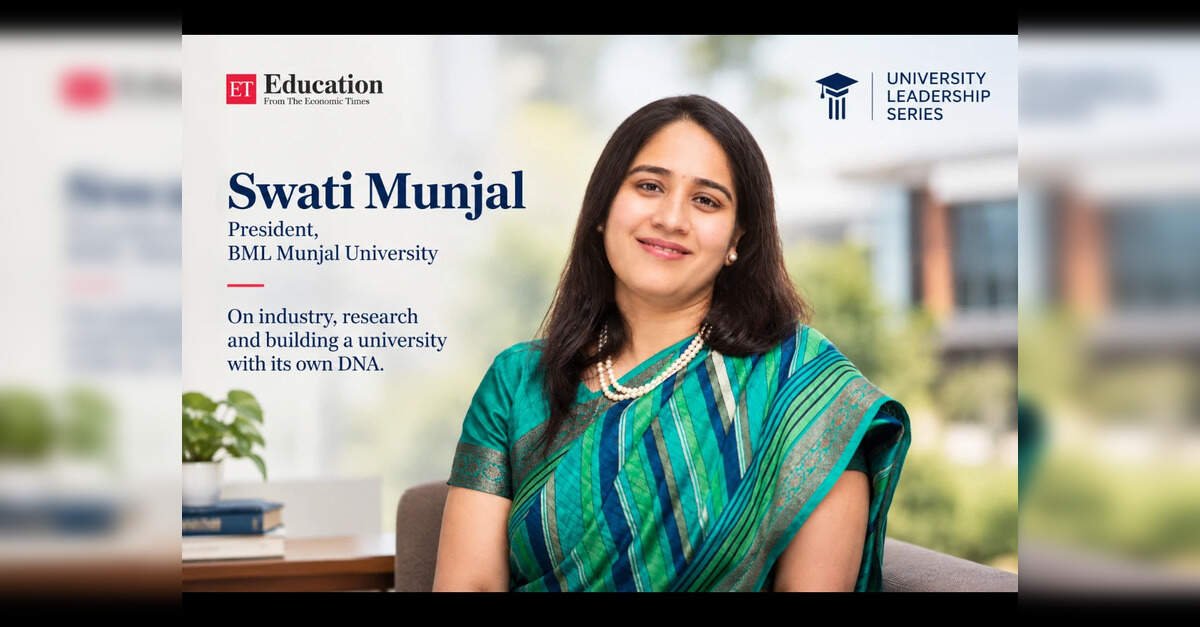
BML Munjal University (BMU) president Swati Munjal believes universities need to evolve with industry and society without losing their academic identity. In a conversation with ETEducation, Munjal speaks about how an industry-backed institution can draw from the corporate world while retaining the freedom and culture of a university, why research is central to institutional reputation, the need to develop Indian faculty rather than rely primarily on international hiring, and how AI is forcing universities to rethink their relevance. She also outlines BMU’s ambition to build a research ecosystem, strengthen interdisciplinary learning and position the university as a public good and partner for industry, government and the wider community.Q. BML Munjal University has built its proposition around industry relevance and experiential learning. How has that proposition evolved as expectations from universities and employers have changed?
Swati Munjal: I don’t think the expectations of employers have fundamentally changed. They have consistently wanted students who are industry-ready, not just for their first job, but who can think critically, evaluate, communicate and bring both hard and soft skills to the workplace.
What has changed is that academia has not always been able to match those expectations. That is why we continue to see reports year after year about students being unemployable or not being ready for the real world. As industry changes, the skills employers look for will naturally evolve. Academia therefore needs to remain in continuous conversation with industry about what it wants and what it is looking for.
At BMU, we have tried to make our programmes and courses experiential. Across engineering, management, law and liberal education, our focus is on what we call active learning. There is a difference between experiential learning and active learning. Experiential learning is about experiencing something. Active learning puts the learner in the middle of the experience and asks them to immerse themselves in it.
For us, that can mean students going into a village, living in a community or spending time working with an industry or community organisation. When students are immersed in their learning, that is when learning really happens.
Q. BMU is backed by an industrial foundation. How does that industry connection influence the university’s curriculum, culture and approach to preparing students for the workplace?
Swati Munjal: I want to clarify one thing. I don’t think universities should simply become corporate institutions. Whether the founder is the government or a corporate entity, the founder’s DNA often gets transmitted to the institution. But universities need an identity of their own.
They should neither be corporate nor government. Fundamentally, a university is a place for learning, development and knowledge creation. It needs to develop its own DNA while learning from the ecosystem around it. What we have tried to do at BMU is bring together some of the strengths of both worlds. From the corporate side, we have tried to bring efficiency and productivity into the management and operations of the university.
But the corporate connection goes beyond operations. Industry can play a role in curriculum development, in setting up centres of excellence, in supporting research and, importantly, in becoming a real partner in preparing students for the real world. We also have faculty members and leaders who have worked in industry. So the industry connection becomes part of the university ecosystem rather than simply being an external association.
Q. You have argued that universities need to develop their own DNA. What does that mean in practice, particularly when the institution is backed by industry?
Swati Munjal: Universities are different from corporations because some of the things that universities are trying to create, particularly research and innovation, cannot always be driven by quarterly targets.
Research needs an environment where people have the freedom to think, experiment and follow their instincts. If you tell someone, “I want this research output today”, it doesn’t necessarily work that way. You need to give people the ability to work, explore and allow creative ideas to emerge. That does not mean researchers don’t have timelines or pressure. It is simply a different kind of process.
So our effort has been to take what is useful from the corporate world while creating an environment that respects the nature of a university.
Q. You have spoken about research as a key driver of a university’s reputation. Why is building a research culture particularly important for a young private university like BMU?
Swati Munjal: If you think about the reputation of a university, it is predominantly built through research. Teaching is extremely important because universities are preparing students for the real world, but good teaching also improves when teachers are engaged in research and continuously improving their learning.
If you look at the world’s leading universities, most have built their reputation over a period of time through research. In India, much of the research in universities has historically happened in the government sector, partly because that is where a large proportion of research funding has been available.
So at BMU, we are focusing on building research year after year. We are investing in research labs, creating a research ecosystem, attracting researchers and setting up chair professorships.
We have also received approval from our board to make a sustained commitment to research. We have a dedicated allocation every year which we do not want to touch. The objective is to build the research ecosystem over the next decade.
Q. What kind of research do you want BMU to become known for, and how do you ensure that research translates into real-world impact?
Swati Munjal: We have identified certain sectors where we want to build our reputation in research. But for that, you need to create the right ecosystem for faculty.
That means academic freedom, an environment that allows research and expression, and the right infrastructure. We are trying to attract researchers and have seen good-quality applications, including from people returning from overseas who are looking at institutions where they can work.
Our longer-term ambition is not simply to produce research papers. We want to be known for translational research, where research actually goes live and has an impact on the community. We want to be a university that leads with purpose, solves societal problems, creates leaders for the future and becomes an aspiration for industry, government, academia and the community.
I see a university as a public good, even when it has been set up by a private entity. It is a not-for-profit institution, and we are already trying to build roots in communities and find like-minded partners.
Q. Indian private universities are increasingly aspiring to compete globally. What are the biggest gaps they still need to address?
Swati Munjal: Research is certainly one of them. But it is also about developing the institution and its people over a period of time. We often compare Indian institutions with universities such as Stanford or MIT, but those universities have been around for 100, 150 or even 200 years. You cannot replicate that history overnight.
One important area is faculty development. There is a tendency to think that global competitiveness can be achieved simply by bringing in large numbers of international faculty. I don’t think that is sustainable. There needs to be a period in which our own faculty are trained and exposed to different approaches to teaching and learning. You cannot create a pipeline simply by bringing hundreds of people from overseas.
At BMU, we are strengthening our Centre for Teaching and Learning and looking at programmes that can help faculty understand experiential learning. Around 25-30% of our faculty have either studied overseas, taught overseas or completed postdoctoral work overseas. We are also sending faculty abroad for training. A group recently returned from the University of California, San Diego, after training in innovation and entrepreneurship, and more groups will travel for similar programmes.
Q. How important is international exposure for faculty, if the goal is to build globally competitive Indian universities?
Swati Munjal: Internationalisation is not only about bringing international faculty into the university. It is also about training the faculty you already have and giving them exposure to what is happening in universities overseas.
We need to create an environment where experiential learning becomes part of the DNA of people working in the university. It should not be something that we have to import from somewhere and then plug into the system. Faculty mobility, international exposure and continuous development can help build that capacity within the institution.
Q. AI is rapidly changing higher education and the workplace. What role will AI play in BMU’s priorities over the next five years?
Swati Munjal: AI is not an optional thing. Even if I don’t focus on it, we will have to move because we don’t have an option. Things like AI and making students relevant for the real world are now musts. There is no option left.
I often think about a story from the road between Bombay and Pune. There used to be a dhaba where I would stop on the way. Then a flyover came up, and stopping at the dhaba suddenly meant spending an extra half an hour. Universities that don’t adapt could become like that dhaba. Students will simply take the flyover to reach industry by developing skills through EdTech, diplomas, degrees and other routes.
Industry is also increasingly willing to pay for skills, even when someone does not have a traditional degree. Companies such as Google have programmes that recognise this shift. So universities cannot assume that the degree alone will remain enough. They have to remain relevant to the real world.
Q. Looking towards 2030 and beyond, what do you want BMU to be known for?
Swati Munjal: We want to create a university that is truly a public good and community-driven. It may have been set up by a private entity, but we want it to become an institution that different kinds of organisations want to partner with. Whether it is a company such as Google wanting to launch a programme or a foundation wanting to work with us, we want BMU to be seen as a university that can be partnered with to solve problems.
There are also areas where we want to build a clear identity. One is interdisciplinarity. Every student should not only study within the school they belong to. An engineering student should study management or law, for example. We want students to have exposure to at least two other schools.
That is part of what leading American universities have been known for, and we are already building that into our programmes. We also want to be known for entrepreneurship.
Ultimately, the ambition is to build a university that leads with purpose, creates leaders for the future, solves real-world problems and has a meaningful impact on society.
