


It can be slightly off-putting to encounter the work of self-referential writers whose characters’ whole identity revolves around the act of reading or writing. This is because readerly characters are mostly all good. Indeed, with a life so fixated on books and libraries, they are often quite bland. Still, much depends on treatment. A reader can have a colourful life too and, if presented well, even the most cliched readerly life can be exciting to read about.
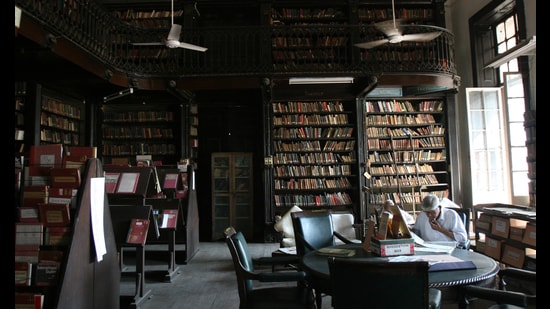
Who else can do this better than a poet writing a novel about a readerly life? Udayan Vajpeyi’s novel Qayas (Speculation), masterfully translated from the original Hindi as Love Is Participation In Eternity by Poonam Saxena, is one such work.
A wonderful read with sentences that flow like a river, it grips readers and makes them wait for something to happen. Nothing ever does. Perhaps, that’s the beauty of it. The book’s protagonist, Sudipt, arrives in an unnamed city, joins an old library, and helps revive it. After some time, he is killed. His sudden death leaves people with many questions, and he “remains absent throughout the novel.”
Through the voices of those who knew him including his wife Mridula, his former lover Veena, his daughter Noa, and his loyal house help Lakhana and others, Vajpeyi gradually reveals who Sudipt was and what he meant to them.
The author shows how different people perceive the same person differently and explores how, in memory and remembrance, an individual’s identity becomes layered and gains profundity. To his daughter, Sudipt was a loving father; his friend Vandana viewed him as a reader and an adored companion. For Mridula, he was someone she loved, someone she constantly feared losing. Once Sudipt was gone, Vandana’s family, which was suspicious of their closeness, could no longer sustain their hostility toward him. Even Mridula’s jealousy gradually melts into affection for Vandana. Vajpeyi is at his finest when he writes about Sudipt’s ex-lover’s memories. “Paris has been forlorn for years now,” Veena says. In his absence, literature kept her desires alive.
Nothing much happens in this Chekhovian narrative; the plot is static and the atmosphere takes precedence. The writing is also reminiscent of the style of Hindi novelist Nirmal Verma, whose work was greatly influenced by European literature. Immersed in world literature, Vajpeyi himself cannot help but give the novel a cultural-neutral tone. Though the reader is told that the story is set in India, the city itself remains unnamed throughout. It could just as easily be anywhere in the world.
Unusually for Hindi fiction, the novel has some striking vignettes such as Vandana’s cousin Saanavli being gripped by an overwhelming sensation that is familiar to everyone in the novel and in the world outside too: “This was a fever of longing that held me. It could do the same to anyone. There is no knowing who it would choose as its fairy. It was my good fortune that this time I was chosen as the fairy. A fairy, who had no wish of her own; her wishes become those of the one who had her under his control. I won’t tell you anything more. There is nothing more to tell anyway. But before leaving, I will say it one more time: ‘fever of longing’”.
However, the one thing that bothered this reviewer is how Sudipt is always viewed as harmless and innocuous. Everyone has a fond tale about him. It is difficult to imagine someone in an Indian city, especially one accused of having an affair, being so untouched by hostility or judgment in quite this nonchalant French way.
The romanticization of the act of reading is also not persuasive. Vandana and Sudipt organise a literary show in the city. How did he pull it off? How did he grow to be so influential? By making his identity as a reader so central, the novel risks stripping the character of other traits, interests, and flaws that might have made him more complex and human.
Despite that, it is difficult to put down this book once you’ve started reading it. The words and vignettes remain etched in the mind. As Urdu novelist Khalid Jawed writes in his blurb: “Akira Kurosawa’s Rashomon comes to mind… Everyone’s communication is limited, yet it is the only way one can perceive the truth.”
Mayank Jain Parichha is an independent bilingual journalist. He writes about the environment, wildlife, culture, literature, and politics.
