



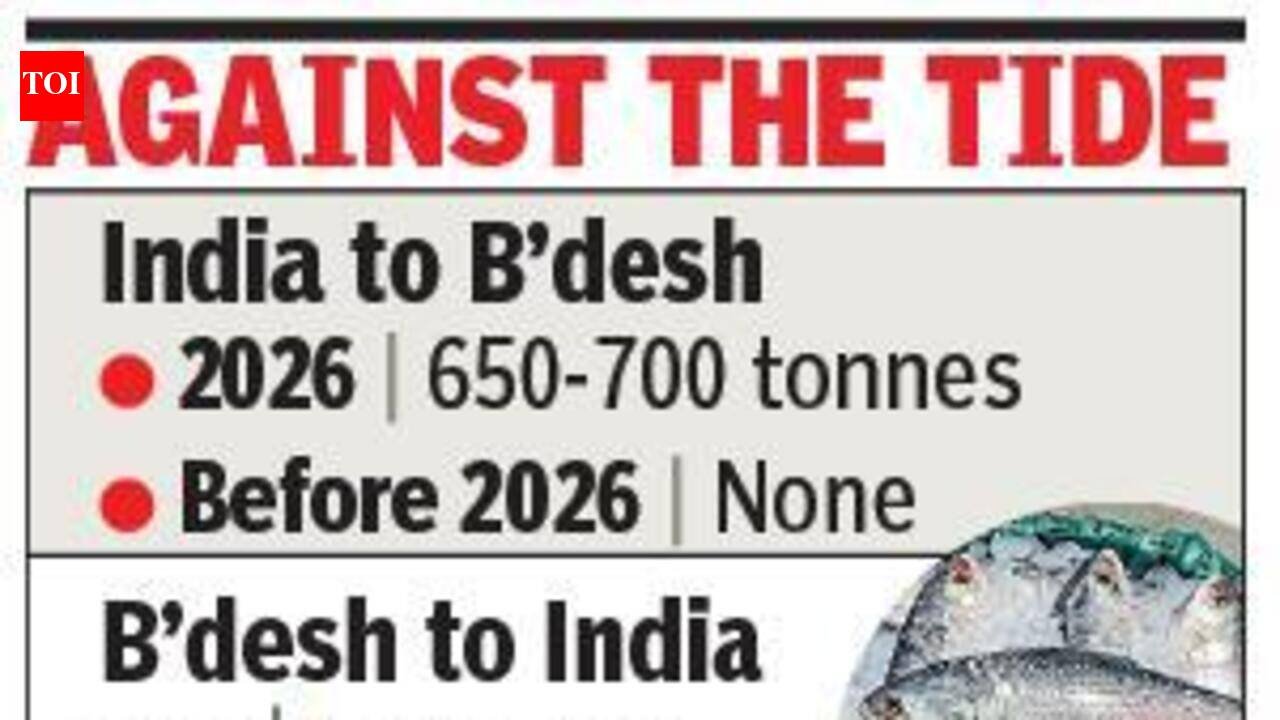
Kolkata: India is set to export 650-700 tonnes of hilsa to Bangladesh this year, more than four times the amount it imported from the country last year, marking a reversal of the traditional trade flow of the prized fish between the neighbours.About 500 tonnes of hilsa have already crossed Petrapole border into Bangladesh over the past couple of months and some 150-200 tonnes are expected to do so by this weekend. Clearing agents at Petrapole said the exports began early July.Significantly, most of the consignments that entered Bangladesh were sourced from Gujarat and shipped through Bharuch port while some supplies were routed through Howrah wholesale market. Nearly all the exports were carried out by Howrah-based traders.“We usually export fish such as boal, rohu, parse and tangra to Bangladesh. This is the first time that we attempted to export Indian hilsa to Bangladesh due to poor catch there. When a large consignment arrived from Gujarat, we decided to send some of it to Bangladesh. It was well received and prompted us to export more hilsa. So far, we have exported 500 tonnes. Two days ago, there was another bumper catch of 500 tonnes in Gujarat, of which we hope to export around 150-200 tonnes to Bangladesh,” said Howrah Wholesale Fish Market secretary Syed Maqsood Anwar.The Gujarat variety of hilsa has relatively limited demand in Kolkata due to its high egg (roe) content. However, this characteristic makes it particularly attractive to Bangladeshi buyers, especially fish processing units in Chittagong, Sylhet and Cox Bazaar where the roe is extracted and processed for export to Europe and the US, which have large Bangladeshi settlements. “After the roe is extracted, the meat is dried and salted. It is not consumed like fresh hilsa,” explained a Bangladeshi importer.Clearing agents said most of the hilsa entering Bangladesh weigh between 700 gm and 1.5 kg and the price ranges between Rs 500 and Rs 1,000 per kg depending on quality. “The fish undergoes required food-quality checks and an NOC is obtained from animal quarantine authorities. All formalities are maintained before the consignments are sent,” said Kartick Chakraborty, secretary of Petrapole Clearing Agent Staff Welfare Association.The development reflects changing patterns of production, availability and consumer demand in the two neighbouring countries, says Pradip Dey, director of ICAR-Central Inland Fisheries Research Institute. “The reverse movement demonstrates that India can emerge as a competitive supplier to neighbouring and international markets when domestic availability, quality and supply chains align with demand,” Dey said.While exports continue, Maqsood Anwar, who is also the secretary of Fish Importer’s Association, travelled to Bangladesh with other members and met the country’s commerce secretary Ataur Rahman Khan and officials from Indian High Commission to press for export of hilsa from Padma and Meghna to India.“We requested them to fix the quantity to be exported but refrained from setting a time limit as only a fraction of the amount reaches India before the deadline expires,” said Maqsood.
