



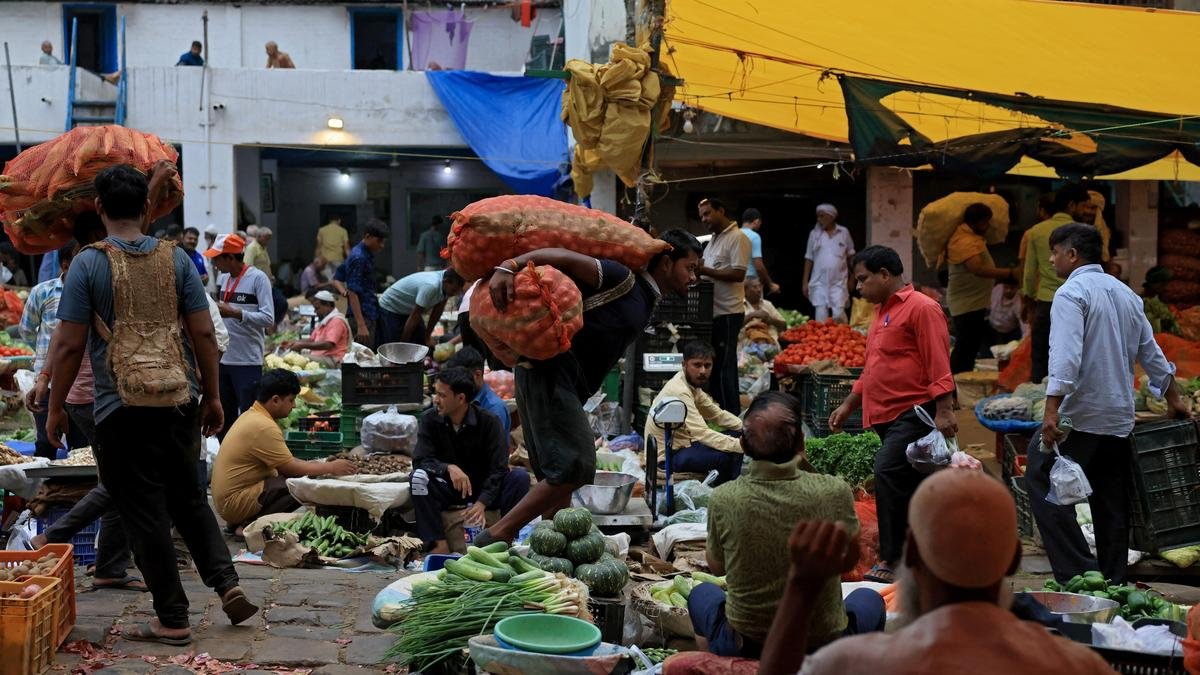
A wholesale vegetable market in the old quarters of Delhi
| Photo Credit: Reuters
Retail inflation rose to a 19-month high of 4.45% in July, driven up by higher food and fuel prices, official data released on Wednesday showed.
The Consumer Price Index (CPI) data released by the Ministry of Statistics and Programme Implementation showed that food, restaurant and accommodation services, and transport became costlier in July, while inflation in other services such as healthcare, recreation, sports and culture, cooled marginally.
The CPI series was updated earlier this year, with a new base year of 2024. As a result, while there is historical data for the overall index that goes back to August 2021, sector-wise data is available only from January 2026 onwards.
Costlier food ahead
Inflation in the food and beverages category quickened to 5.2% in July 2026 from 5.05% a month earlier.
According to Rajeev Sharan, Head of Research at Brickwork Ratings, this was driven by “fresh spikes in onion and garlic alongside persistently high ginger prices, even as potato and tomato swung into deflation”.
The expectation ahead is that food inflation will rise further, Madan Sabnavis, chief economist at the Bank of Baroda said.
“While the monsoon has recovered substantially in July, there has been news of crop damage due to excess rains,” Mr. Sabnavis said. “This, combined with a longer cropping period and hence harvest, will push up prices of pulses in particular. Global prices of edible oils are also high which is being felt in domestic markets.”
Fuel adding to fire
Driven by higher food and fuel prices, inflation in the restaurants and accommodation services segment quickened to 7.7% in July 2026, the highest this year, up from a previous yearly-high of 6.9% in June.
“The war impact on prices can be seen from higher inflation for restaurants and food services where higher fuel prices have made units increase prices,” Mr. Sabnavis explained. “While there is some normalisation in supply of fuel, prices remain where they are and tend to be inelastic in downward direction.”
Inflation in the transport sector also quickened to 4.4% in July 2026 from 4.3% in June.
Cooling inflation
There were, however, some services that saw inflation easing in July.
The health segment, for example, saw inflation cooling to 1.3% in July 2026 from 1.4% in June. Inflation in this segment has been falling since February 2026.
The other segment that saw inflation easing was the ‘recreation, sport and culture’ category to 1.6% in July 2026 from 1.75% a month earlier.
While inflation in the ‘personal care, social protection and miscellaneous goods & services’ category — which includes gold and silver purchases — remained in double digits at 14.8% in July 2026, it was the lowest level recorded so far this year.
Published – August 12, 2026 05:39 pm IST


